




Why can sewage be accurately measured? Anti-pollution Tips for Electromagnetic Flowmeters
2026-01-08 09:58:07
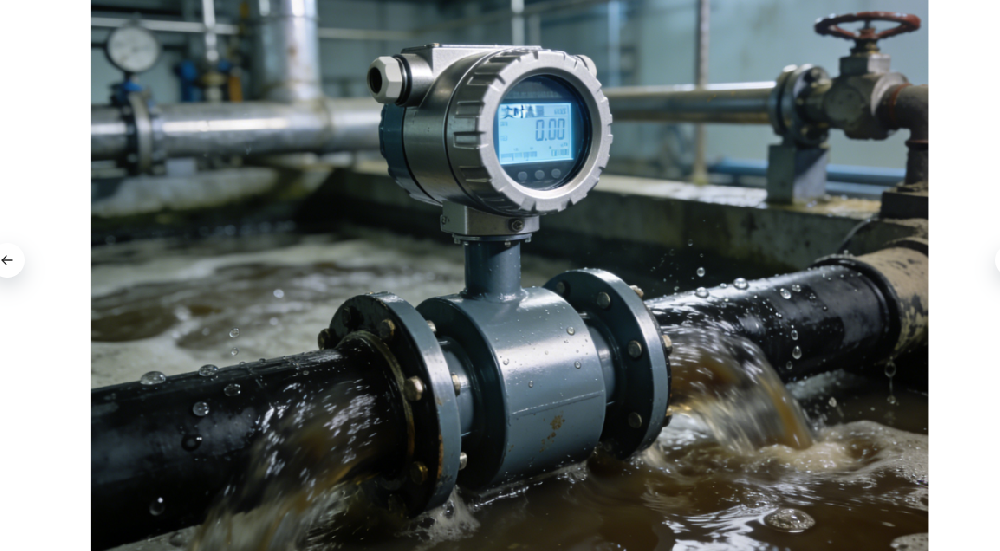
Wastewater treatment is a crucial component of environmental protection, and accurate measurement of wastewater flow serves as the fundamental basis for optimizing treatment processes and evaluating treatment performance. Wastewater has a complex composition, containing large amounts of suspended solids, organic matter, heavy metal ions, and other pollutants. It is highly corrosive, prone to scaling, and has a high solids content, placing stringent demands on the anti-fouling performance of flow measurement devices. Among the many measuring equipment, electromagnetic flowmeter has become the preferred equipment for sewage measurement due to its excellent anti-pollution performance. Then, why can the electromagnetic flowmeter achieve accurate measurement in the harsh sewage environment? What anti-pollution skills are behind it? This article will launch a detailed science popularization for this problem and uncover the core secret of the electromagnetic flowmeter's adaptation to sewage measurement.
To understand the anti-pollution ability of electromagnetic flowmeter, we need to start with its working principle and structural design. Unlike traditional mechanical flow meters, electromagnetic flow meters work based on Faraday's law of electromagnetic induction. The measurement process does not require direct contact between mechanical parts and the fluid.“Contactless”The measurement method fundamentally reduces the impact of contaminants on the equipment. Traditional mechanical flowmeters rely on rotating parts such as impellers and turbines to measure flow. Suspended solids in sewage are easy to wind and block rotating parts, resulting in equipment failure and measurement accuracy decline. However, the measuring tube of the electromagnetic flowmeter is designed with full diameter, and there are no mechanical parts hindering fluid flow inside, so that sewage can flow smoothly, avoiding accumulation and blockage of pollutants.
The material selection of the core components of the first anti-pollution tips of the electromagnetic flowmeter. In view of the corrosion and abrasion of sewage, the key components of the electromagnetic flowmeter are made of special materials with corrosion resistance and wear resistance. The measuring tube is usually used as a flow channel for sewage.316LStainless steel, glass fiber reinforced plastic and other materials with strong corrosion resistance can resist the corrosion of acid and alkali substances and heavy metal ions in sewage and avoid pipe body damage. As the core component of signal acquisition, the electrode is more strictly selected for materials. Hastelloy alloy, titanium alloy, etc. are commonly used. These materials not only have excellent corrosion resistance, but also can reduce the adsorption and scaling of pollutants in sewage on the electrode surface. For example, Hastelloy electrodes can withstand the corrosion of strong acid and alkali wastewater, while titanium alloy electrodes show good stability in chlorine-containing wastewater.
In addition to material selection, the lining design of the electromagnetic flowmeter is also an important guarantee for its anti-pollution, which is the second anti-pollution trick. The lining is an insulating protective layer on the inner wall of the measuring pipe, which is directly in contact with the sewage. Its main function is to isolate the sewage from the measuring pipe, prevent the corrosion of the pipe body, and reduce the adhesion of pollutants on the pipe wall. According to the different characteristics of sewage, the lining material will also be selected: for sewage with high sand content and strong abrasion, ceramic lining is usually selected, which has high hardness and excellent abrasion resistance, and can effectively resist the erosion of solid particles on the pipe wall; For highly corrosive sewage, PTFE (PTFE) The lining has strong corrosion resistance and can withstand the erosion of most acid and alkali media; for conventional sewage, the natural rubber lining has good elasticity and corrosion resistance, and the cost is more economical.
The third anti-pollution tip is the application of non-contact electrode technology. Although the traditional contact electrode has high signal acquisition sensitivity, it is easy to be covered by pollutants and scale in the sewage environment, resulting in signal attenuation. To address this issue, non-contact electrode technology has emerged. Non-contact electrodes (such as capacitive electrodes) are isolated from sewage by lining and do not directly contact with sewage, which fundamentally avoids the adsorption and corrosion of pollutants. This electrode technology collects induced electromotive force signals through capacitive coupling. Although there is a certain attenuation in the signal transmission process, it can ensure the measurement accuracy with a high-sensitivity signal processing circuit, and at the same time greatly improve the anti-pollution ability and service life of the equipment. It is especially suitable for sewage measurement scenarios with high solid content and easy scaling.
In addition, the automatic cleaning function of the electromagnetic flowmeter is also an important means to deal with sewage pollution, which is the fourth anti-pollution trick. Part of the electromagnetic flowmeter designed for highly polluted sewage is equipped with an automatic cleaning device, such as ultrasonic cleaning and mechanical scraping cleaning. Ultrasonic cleaning through the ultrasonic vibration, the electrode surface and the lining of the pollutants stripping off, off, to achieve automatic cleaning; mechanical scrape brush cleaning through the motor drive scrape parts, the electrode surface periodically scrape brush, remove scaling and pollutants. These automatic cleaning functions can reduce the frequency of manual maintenance, ensure that the equipment in the long-term operation process always maintain a good measurement state, to avoid the accumulation of pollutants caused by measurement errors and equipment failure.
In practical applications, the installation and operating guidelines for electromagnetic flowmeters can also affect their resistance to fouling. For example, the sensor is installed in the vertical section of the pipeline to allow the sewage to flow from bottom to top, which can reduce the accumulation of pollutants in the measuring pipe by using the impact force of the water flow. Reasonable selection of installation location, avoiding the dead water area and sedimentation area of the sewage pipe, ensuring the stability of the sewage flowing through the sensor and reducing the residence time of pollutants. At the same time, regular maintenance and inspection of the equipment, such as cleaning the attachment to the inner wall of the measuring tube, checking the integrity of the electrode and lining, can further improve the anti-pollution ability of the equipment and ensure the measurement accuracy.
The accuracy of sewage measurement is directly related to the effect and efficiency of sewage treatment. Electromagnetic flowmeter has successfully overcome many difficult problems of sewage measurement and has become an indispensable measurement equipment in the field of sewage treatment by virtue of a series of anti-pollution small skills such as full-diameter non-mechanical parts design, corrosion-resistant and wear-resistant material selection, special lining protection, non-contact electrode technology and automatic cleaning function. With the continuous improvement of environmental protection requirements, the sewage treatment industry has put forward higher requirements for the accuracy and stability of flow measurement, and the anti-pollution technology of electromagnetic flowmeter will also be continuously upgraded and optimized to provide more reliable technical support for the protection of the ecological environment.
Hot News
- Buy flowmeter, first look at the site conditions! 2026 Depth Comparison of Domestic and Imported Brands of Electromagnetic Flowmeter Manufacturers
- 2026 domestic electromagnetic flow manufacturers recommended: top ten brands of intelligent flow meter recommended reasons
- How to choose imported flat electromagnetic flowmeter? How to choose micro-caliber, conventional flange and plug-in electromagnetic? Recommended by domestic high-quality manufacturers
- Four major brands of electromagnetic flowmeter hard core PK: Herbalife Water, Cloud Meter, E H, Cologne, who is more worthy of choice?
- November 2026 Top Ten Brands of Electromagnetic Flowmeter at Home and Abroad Ranking
- Recommended Top Ten Brands of Electromagnetic Flowmeter in 2026: Reference for Project Selection of Water Treatment, Sewage and Conductive Liquid
- TOP5 Manufacturer's Selection Guide for Food Sanitary Electromagnetic Flowmeter: Material and Connection Mode Check before Purchase
- Cost-effective chemical oxygen demand water quality online monitor manufacturers contact information
- How to choose the integrated electromagnetic water meter? Domestic high-quality manufacturers recommendation and selection guide
- Selection of Electromagnetic Flowmeter for Small Diameter Ultra-high Temperature Medium Metering Engineering



