




From Faraday's Law to Water Pipe Metering: How Can Electromagnetic Flowmeters Read Water Flow Codes?
2026-01-08 09:51:29
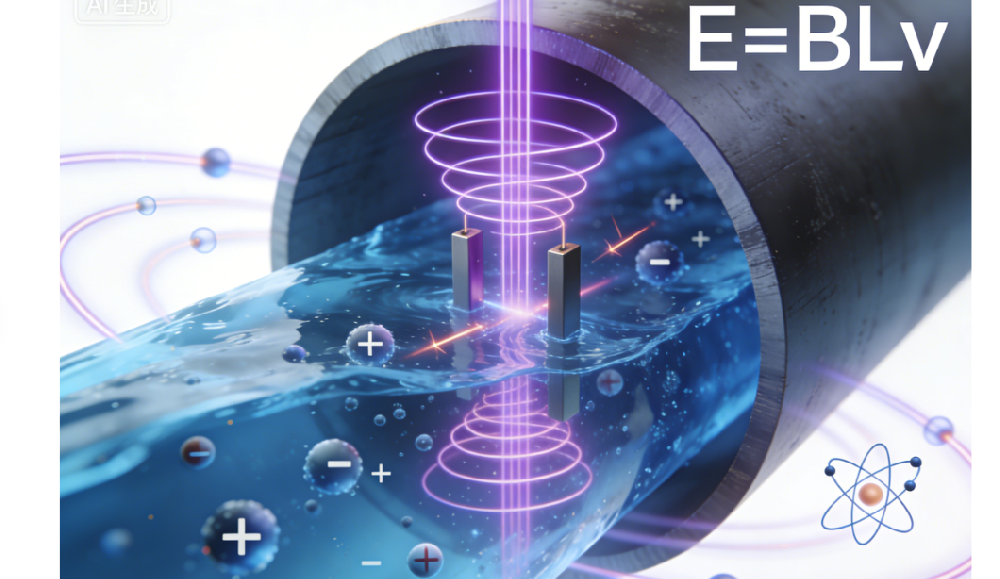
When you turn on a faucet at home, clear tap water flows out smoothly. As urban water supply networks deliver water to countless households, how are the flow rate data of these streams captured with precision? The answer lies in electromagnetic flowmeters designed based on Faraday’s law of electromagnetic induction. Faraday's law of electromagnetic induction, as an important theory of classical physics, seems to be far away from the daily measurement of water pipes, but it has been cleverly transformed into practical measurement technology by engineers, allowing electromagnetic flow meters to have“Understand”Water flow password ability. This article will start from the basic cognition of Faraday's law, sort out its association with electromagnetic flowmeter, interpret the complete process of electromagnetic flowmeter interpreting water flow password in detail, and take you into the fusion world of physical law and industrial application.
To understand how the electromagnetic flowmeter reads the water flow code, it is necessary to clearly understand the core connotation of Faraday's law of electromagnetic induction.1831In, British physicist Faraday discovered that when a conductor cuts a magnetic induction line in a uniform magnetic field, an induced current will be generated in the conductor loop. This phenomenon is called electromagnetic induction. Subsequent studies have further clarified that the magnitude of the induced electromotive force is proportional to the speed at which the conductor cuts the magnetic line of induction, the intensity of the magnetic field, and the effective length of the conductor in the magnetic field. This law not only reveals the mutual transformation relationship between electricity and magnetism, but also lays the foundation for the development of many subsequent electromagnetic application technologies, and electromagnetic flowmeter is a typical representative.
In the design of electromagnetic flow meters, engineers put Faraday's law of electromagnetic induction in“conductor”into a conductive stream of water,“Magnetic field”Generated by the device's built-in excitation coil,“Speed of conductor cutting magnetic induction line”Then it corresponds to the flow velocity of the water. This transformation is not a simple concept replacement, but through sophisticated structural design and technical optimization, to achieve the physical law to the measurement function of the landing. The core structure of the electromagnetic flowmeter includes a measuring tube, an excitation coil, an electrode, and a converter. The measuring tube is the flow channel of the water flow and the bearing space of the magnetic field. The inner wall of the measuring tube is usually lined with an insulating lining, which can prevent the measuring tube from being corroded. It can also avoid the influence of the tube body conduction on the magnetic field distribution.
When the water flows through the measuring tube, the excitation coil will generate a uniform and stable magnetic field under the action of the control system, and the direction of the magnetic field is perpendicular to the direction of the water flow. At this time, the water flow with conductivity (the minerals contained in the natural water make it have a certain conductivity) flows in the magnetic field, which is equivalent to countless tiny conductors cutting the magnetic induction line. According to Faraday's law of electromagnetic induction, induced electromotive force will be generated in the water flow. These induced electromotive force will push the charge in the water flow to move to the electrodes on both sides of the measuring tube, and finally form a stable potential difference between the two electrodes. This potential difference is captured by the electromagnetic flowmeter.“Flow signal”It is also the core basis for interpreting the water flow password.
However, the potential difference signal at this time is very weak, and it is easily affected by electromagnetic interference in the industrial field, water pulsation and other factors, and cannot be directly used for flow calculation. This requires a converter to play“Signal Translator”The role of. The converter first amplifies the weak potential difference signal to a level that can be processed through a high-sensitivity amplifier circuit; then, the filter circuit filters out the interference signal and retains the pure effective signal; finally, according to the derivation formula of Faraday's law of electromagnetic induction, combined with the known parameters such as the inner diameter of the measuring tube and the magnetic field strength, the potential difference signal is converted into the flow rate of the water flow, and then the flow rate and the cross-sectional area of the pipe are calculated, the volumetric flow rate of the water flow is derived.
It is worth noting that the accuracy of electromagnetic flowmeters in decoding water flow patterns is not fixed; rather, it is influenced by a variety of factors. Among them, the conductivity of water flow is the basic premise. If the conductivity of water flow is too low (such as pure water), the electric charge cannot effectively form induced electromotive force, which will lead to signal acquisition failure. The stability of the magnetic field generated by the excitation coil is also very important. The fluctuation of magnetic field strength will directly affect the magnitude of induced electromotive force, which will lead to flow measurement error. In addition, the flow state in the measuring tube will also affect the measurement accuracy, if the water flow has vortex and uneven flow velocity, it will lead to uneven distribution of induced electromotive force, which will affect the signal acquisition of the electrode. Therefore, during the installation and operation of electromagnetic flowmeters, it is essential to ensure that the fluid has sufficient conductivity, that the equipment is properly grounded (to minimize electromagnetic interference), and that the meter is positioned away from locations—such as pipe bends and valves—that can disrupt the flow profile.
In the field of municipal water supply, electromagnetic flowmeter is widely used in flow monitoring of water supply network. Through accurate interpretation of water flow code, staff can grasp the water delivery situation of the network in real time, find problems such as leakage and abnormal flow in the network in time, and ensure the stability and efficiency of water supply. In the field of sewage treatment, electromagnetic flowmeter can monitor the transportation flow of sewage, provide data support for the adjustment of sewage treatment process, and help the recycling of water resources. These application scenarios fully reflect the core significance of electromagnetic flowmeter to transform Faraday's law of electromagnetic induction into practical value, and also let us see the strong vitality of classical physical laws in modern industry and people's livelihood.
From the discovery of Faraday's law of electromagnetic induction to the invention and application of electromagnetic flowmeter, it is a typical case of the transformation of scientific theory to technological achievements. The electromagnetic flowmeter converts water flow“perceptible conductor”The induced electromotive force generated by the magnetic field captures the water flow signal, and then completes the flow calculation through the signal processing technology, and finally realizes the accurate interpretation of the water flow password. With the continuous progress of technology, the measurement accuracy, anti-interference ability and intelligent level of electromagnetic flowmeter are constantly improved. In the future, it will play an important role in more fields related to water flow, and continue to provide reliable guarantee for the scientific management and efficient utilization of water resources.
Hot News
- Buy flowmeter, first look at the site conditions! 2026 Depth Comparison of Domestic and Imported Brands of Electromagnetic Flowmeter Manufacturers
- 2026 domestic electromagnetic flow manufacturers recommended: top ten brands of intelligent flow meter recommended reasons
- How to choose imported flat electromagnetic flowmeter? How to choose micro-caliber, conventional flange and plug-in electromagnetic? Recommended by domestic high-quality manufacturers
- Four major brands of electromagnetic flowmeter hard core PK: Herbalife Water, Cloud Meter, E H, Cologne, who is more worthy of choice?
- November 2026 Top Ten Brands of Electromagnetic Flowmeter at Home and Abroad Ranking
- Recommended Top Ten Brands of Electromagnetic Flowmeter in 2026: Reference for Project Selection of Water Treatment, Sewage and Conductive Liquid
- TOP5 Manufacturer's Selection Guide for Food Sanitary Electromagnetic Flowmeter: Material and Connection Mode Check before Purchase
- Cost-effective chemical oxygen demand water quality online monitor manufacturers contact information
- How to choose the integrated electromagnetic water meter? Domestic high-quality manufacturers recommendation and selection guide
- Selection of Electromagnetic Flowmeter for Small Diameter Ultra-high Temperature Medium Metering Engineering



