




The invisible "flow referee": the working principle of electromagnetic flowmeter is revealed
2026-01-08 09:49:14
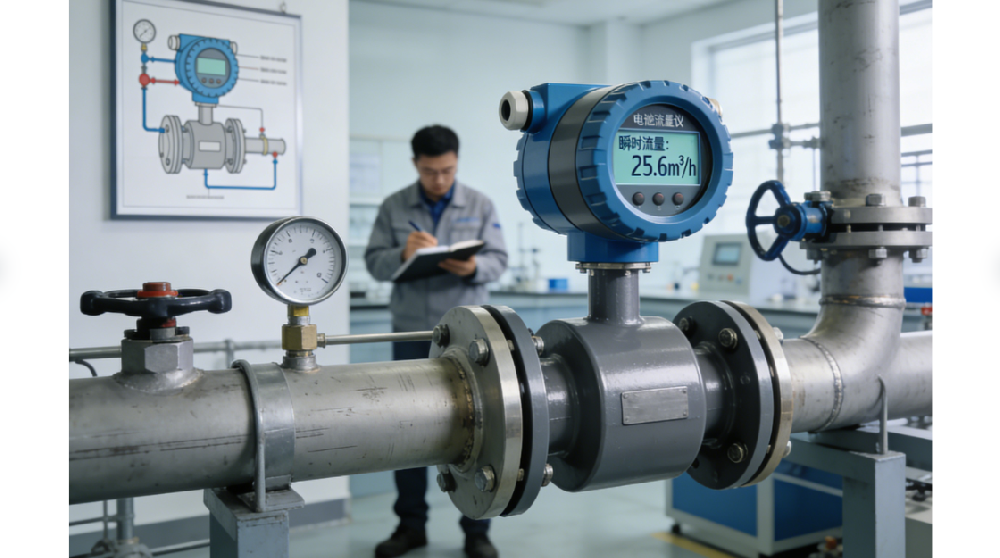
In the pipe network system of municipal water supply, the production line of the factory, and the transportation link of sewage treatment, there is a kind“Invisible referee”Always accurately control the flow data of the fluid, it is the electromagnetic flowmeter. As an indispensable flow-measurement device in both industrial and everyday applications, electromagnetic flowmeters have become the preferred choice for numerous scenarios thanks to their advantages, including zero mechanical wear, a wide measurement range, and compatibility with various media. But for most people, it“Can measure flow without contact”The character is full of mystery. This article will start from the basic principles, layer by layer dismantling the working mechanism of electromagnetic flowmeter, revealing the core logic of its precise measurement, so that the working principle of this industrial equipment becomes easy to understand.
The core of the electromagnetic flowmeter is derived from Faraday's law of electromagnetic induction in physics. The core content of this law is: when the conductor cuts the magnetic induction line in the magnetic field, the induced electromotive force will be generated inside the conductor. The electromagnetic flowmeter is a clever application of this physical law in fluid metering, but here“conductor”It is not a metal wire, but a fluid medium with a certain conductivity. From the structural point of view, the electromagnetic flowmeter is mainly composed of two parts: a sensor and a converter. The sensor is responsible for sensing the flow signal, and the converter converts the sensed signal into readable flow data. The two work together to complete the measurement process.
Specifically, the core components of the sensor include a measuring tube, an excitation coil, and electrodes. The measuring tube is the flow channel of the fluid, and its material needs to meet the non-magnetic requirements to avoid interfering with the magnetic field distribution. Commonly used are stainless steel, glass fiber reinforced plastic, etc. An excitation coil is wound on the outside of the measuring tube. When the excitation coil is connected to the power supply, a uniform and stable magnetic field will be generated inside the measuring tube, and the direction of the magnetic field is perpendicular to the direction of fluid flow. On both sides of the inner wall of the measuring tube, a pair of electrodes are symmetrically installed, which are the key components for sensing the induced electromotive force, and their materials need to be selected according to the characteristics of the fluid medium to ensure the stability of signal acquisition.
When a conductive fluid (such as tap water, sewage, acid-base solution, etc.) flows through the measuring tube at a certain flow rate, it is equivalent to the conductor cutting magnetic induction line movement in the magnetic field. At this time, the charge in the fluid will move to the electrodes on both sides of the measuring tube under the action of Lorentz force, and finally form a stable potential difference between the two electrodes, which is the induced electromotive force. There is a fixed mathematical relationship between the magnitude of the induced electromotive force and the flow rate of the fluid, the magnetic field strength, the inner diameter of the measuring tube and other parameters, and the core formula isE = k · B · D · v(whereEfor the induced electromotive force,kis the meter constant,Bfor the magnetic field strength,DTo measure the inner diameter of the tube,vis the average flow rate of the fluid).
The induced electromotive force signal collected by the sensor is very weak, usually millivolt or even microvolt, which cannot be directly used for flow calculation, which requires the converter to play a role. A high-gain, low-noise operational amplifier is integrated inside the converter, which can amplify the weak induced electromotive force to a voltage signal that can be processed. At the same time, the converter also eliminates the interference signals such as electromagnetic interference and fluid pulsation in the industrial field through the filter circuit to ensure the accuracy of the signal. Subsequently, the converter calculates the flow rate of the fluid through the core formula according to the preset instrument constant, the inner diameter of the measuring tube and other parameters, combined with the amplified induced electromotive force signal, and then calculates the volume flow rate according to the cross-sectional area of the measuring tube, and finally displays it digitally,4-20mACurrent signals and other forms of output for the staff to read or access the control system.
It is worth mentioning that the measurement accuracy of electromagnetic flowmeter is not affected by physical parameters such as fluid density, viscosity, temperature, etc., which is also one of its significant advantages over other flowmeters. But the premise of this advantage is that the fluid needs to have sufficient conductivity, usually requires conductivity.≥ 5 μs/cm. If the fluid conductivity is insufficient, such as pure water, some organic solvents, the charge can not effectively form the induced electromotive force, it will lead to the increase of measurement error or even the normal measurement. In view of this kind of low conductive medium, there are also special low frequency square wave excitation type electromagnetic flowmeter. By optimizing the excitation technology, the signal acquisition ability is improved, and the adaptation range of electromagnetic flowmeter is expanded.
In practical application, the working stability of electromagnetic flowmeter is closely related to the installation conditions. For example, when installing the sensor, it is necessary to avoid pipe elbows, valves and other positions that will cause fluid flow disorder, and reserve sufficient straight pipe sections to ensure that the fluid flows through the measuring tube in a stable flow state; at the same time, the sensor and the converter need to be well grounded to avoid power frequency interference in the industrial field from affecting magnetic field stability and signal transmission. These installation details may seem minor, but they directly affect the electromagnetic flowmeter.“Traffic Referee”The accuracy of the penalty.
From the measurement of tap water in life to the transportation of chemical raw materials in industrial production, electromagnetic flow meters are everywhere. With the ingenious design based on Faraday's law of electromagnetic induction, it realizes the accurate measurement of fluid flow, and provides reliable data support for the rational use of resources and efficient operation of production. By understanding how it works, we can not only better understand the core value of this device, but also use and maintain it more scientifically in practical applications. With the continuous development of technology, electromagnetic flow meters are being upgraded in the direction of intelligence and integration. In the future, they will play an important role in more fields and continue to protect the accuracy and fairness of flow measurement.
Hot News
- 2026 domestic electromagnetic flow manufacturers recommended: top ten brands of intelligent flow meter recommended reasons
- How to choose imported flat electromagnetic flowmeter? How to choose micro-caliber, conventional flange and plug-in electromagnetic? Recommended by domestic high-quality manufacturers
- Four major brands of electromagnetic flowmeter hard core PK: Herbalife Water, Cloud Meter, E H, Cologne, who is more worthy of choice?
- November 2026 Top Ten Brands of Electromagnetic Flowmeter at Home and Abroad Ranking
- Recommended Top Ten Brands of Electromagnetic Flowmeter in 2026: Reference for Project Selection of Water Treatment, Sewage and Conductive Liquid
- TOP5 Manufacturer's Selection Guide for Food Sanitary Electromagnetic Flowmeter: Material and Connection Mode Check before Purchase
- Cost-effective chemical oxygen demand water quality online monitor manufacturers contact information
- How to choose the integrated electromagnetic water meter? Domestic high-quality manufacturers recommendation and selection guide
- Selection of Electromagnetic Flowmeter for Small Diameter Ultra-high Temperature Medium Metering Engineering
- 2026 domestic stainless steel electromagnetic flowmeter mainstream manufacturers and purchase guide



