




Electromagnetic flowmeter selection guide: material, caliber, electrode type of scientific matching scheme
2026-01-08 09:32:07
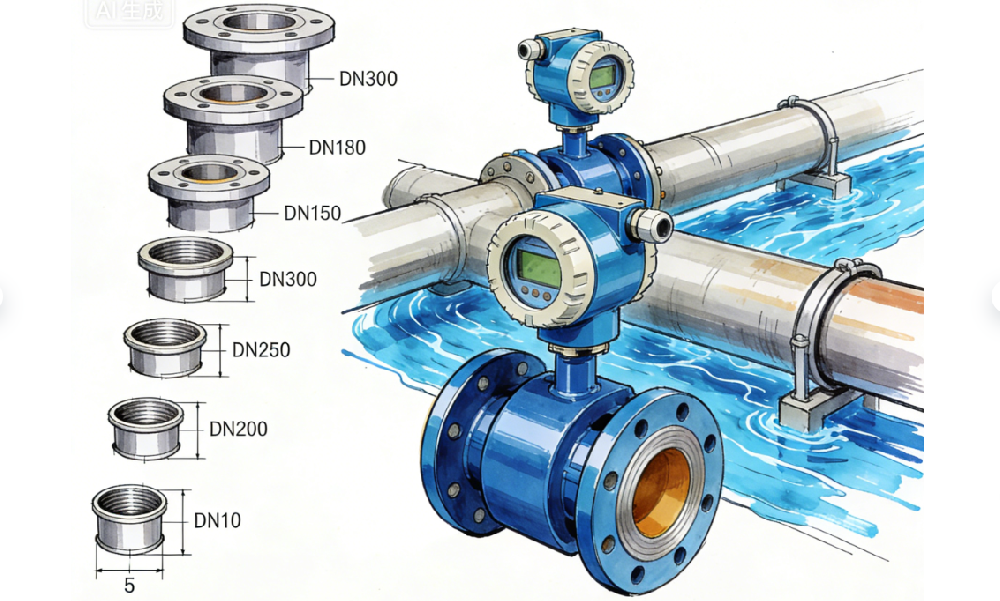
As a key instrument for industrial flow measurement, the scientific selection of electromagnetic flowmeters directly determines measurement accuracy, operational stability, and service life. In various industry settings—such as municipal water services, petrochemicals, food and pharmaceuticals, and metallurgy and mining—the characteristics of the process fluid (corrosivity, solids content, temperature), operating parameters (flow range, pressure), and installation conditions differ significantly, thereby imposing specific requirements on equipment regarding material compatibility, appropriate pipe size, and electrode suitability. If the selection is inappropriate, it can easily lead to measurement errors, equipment wear, frequent failures, and other issues, thereby increasing operation and maintenance costs. This article focuses on the three core selection factors—material, diameter, and electrode type—deconstructing the selection logic and technical considerations for each. It offers scientifically grounded matching solutions tailored to different operating conditions, providing industrial users with comprehensive guidance for precise equipment selection.
Material selection is fundamental to adapting an electromagnetic flowmeter to the specific operating conditions. It primarily involves the three key components—the measuring tube, liner, and electrodes—and must be precisely matched to the fluid’s corrosivity, temperature, solids content, and other characteristics to prevent physicochemical reactions or mechanical wear between the material and the process fluid.
1. Core Component Material Selection Logic
The material of the measuring tube must balance structural strength and corrosion resistance, while also satisfying“Nonmagnetic”Requirements (to avoid disturbing the magnetic field distribution). Under normal operating conditions,304Stainless steel is suitable for neutral clean water and ordinary media at ambient temperature; it is cost-effective and highly versatile.316LStainless steel performs exceptionally well in mildly corrosive environments (such as weak acid or alkaline solutions, or water containing trace amounts of chloride ions) and is the mainstream choice in industrial applications; for highly corrosive media (such as concentrated hydrochloric acid or nitric acid) or high-temperature operating conditions (≤200℃), Hastelloy must be selected.C- 276Or made of titanium alloy, which exhibits significantly superior corrosion resistance and high-temperature stability compared to stainless steel, but at a higher cost. In special applications, fiberglass-reinforced plastic (FRP) measuring tubes are suitable for large-diameter municipal sewage conveyance due to their light weight and excellent corrosion resistance; however, care should be taken to avoid high‑impact loads.
The lining material is in direct contact with the process fluid; its primary functions are to isolate against corrosion, reduce wear, and ensure smooth fluid flow. Selecting the appropriate lining material is critical for material compatibility. Polytetrafluoroethylene (PTFE) The lining exhibits excellent corrosion resistance and is suitable for strong acids, strong bases, and high-temperature media (operating temperature≤150℃), is the first choice for highly corrosive service conditions and is widely used in the chemical industry; fluorinated ethylene propylene (FEP)The lining's corrosion resistance is slightly inferior toPTFEHowever, it offers better processability, can be formed into complex shapes, and is suitable for standard corrosive media and ambient-temperature service conditions. Natural rubber linings are compatible with non-corrosive media such as fresh water and wastewater; they provide good elasticity but only moderate wear resistance and are relatively low-cost. Nitrile rubber linings exhibit excellent oil resistance and are well suited for measuring oily media like crude oil and lubricating oils. Ceramic linings (alumina ceramics) offer outstanding wear resistance and high hardness, making them appropriate for media with high solid content and hard particles (e.g., coal slurry, mineral slurry, sand-laden water); however, they are quite brittle and should be protected from severe vibration and rapid temperature changes.
The electrode material must be compatible with the medium’s corrosivity and conductivity, while minimizing polarization (to prevent signal attenuation).316LStainless steel electrodes are suitable for neutral and mildly corrosive media, offering broad versatility and making them the preferred choice for standard operating conditions; HastelloyBThe electrode is resistant to corrosion by strong acids such as hydrochloric acid and sulfuric acid; Hastelloy.CElectrodes resistant to oxidizing acids (such as nitric acid) and mixed acids are the core choice for severe corrosive conditions in the chemical industry; titanium electrodes exhibit excellent stability in chlorine-containing media (such as seawater and sodium hypochlorite solutions) and strongly oxidizing environments, with outstanding high-temperature resistance; platinum–iridium alloy electrodes possess extremely strong corrosion and oxidation resistance, making them suitable for precision metering applications under high temperature, high pressure, and highly corrosive conditions (such as pharmaceuticals and advanced chemicals), but their cost is very high, so they are used only for specialized requirements.
2. Caliber selection: Balancing flow range and operational efficiency
The selection of the electromagnetic flowmeter’s nominal diameter should be based primarily on the actual flow range, taking into account pipe size and velocity requirements to ensure proper sizing. This prevents issues such as excessively low flow velocities (reducing measurement accuracy) caused by an oversized meter or excessive pressure loss (increasing energy consumption) due to an undersized meter. Its core principle is: to ensure that the actual maximum flow rate falls within the instrument’s range.70%-80%, under normal operating conditions, the flow rate is controlled at0.5-10m/s, the optimal flow rate range is1-5m/s。
The selection of the pipe diameter requires derivation using the flow rate formula:Q = v·S(QFor volumetric flow rate,vFor fluid flow velocity,STo measure the pipe’s cross-sectional area, based on the actual maximum flow rate.QmaxWith the optimal flow ratevopt, calculate the required minimum inner diameter of the measuring tubeD(S = π·(D/2)²). For example, the actual maximum flow rate of a certain municipal water supply project is500m³/h, the optimal flow rate is taken2m/s, through calculation, it can be determined that the required inner diameter of the measuring tube is approximately0.94m, at this time should chooseDN1000Caliber (standard calibers should be preferred to avoid the added cost of non-standard customizations). If the actual flow rate fluctuates significantly, allow for sufficient margin in the measurement range; you may select a pipe diameter slightly larger than the calculated value, but ensure that the flow velocity at the minimum flow rate is not less than0.5m/s;If the pipe size is fixed, it can be accommodated by adjusting the meter’s span ratio; for mainstream electromagnetic flowmeters, the span ratio can reach1:50-1:100,can handle most traffic fluctuation scenarios.
Casing selection under special operating conditions requires tailored adjustments: For high‑flow applications (e.g., water conservancy projects, large chemical plants), prioritize full‑bore models with larger diameters to minimize pressure loss; concurrently, use thickened measuring tubes to ensure structural integrity. For low‑flow applications (e.g., precision pharmaceuticals, laboratory metering), avoid oversized casings; instead, select small‑diameter models paired with instruments featuring narrow ranges to maintain flow velocity within the optimal range. For media with high solid content, appropriately increase the casing diameter to reduce flow velocity, thereby mitigating wear on the liner and electrodes caused by solid particles and extending equipment service life.
3. Electrode Type Selection: Matching the Medium State and Measurement Requirements
Electrode types for electromagnetic flowmeters can be broadly classified into contact and non-contact categories based on installation method and structure. Selection must be precise, taking into account factors such as the solid content, scaling tendency, and corrosivity of the process fluid, to ensure stable and reliable signal acquisition.
Contact-type electrodes are in direct contact with the medium, offering high signal acquisition sensitivity, and are the mainstream choice for conventional operating conditions. Based on their structure, they can be classified into insertion-type and flange-type. Flanged contact electrodes are integrally mounted with the measuring tube, ensuring secure installation and excellent sealing. They are suitable for clean media with low solid content (such as fresh water or chemical feed liquids) and offer high measurement accuracy. Insertion-type contact electrodes can be installed and removed online without shutting off the flow or interrupting the pipeline, making them ideal for large-diameter pipes and retrofits of aging networks. However, their measurement accuracy is significantly affected by installation position, so strict adherence to straight-pipe requirements (upstream10Dafter5D). The limitation of contact-type electrodes is their susceptibility to media contamination. If the medium has a high solids content and is prone to scaling—such as wastewater or black liquor from papermaking—the electrode surface can become fouled and eroded, leading to signal attenuation, necessitating regular cleaning and maintenance.
Non-contact electrodes (such as capacitive electrodes) are isolated from the process medium by a liner; their key advantages are strong resistance to fouling and abrasion, making them well suited for harsh operating conditions with high solid content, scaling tendencies, and severe corrosion. Its electrodes do not come into direct contact with the process fluid, effectively preventing scaling, abrasion, and corrosion. This eliminates the need for frequent maintenance and makes it suitable for a wide range of applications, including wastewater treatment, slurry transport in mining, and metering of highly corrosive chemicals. However, non-contact electrodes exhibit some signal attenuation and must be used with high-sensitivity signal-processing circuitry; moreover, their measurement accuracy is slightly lower than that of contact electrodes, making them unsuitable for high-precision commercial metering applications. In special applications, electrodes with automatic cleaning functions (such as ultrasonic or mechanical scraping cleaning) can be selected, combining the high accuracy of contact electrodes with the anti-fouling advantages of non-contact electrodes. This makes them suitable for conditions where scaling is likely but high measurement accuracy is required, such as metering syrups and jams in food processing.
4. Summary of Scientific Matching Schemes for Different Operating Conditions
1. Municipal Water Services (Clean Water/Sewage conveyance): Selection of measuring pipe316LStainless steel; lining options include natural rubber (for clean water) or ceramic (for sand-laden wastewater); diameter is matched to the network flow rate and pipe specifications (standard).DN100-DN1000), electrode selection316LStainless steel, contact type (clean water) or non-contact type (wastewater). For smart water management upgrade projects, insertion-type electrodes with IoT modules can be selected to facilitate online monitoring and maintenance.
2. Petrochemicals (crude oil/Acidic and alkaline media): The measuring tube is made of Hastelloy.C- 276, lining selectionPTFE(Acidic/alkaline media) or nitrile rubber (crude oil); the diameter is matched to the flow rate (standard).DN50-DN500), the electrode is made of Hastelloy alloyB/CContact type. High-temperature operating conditions (>150℃) High temperature must be selected.PTFEThe liner and titanium electrode ensure material stability.
3. Metallurgical Mines (Slurry/Sand-laden water): Selection of the measuring tube316LStainless steel or fiberglass reinforced plastic; lining选用 ceramic (wear-resistant); bore diameter appropriately enlarged (larger than the calculated value).1-2For this specification, reduce the flow rate and select either a titanium‑alloy non‑contact electrode or a contact electrode with automatic cleaning to minimize wear and scaling.
4. Food and Pharmaceutical (Cleaning Media)/High-temperature liquid medicine): Selection of measuring tube316LStainless steel or titanium alloy, lining selectionPTFE(Heat-resistant and easy to clean), with a diameter matched to the production flow rate (standard)DN25-DN200), electrode selection316LContact type made of stainless steel or platinum-iridium alloy, ensuring compliance withGMPCertification requirements: no residue, easy to clean.
5. Selection Considerations
1. Prioritize matching the medium’s core characteristics: Corrosivity is the primary criterion for material selection; the corrosion‑resistance grade must be determined via a media composition analysis report to prevent equipment damage caused by improper material pairing. Solids content and scaling propensity directly dictate the electrode type; for media with high solids content or a tendency to foul, non‑contact or self‑cleaning electrodes should be preferred.
2. Balance operating parameters and installation constraints: Select the pipe size based on actual flow rate and pipeline specifications, avoiding blind adherence to nominal pipe dimensions that could push flow velocity outside the optimal range. When installation space is limited, consider insertion-type models; for retrofitting aging networks, prioritize electrode types that allow for online installation.
3. Balancing accuracy requirements with cost: For high-precision trade settlement applications, contact-type electrodes made of premium materials (such as Hastelloy,PTFE); For standard process control applications, general-purpose materials and models can be selected to keep costs down.
4. Reserved space for operations and maintenance: When selecting equipment, consider ease of maintenance—for example, choose removable and washable electrodes for conditions prone to scaling, and opt for models with low failure rates and readily available spare parts in remote locations.
In summary, the core of selecting an electromagnetic flowmeter is to achieve“Material-medium”“Caliber-Traffic”“electrode-Operating condition”Three-dimensional precise matching. Users should first clarify the medium characteristics, operating conditions, and measurement requirements, then start with the material of the core components to determine the nominal diameter and electrode type in sequence, and finally optimize the matching solution in conjunction with the specific industry application scenario. Scientific equipment selection not only ensures measurement accuracy and operational stability, but also reduces O&M costs and extends equipment service life. Against the backdrop of industrial automation and intelligent upgrades, when selecting equipment, it is advisable to also consider its smart features—such as remote monitoring and self‑diagnosis—to enhance overall operational and management efficiency.
Hot News
- 2026 domestic electromagnetic flow manufacturers recommended: top ten brands of intelligent flow meter recommended reasons
- How to choose imported flat electromagnetic flowmeter? How to choose micro-caliber, conventional flange and plug-in electromagnetic? Recommended by domestic high-quality manufacturers
- Four major brands of electromagnetic flowmeter hard core PK: Herbalife Water, Cloud Meter, E H, Cologne, who is more worthy of choice?
- November 2026 Top Ten Brands of Electromagnetic Flowmeter at Home and Abroad Ranking
- Recommended Top Ten Brands of Electromagnetic Flowmeter in 2026: Reference for Project Selection of Water Treatment, Sewage and Conductive Liquid
- TOP5 Manufacturer's Selection Guide for Food Sanitary Electromagnetic Flowmeter: Material and Connection Mode Check before Purchase
- Cost-effective chemical oxygen demand water quality online monitor manufacturers contact information
- How to choose the integrated electromagnetic water meter? Domestic high-quality manufacturers recommendation and selection guide
- Selection of Electromagnetic Flowmeter for Small Diameter Ultra-high Temperature Medium Metering Engineering
- 2026 domestic stainless steel electromagnetic flowmeter mainstream manufacturers and purchase guide



