




Analysis of Factors Affecting the Accuracy of Electromagnetic Flowmeter: How to Avoid Interference to Achieve Accurate Measurement?
2026-01-08 09:24:50
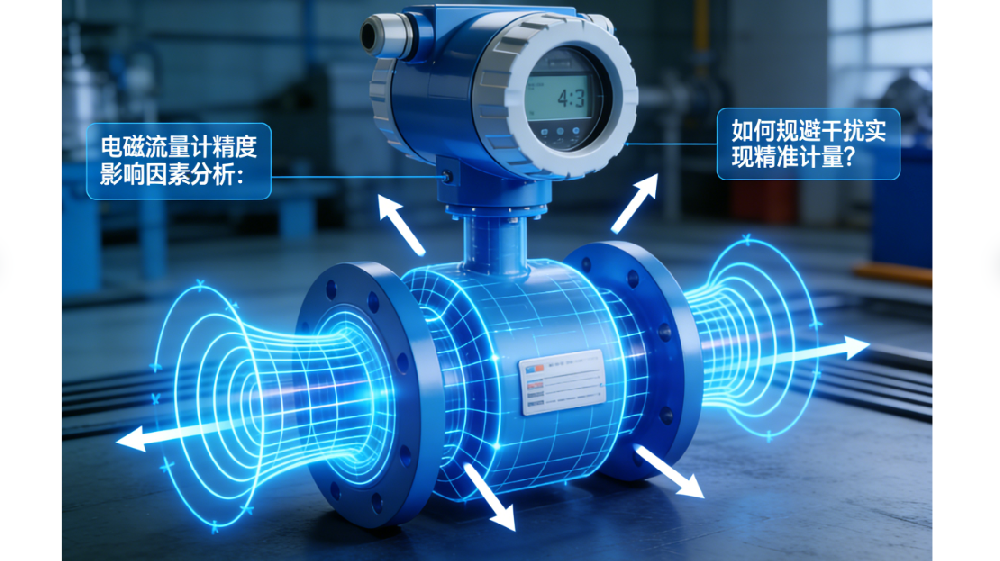
As a core instrument in industrial flow measurement, electromagnetic flowmeters are widely used in municipal water supply, petrochemicals, food processing, pharmaceuticals, and other industries, thanks to their advantages such as full-bore design, absence of mechanical wear, and compatibility with various conductive media. Its measurement accuracy directly affects production efficiency, cost control, and the fairness of trade settlements, while the complex operating conditions in industrial settings often cause accuracy to be influenced by multidimensional factors. From the characteristics of the medium to the design of the equipment, from the installation environment to the signal processing, any link of the deviation may lead to measurement error. This paper systematically analyzes the core factors affecting the accuracy of electromagnetic flowmeter, and puts forward the interference avoidance strategy and accurate measurement guarantee scheme, which provides technical reference for industrial practice.
The properties of the measured medium are fundamental factors affecting the accuracy of electromagnetic flowmeters, primarily manifesting in four aspects: conductivity, solid content, temperature and viscosity, and corrosivity. The working principle of electromagnetic flowmeter is based on Faraday's law of electromagnetic induction, which requires the medium to have a certain conductivity (usually conductivity ≥ 5 μS/cm). If the conductivity of the medium is insufficient (such as pure water and some organic solvents), the charge cannot effectively form induced electromotive force, which will lead to signal attenuation, increase of measurement deviation, and even fail to measure normally. When the solid content of the medium is too high (such as coal slurry and sewage), the solid particles will wear the electrode and lining and destroy the uniformity of the magnetic field. At the same time, the blocking of the particles will lead to uneven flow velocity distribution and expand the measurement error by 5%-15%. In addition, the medium temperature is too high will lead to the expansion of the lining deformation, change the inner diameter of the measuring tube; viscosity increase will increase the fluid flow resistance, destroy the stability of the flow rate, both will indirectly affect the measurement accuracy. If highly corrosive media are not matched with compatible electrode and liner materials, the electrodes may corrode and the liners may be damaged, leading to signal distortion.
The design and manufacturing precision of the equipment itself are central to determining measurement accuracy. The machining accuracy of the measuring tube directly affects the flow velocity distribution. If the inner diameter roundness deviation is too large and the inner wall is rough, eddy current will be generated in the fluid, causing the flow velocity distribution coefficient to fluctuate, thus causing the measurement error of more than 1%. Through precision machining and fluid simulation optimization, the inner diameter tolerance of high-quality products can be controlled within 0.1mm, and the flow velocity distribution coefficient error can be reduced to less than 0.2. The material selection and installation accuracy of the electrode are very important. Material mismatch will lead to polarization (such as using ordinary stainless steel electrodes when measuring salt water), which will increase the contact resistance and attenuate the signal. Asymmetric installation position will lead to magnetic field offset, induced electromotive force acquisition imbalance, and system error. The stability of the excitation system directly determines the magnetic field strength. If the excitation coil is unevenly wound and the power supply fluctuates too much, the magnetic field strength will fluctuate. According to the formula e = k B d v, the slight change of the magnetic field B will be directly transmitted to the induced electromotive force e, resulting in flow measurement deviation. Non-uniform lining thickness and insufficient bonding strength can lead to media penetration and pipe corrosion, as well as signal interference. High-quality linings must meet a thickness tolerance of ±0.2mm and a bonding strength of ≥2.5 MPa.
Installation conditions and environmental interference are the key external factors that affect the accuracy of industrial sites. Improper installation position is the most common source of error. If the sensor is installed at the elbow of the pipeline and downstream of the valve, and not enough straight pipe sections are reserved (usually 5D after 10D, D is the inner diameter of the measuring pipe), the fluid will not form a stable flow state, resulting in vortex and uneven flow velocity, increasing the measurement error by 10%-20%; When the sensor is installed in a vertical pipeline, if the medium flows upward and does not fill the pipeline, incomplete signal acquisition will be caused by air traffic control, causing deviation. Poor grounding is an important interference factor. Motors and transformers in industrial sites will produce power frequency interference (50Hz). If sensors and converters are not separately grounded (grounding resistance ≤ 10Ω), or grounding electrodes are shared with power equipment, interference signals will be superimposed on the measurement signals and the stability of induced electromotive force will be destroyed. In addition, the ambient temperature is too high (>60 ℃) will affect the performance of electronic components, humidity> 85% will lead to the decline of circuit insulation, vibration interference will destroy the excitation coil and electrode installation stability, will indirectly affect the measurement accuracy.
The performance of the signal processing system directly determines the denoising and fidelity results, thereby affecting the final measurement accuracy. The induced electromotive force collected by electromagnetic flowmeter is usually millivolt or even microvolt, which is extremely susceptible to interference. If the gain of the signal amplification circuit is insufficient and the noise is too large, the effective signal will be covered by the interference signal. The circuit with insufficient common mode rejection ratio (CMRR) (<80dB) cannot effectively suppress common mode interference, which will distort the signal. The degree of optimization of the filtering system is very important, if only a single low-pass filter is used, it is impossible to filter out high-frequency electromagnetic interference and low-frequency medium pulsation interference at the same time, resulting in excessive fluctuations in the measured value. In addition, if a perfect compensation mechanism (such as zero drift compensation, temperature compensation and flow velocity distribution compensation) is not set up in the signal operation process, system errors will accumulate: zero drift will cause baseline deviation if it is not corrected in time, and temperature change will cause instrument constant k deviation if it is not compensated, which will directly affect the accuracy of flow calculation.
In view of the above influencing factors, it is necessary to formulate interference avoidance strategies from the four dimensions of media adaptation, equipment selection, installation specifications and signal optimization to ensure accurate metering. At the medium adaptation level, the conductivity of the medium shall be detected in advance. For low-conductive medium, a special low-frequency square wave excitation electromagnetic flowmeter may be selected, or the conductivity may be improved by adding conductive medium. Medium with high solid content shall be made of ceramic lined non-contact electrodes to reduce wear and pollution. Strong corrosive medium shall be matched with corrosion-resistant electrodes such as Hastelloy alloy and titanium alloy and PTFE lining to avoid material damage.
Equipment selection shall focus on core performance parameters, and priority shall be given to products with precision processing of measuring tube and stable excitation system to ensure that the error of flow velocity distribution coefficient is less than or equal to 0.2 and the fluctuation of magnetic field strength is less than or equal to 0.5. Accurate matching of electrode and lining materials according to medium characteristics, such as Hastelloy electrode + PTFE lining for strong acid medium measurement, ceramic lining + 316L stainless steel electrode for sand water measurement. The installation process shall strictly follow the specifications: the installation position of the sensor shall avoid elbows and valves, reserve enough straight pipe sections, and ensure that the medium is filled with the pipeline during vertical installation; A separate grounding system shall be adopted, with grounding resistance ≤ 10Ω, and the signal lines of the sensor and the converter shall be shielded to avoid parallel laying with the power cable.
Optimization of signal processing system is the key to improve accuracy. Operational amplifiers with high gain and low noise (common mode rejection ratio ≥ 100dB, input impedance ≥ 10 ¹ Ω) need to be selected, and multi-stage filtering strategy (RC low-pass filtering + Kalman digital filtering) is adopted to effectively filter out high and low frequency interference and reduce signal fluctuation amplitude by more than 60%. Perfect the compensation mechanism and realize automatic correction of zero drift through zero excitation phase detection, the instrument constant is adjusted in real time according to the medium temperature, and the non-full tube error is corrected by the flow rate distribution model. In addition, establish a regular operation and maintenance mechanism: regularly clean the electrodes and linings to avoid scaling pollution; Detect the performance of excitation coils and circuits, and replace aging components in time; Regularly calibrate equipment to ensure that the measurement accuracy meets the standard requirements (such as JJG 1033-2007 "Electromagnetic Flowmeter Verification Regulations").
Under special working conditions, targeted strengthening measures should be taken: thickened measuring pipes should be selected for large flow conditions to avoid pipe deformation and adaptive excitation technology should be adopted to improve magnetic field stability; High temperature resistant lining (such as high temperature PTFE, with operating temperature ≤ 180 ℃) and sensors with excellent sealing performance should be selected for high temperature and high pressure conditions to reduce the influence of temperature on electronic components; Electromagnetic flowmeter integrated with Internet of Things module can be selected for intelligent scenes such as intelligent water services, real-time monitoring of signal fluctuations through the cloud platform, early warning of error anomalies, improve operation and maintenance efficiency.
In summary, the measurement accuracy of electromagnetic flowmeter is affected by multi-dimensional factors such as medium characteristics, equipment design, installation environment, signal processing, etc., and omissions in any link may cause errors. To achieve accurate measurement, we need to adhere to the concept of "whole process control", from media adaptation, equipment selection to installation specifications, signal optimization, regular operation and maintenance to form a closed-loop management. With the development of material science and electronic technology, the application of adaptive excitation, AI intelligent filtering and other technologies will further improve the anti-interference ability and accuracy stability of electromagnetic flowmeter, and better meet the high-end measurement needs of industrial automation, intelligent water and other fields.
Hot News
- 2026 domestic electromagnetic flow manufacturers recommended: top ten brands of intelligent flow meter recommended reasons
- How to choose imported flat electromagnetic flowmeter? How to choose micro-caliber, conventional flange and plug-in electromagnetic? Recommended by domestic high-quality manufacturers
- Four major brands of electromagnetic flowmeter hard core PK: Herbalife Water, Cloud Meter, E H, Cologne, who is more worthy of choice?
- November 2026 Top Ten Brands of Electromagnetic Flowmeter at Home and Abroad Ranking
- Recommended Top Ten Brands of Electromagnetic Flowmeter in 2026: Reference for Project Selection of Water Treatment, Sewage and Conductive Liquid
- TOP5 Manufacturer's Selection Guide for Food Sanitary Electromagnetic Flowmeter: Material and Connection Mode Check before Purchase
- Cost-effective chemical oxygen demand water quality online monitor manufacturers contact information
- How to choose the integrated electromagnetic water meter? Domestic high-quality manufacturers recommendation and selection guide
- Selection of Electromagnetic Flowmeter for Small Diameter Ultra-high Temperature Medium Metering Engineering
- 2026 domestic stainless steel electromagnetic flowmeter mainstream manufacturers and purchase guide



