




Working principle and core technology of electromagnetic flowmeter: from sensor to signal processing
2026-01-08 09:10:50
As a flow measurement device based on the principle of electromagnetic induction, the electromagnetic flowmeter—boasting advantages such as no mechanical wear, full-bore measurement, and compatibility with various conductive media—is widely used in municipal water supply, petrochemicals, food and pharmaceuticals, metallurgy, mining, and other sectors. Its core performance hinges on the synergistic optimization of sensor design, excitation technology, and the signal-processing system; together, these factors determine measurement accuracy, stability, and resistance to interference. This paper begins with the fundamental operating principles of electromagnetic flowmeters, systematically dissects the core technologies across the entire signal chain—from sensor sensing to signal output—and analyzes the technical key points and optimization directions at each stage, thereby providing technical support for understanding device performance and guiding selection and application.
The operating principle of an electromagnetic flowmeter is based on Faraday’s law of electromagnetic induction: when a conductive liquid moves through a magnetic field, cutting the magnetic field lines, an electromotive force (EMF) is induced in the liquid. The magnitude of this EMF is fixedly related to parameters such as the fluid velocity, magnetic field strength, and the inner diameter of the measuring tube. Specifically, excitation coils are installed on both sides of the measuring tube to generate a uniform and stable magnetic field; when a conductive medium flows at a velocityvAs the fluid flows through the measuring tube, the charges in the medium are deflected toward the electrodes at both ends of the tube under the Lorentz force, creating a potential difference (i.e., an induced electromotive force). Its core computational formula is:E = k · B · D · v, among whichEfor the induced electromotive force,kis the meter constant,Bfor the magnetic field strength,DTo measure the inner diameter of the tube,vIt is the average flow velocity of the fluid. By detecting the induced electromotive forceE, combined with the knownk、B、DThe fluid flow velocity can be calculated from the parameters.v, then calculate the volumetric flow rate based on the cross-sectional area of the measuring tube.Q(Q = v·π·(D/2)²)。
The sensor is the core component of an electromagnetic flowmeter that detects flow signals; its design accuracy directly determines the quality of the raw signal. It primarily consists of three key components: the measuring tube, electrodes, and lining. As the core component responsible for fluid flow and magnetic field support, the measuring tube must meet“Non-magnetic, low conductivity, high strength”要求,常用材质为不锈钢(304、316L) or fiberglass. Under high-flow conditions, the measuring tube must feature a thickened design to prevent deformation caused by the impact of high-velocity fluids. Additionally, precision machining is employed to ensure the roundness of the inner diameter, thereby minimizing the influence of non-uniform velocity distribution on measurement accuracy.——部分高端产品通过流体仿真优化测量管内流道,使流速分布系数误差控制在±0.1%Within.
电极是采集感应电动势的关键元件,其材质与结构设计需兼顾导电性、耐腐蚀性与抗污染能力。常用电极材质包括316LStainless steel (suitable for neutral and mildly corrosive media), Hastelloy (suitable for strong acid and strong alkali media), titanium alloy (suitable for highly corrosive, chlorine-containing media), etc.; under special operating conditions, platinum–iridium alloy may also be used (suitable for high-temperature, strongly oxidizing media). Electrode configurations are classified as insertion-type, contact-type, and non-contact-type. Contact-type electrodes are in direct contact with the process medium, offering high signal acquisition sensitivity but being prone to contamination by media constituents such as scaling or deposits. Non-contact electrodes (e.g., capacitive electrodes) isolate the medium via a liner, providing strong resistance to fouling and making them suitable for media with high solid content or a tendency to foul (such as wastewater or coal slurry); however, they exhibit significant signal attenuation and must be used with high-sensitivity signal-processing circuitry. Furthermore, the electrode mounting positions must be strictly symmetrical to prevent signal distortion caused by magnetic field offset; typically, they are perpendicular to the measuring tube axis and lie in the same horizontal plane.
As a protective layer for the inner wall of the measuring tube, the lining’s primary function is to isolate the tube from the process fluid, preventing corrosion of the tube body while reducing fluid friction and ensuring smooth flow. The choice of lining material must match the characteristics of the process fluid; common materials include polytetrafluoroethylene (PTFE,适配强酸、强碱、高温介质,使用温度≤150℃)、polytetrafluoroethylene-propylene (FEP,耐腐蚀性略逊于PTFE,但加工性能更好,适合常规腐蚀介质)、橡胶(天然橡胶适配清水、污水,丁腈橡胶适配油性介质)、陶瓷(氧化铝陶瓷,耐磨损、耐高温,适合含沙量高、高温的恶劣工况)。衬里的施工工艺至关重要,需保证与测量管内壁紧密贴合,无气泡、裂纹,否则会导致介质渗透腐蚀管体,同时引发信号干扰——优质衬里的厚度公差可控制在±0.2mm,粘接强度≥2.5MPa,长期运行无脱落风险。
励磁技术是保障磁场稳定性的核心,其核心目标是产生均匀、稳定的磁场,减少磁场波动对感应电动势测量的干扰。目前主流的励磁方式分为三种:直流励磁、交流励磁与低频方波励磁,不同方式适用于不同工况,各有优劣。直流励磁通过恒定电流产生恒定磁场,结构简单、抗干扰能力强,适合测量导电性强的介质(如盐水、酸碱溶液),但存在电极极化现象(介质中的离子在电极表面沉积,导致接触电阻增大,信号衰减),因此不适用于导电性差的介质(如纯净水、部分有机溶剂)。
交流励磁采用50Hz工频交流电产生交变磁场,可有效避免电极极化问题,适配性更广,是早期电磁流量计的主流励磁方式。但交流励磁存在明显缺陷:一是易受工频干扰(如工业现场的电机、变压器产生的电磁场),导致磁场叠加失真;二是会产生涡流损耗(测量管中的感应电流),影响磁场均匀性。为解决这一问题,低频方波励磁技术应运而生,其采用低频(0.5-10Hz)矩形波作为励磁信号,兼具直流励磁的稳定性与交流励磁的抗极化优势。低频方波励磁通过“Forward excitation—Zero excitation—Reverse Excitation—Zero excitation”The cyclical operation maintains a constant magnetic field strength, reducing eddy current losses; meanwhile, the zero-excitation phase can be used to detect zero-point drift, and signal compensation enhances measurement accuracy. Currently, high-end electromagnetic flowmeters generally employ dual-frequency square-wave excitation or adaptive excitation technology, which can automatically adjust the excitation frequency based on the conductivity of the measured medium and variations in flow velocity. This ensures magnetic field stability even under complex operating conditions, with fluctuations in magnetic field strength kept within±0.5%Within.
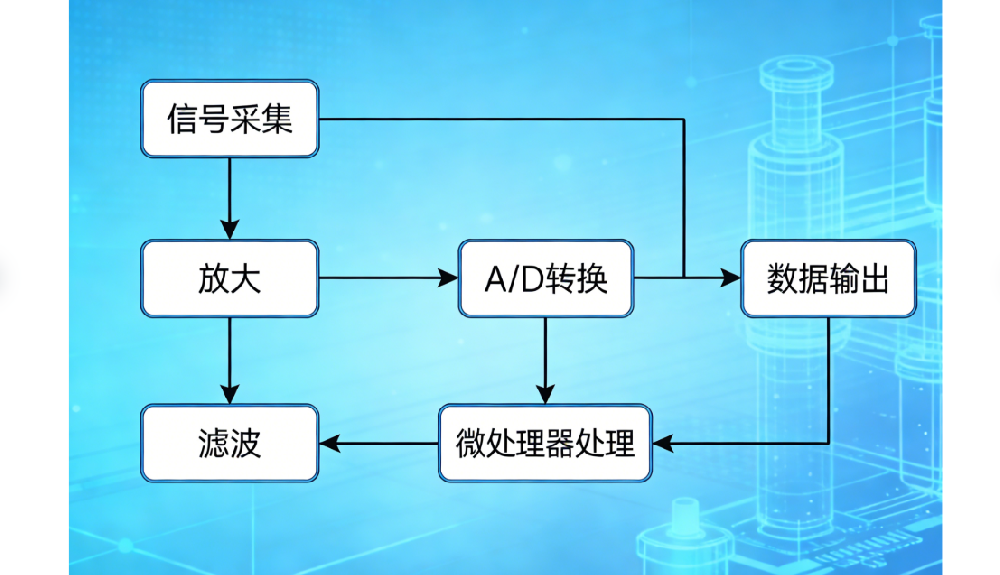
The signal processing system is part of the electromagnetic flowmeter.“brain”, Responsible for amplifying, filtering, and calculating the weak induced electromotive force (usually millivolt or even microvolt) collected by the sensor, and finally converting it into a standardized flow signal (such4-20mAcurrent signal,RS485digital signal). Due to the existence of a large number of interference sources in industrial sites (such as power frequency interference, vibration interference, medium pulsation interference), the core challenge of signal processing systems is“denoising fidelity”To ensure accurate extraction of valid signals.
The signal amplification link uses a high-gain, low-noise operational amplifier to amplify the weak induced electromotive force to a volt-level signal, while suppressing common-mode interference (such as the parasitic potential between the electrode and the measuring tube) through a differential amplifier circuit. The common mode rejection ratio of high-quality signal processing circuits (CMRR) attainable100dBabove, the input impedance≥ 10 ¹ ΩIt can effectively avoid signal attenuation and interference superposition. The filtering link is the key to denoising, usually using multi-stage filtering strategy: first throughRCThe low-pass filter filters out high-frequency interference (such as high-frequency signals generated by electromagnetic radiation), and then eliminates signal fluctuations caused by low-frequency interference and medium pulsation through digital filtering algorithms (such as Kalman filtering and moving average filtering). For example, the Kalman filter algorithm can dynamically adjust the filter parameters according to the signal change law, and can still reduce the signal fluctuation under the condition of large flow rate fluctuation.60%Above, the stability of the measured value is guaranteed.
The signal operation and compensation link is realized by the microprocessor, the core is to complete the flow calculation according to the Faraday's law formula, and at the same time carry out a variety of error compensation to improve the measurement accuracy. Common compensation mechanisms include: zero drift compensation (through the zero excitation phase of the signal detection, automatic correction of zero deviation), temperature compensation (according to the medium temperature adjustment instrument constantk, to avoid changes in the inner diameter of the measuring tube caused by the expansion and contraction of the lining), flow rate distribution compensation (through the preset flow rate distribution model, to correct the error caused by non-full pipe, uneven flow rate). Some intelligent electromagnetic flowmeters also integrate self-diagnosis function, which can monitor electrode pollution, lining damage, excitation coil failure and other problems in real time, and send out alarm prompts through signal abnormality analysis to improve equipment operation and maintenance efficiency. Finally, the processed traffic signal is converted into a standardized signal through the output module, or uploaded to the cloud platform through the Internet of Things module to realize remote monitoring and data traceability.
Collaborative optimization of core technologies is the key to improve the overall performance of electromagnetic flowmeter. For example, under conditions of high flow and high solid content, it is necessary to use“Ceramic lining+Non-contact electrode+Low-Frequency Square-Wave Excitation+Kalman filter”The combination scheme: ceramic lining to ensure wear resistance, non-contact electrode to avoid scaling pollution, low-frequency square wave excitation to reduce magnetic field interference, Kalman filter to inhibit flow rate fluctuations;“PTFElining+Hastelloy electrode+adaptive excitation+Temperature compensation”scheme to ensure measurement accuracy and equipment durability. In addition, with the industry4.0The development of electromagnetic flowmeter is upgrading towards intelligence and integration, and the core technology presents two major trends: one is the integration of sensors and Internet of Things technology, and multi-parameter collaborative measurement is realized through built-in pressure and temperature sensors; the other is the introduction of signal processing systemAIThe algorithm further improves the anti-interference ability and measurement accuracy by ML adaptive different working conditions.
In summary, the operational performance of an electromagnetic flowmeter is the result of the coordinated interaction among the sensor, excitation technology, and signal-processing system. The sensor’s precision design underpins signal acquisition, optimization of excitation technology ensures magnetic field stability, and upgrading the signal processing system is key to noise reduction and fidelity. Understanding the principles and adaptation scenarios of each core technology can not only help users accurately select models, but also provide technical basis for equipment operation and maintenance and performance optimization. In the future, with the deep integration of material science, electronic technology and artificial intelligence, electromagnetic flowmeters will achieve further breakthroughs in measurement accuracy, working condition adaptability, and intelligent level, and better meet industrial automation, smart water and other fields. High-end demand.
Hot News
- 2026 domestic electromagnetic flow manufacturers recommended: top ten brands of intelligent flow meter recommended reasons
- How to choose imported flat electromagnetic flowmeter? How to choose micro-caliber, conventional flange and plug-in electromagnetic? Recommended by domestic high-quality manufacturers
- Four major brands of electromagnetic flowmeter hard core PK: Herbalife Water, Cloud Meter, E H, Cologne, who is more worthy of choice?
- November 2026 Top Ten Brands of Electromagnetic Flowmeter at Home and Abroad Ranking
- Recommended Top Ten Brands of Electromagnetic Flowmeter in 2026: Reference for Project Selection of Water Treatment, Sewage and Conductive Liquid
- TOP5 Manufacturer's Selection Guide for Food Sanitary Electromagnetic Flowmeter: Material and Connection Mode Check before Purchase
- Cost-effective chemical oxygen demand water quality online monitor manufacturers contact information
- How to choose the integrated electromagnetic water meter? Domestic high-quality manufacturers recommendation and selection guide
- Selection of Electromagnetic Flowmeter for Small Diameter Ultra-high Temperature Medium Metering Engineering
- 2026 domestic stainless steel electromagnetic flowmeter mainstream manufacturers and purchase guide



