




Electromagnetic flowmeter vs mechanical flowmeter: who is the "king of cost performance" of industrial measurement "?
2026-01-08 10:04:10
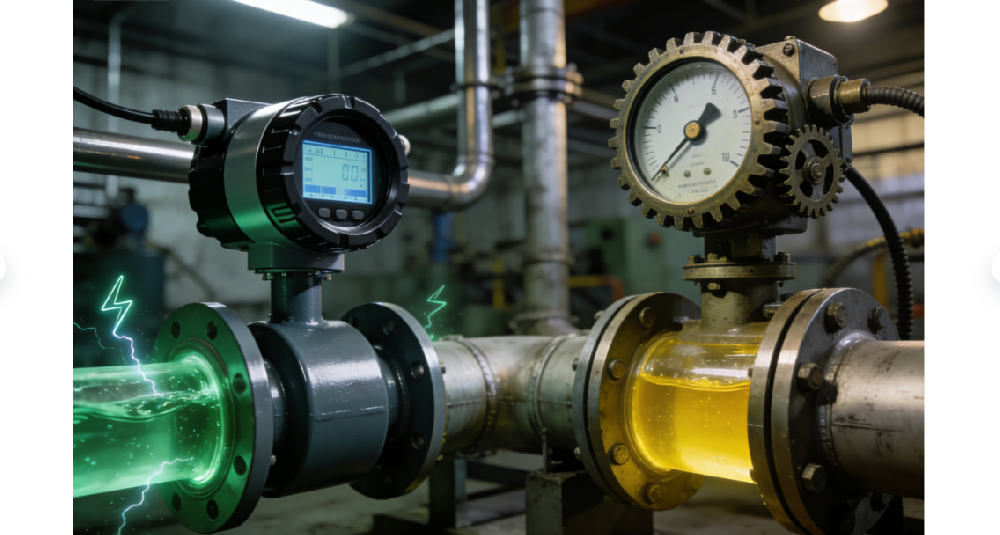
In the field of flow measurement in industrial production, electromagnetic flowmeters and mechanical flowmeters are the two main types of instruments. Based on different operating principles, they each have their own advantages and characteristics and are widely used in various process conditions. For businesses, selecting a cost-effective flow measurement device can ensure measurement accuracy while reducing procurement and operational maintenance costs and improving production efficiency. So, what is the difference between electromagnetic flowmeter and mechanical flowmeter? Who is the industrial measurement“The king of value for money”? This paper will compare and analyze the two from the working principle, performance characteristics, applicable scenarios, cost input and other dimensions, so as to provide popular science reference for equipment selection of enterprises.
First of all, from the working principle, there are essential differences between the two, which is also the core source of their performance characteristics. The electromagnetic flowmeter works based on Faraday's law of electromagnetic induction. It calculates the flow rate by measuring the induced electromotive force generated by the conductive fluid in the magnetic field. During the measurement process, no mechanical parts are in direct contact with the fluid.“Contactless”Measurement; while mechanical flow meters (such as turbine flow meters, impeller flow meters, elliptical gear flow meters, etc.) rely on the kinetic energy of the fluid to drive the internal mechanical parts (turbines, impellers, gears, etc.) to rotate, and calculate the flow by measuring the rotation speed of the mechanical parts, Belonging“Contact”Measurement. The difference in working principle directly leads to the significant difference in anti-pollution ability and wear degree.
In the comparison of performance characteristics, the advantages of electromagnetic flowmeter are mainly reflected in the following aspects: first, full diameter design, no internal mechanical obstacles, small fluid pressure loss, can reduce energy consumption, while avoiding the wear and blockage of mechanical parts, suitable for high solid content, easy to scale media (such as sewage, slurry); second, the measurement range is wide, the range ratio can reach1:50-1:100It can adapt to working conditions with large flow fluctuations, and the measurement accuracy is not affected by physical parameters such as fluid density, viscosity, temperature, etc., and the measurement stability is strong; the third is strong corrosion resistance, through reasonable selection of electrode and lining materials, Can adapt to the measurement of corrosive media such as strong acid and strong alkali.
The advantages of mechanical flowmeters are: First, the structure is simple, the manufacturing process is mature, and the initial purchase cost is relatively low. It has certain cost advantages for some simple working conditions (such as clean and low-viscosity liquid metering); second, the measurement accuracy is relatively high. High, some high-precision mechanical flowmeters (such as elliptical gear flowmeters) can reach measurement accuracy under small flow and stable working conditions±0.2%, Suitable for high-precision trade settlement scenarios; third, installation and maintenance are relatively simple, the requirements for the installation environment are low, and there is no need for complicated grounding and shielding measures.
From the perspective of applicable scenarios, the adaptation range of electromagnetic flowmeters is wider, especially suitable for complex working conditions. In the field of municipal water affairs, it can be used for the flow measurement of sewage and tap water. In the petrochemical field, it can be used for the measurement of corrosive or viscous media such as acid-base solution and crude oil. In the field of metallurgical mines, it can be used for the measurement of media with high solid content such as mineral slurry and sand-containing water. In the field of food and pharmacy, it can be used for the measurement of clean or corrosive media such as liquid and syrup. The mechanical flow meter is more suitable for clean, low viscosity, non-impurity medium measurement, such as gasoline, diesel, pure water, etc., in the chemical raw materials trade settlement, small factory production process control and other scenarios.
Cost input is one of the core indicators of cost performance, where the cost includes not only the initial purchase cost, but also the subsequent operation and maintenance costs and service life costs. From the initial purchase cost, mechanical flow meters of the same caliber are usually lower than electromagnetic flow meters.30%-50%For companies with limited budgets and simple working conditions, mechanical flow meters are attractive. However, from the perspective of long-term operation and maintenance costs, the advantages of electromagnetic flowmeters are more obvious: because they have no mechanical parts to wear, they have a longer service life, usually up10-15The mechanical parts of the mechanical flowmeter are easy to wear and age in long-term operation, and need to be replaced regularly. The operation and maintenance cost is high, and the service life is usually5-8Year.
Taking the acid-base solution metering scenario of a chemical enterprise as an example, if a mechanical flowmeter is selected, the initial purchase cost is2However, due to the strong corrosive nature of the acid-base solution, the mechanical components need to be replaced every year, and the average annual operation and maintenance cost is about0.8Ten thousand yuan, service life according5calculated in the year, the total input cost is2 + 0.8×5 = 6If the electromagnetic flowmeter is selected, the initial purchase cost is3.5million, through the selection of corrosion-resistant Hastelloy electrodes andPTFELining, service life up12The average annual operation and maintenance cost is approximately0.2Ten thousand yuan, the total input cost is.3.5 + 0.2×12 = 5.9Ten thousand yuan. In the long run, the cost advantage of electromagnetic flowmeter is more significant, and it can avoid production interruption caused by mechanical component failure, and indirectly reduce economic losses.
It should be noted that,“The king of value for money”The judgment is not absolute, but depends on the specific working conditions. For scenarios with simple working conditions, short-term use, and limited budget, mechanical flowmeters may be a more appropriate choice; for complex working conditions, long-term operation, and scenarios with high requirements for metering stability and anti-pollution capabilities, electromagnetic flowmeters are more cost-effective. higher. In addition, with the continuous development of technology, the manufacturing cost of electromagnetic flowmeter is gradually reduced, while the performance improvement space of mechanical flowmeter is limited, and the cost-effective gap between the two is gradually narrowing.
In summary, electromagnetic flowmeters and mechanical flowmeters have their own advantages and disadvantages, and there is no absolute“The king of value for money”The key is to accurately match the requirements of the working conditions. When selecting the type, enterprises should comprehensively consider the media characteristics, flow range, measurement accuracy requirements, budget input, operation and maintenance conditions and other factors, and comprehensively evaluate the total cost and use effect of the two. For most complex industrial conditions, electromagnetic flowmeters have more cost-effective advantages due to their wide adaptability, stable metering performance and low long-term operation and maintenance costs; while in simple and clean conditions, mechanical flowmeters It can meet the basic metering requirements with lower initial investment.
Hot News
- Buy flowmeter, first look at the site conditions! 2026 Depth Comparison of Domestic and Imported Brands of Electromagnetic Flowmeter Manufacturers
- 2026 domestic electromagnetic flow manufacturers recommended: top ten brands of intelligent flow meter recommended reasons
- How to choose imported flat electromagnetic flowmeter? How to choose micro-caliber, conventional flange and plug-in electromagnetic? Recommended by domestic high-quality manufacturers
- Four major brands of electromagnetic flowmeter hard core PK: Herbalife Water, Cloud Meter, E H, Cologne, who is more worthy of choice?
- November 2026 Top Ten Brands of Electromagnetic Flowmeter at Home and Abroad Ranking
- Recommended Top Ten Brands of Electromagnetic Flowmeter in 2026: Reference for Project Selection of Water Treatment, Sewage and Conductive Liquid
- TOP5 Manufacturer's Selection Guide for Food Sanitary Electromagnetic Flowmeter: Material and Connection Mode Check before Purchase
- Cost-effective chemical oxygen demand water quality online monitor manufacturers contact information
- How to choose the integrated electromagnetic water meter? Domestic high-quality manufacturers recommendation and selection guide
- Selection of Electromagnetic Flowmeter for Small Diameter Ultra-high Temperature Medium Metering Engineering



