




Electromagnetic flowmeter vs ultrasonic flowmeter: how to choose the sewage metering scene?
2025-12-22 10:32:08
In the field of wastewater measurement, electromagnetic flowmeters and ultrasonic flowmeters are the two most widely used mainstream devices. Whether for inflow and outflow measurement at municipal wastewater treatment plants, effluent discharge monitoring at industrial enterprises, or wastewater flow management in temporary projects, these two types of flow meters have each secured a significant market share thanks to their respective advantages. However, the sewage medium generally has the characteristics of high suspended matter content, large flow fluctuations, corrosive substances in some scenes, and the requirements of different scenes on measurement accuracy, installation conditions, operation and maintenance costs are significantly different, resulting in the selection decision of the two directly affecting the measurement effect and long-term use cost. This paper focuses on the core scene of sewage metering, from the four dimensions of working principle adaptation, core performance difference, typical scene matching, cost-benefit comparison, depth analysis of electromagnetic flowmeter and ultrasonic flowmeter choice logic, for enterprises to provide practical guidance for accurate selection.
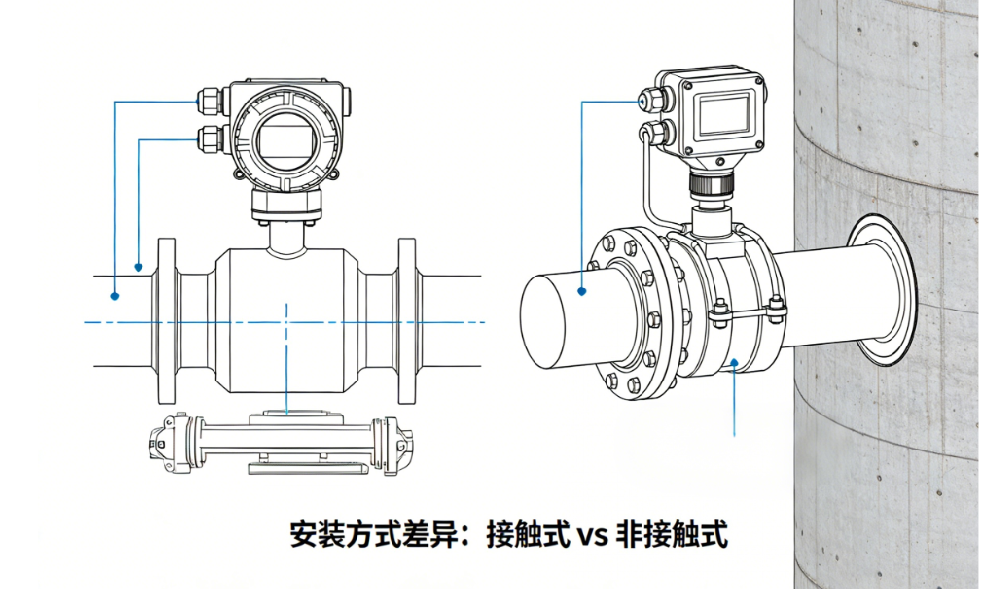
Principle suitability dismantling: core differences under the characteristics of sewage media. The essential difference between electromagnetic flowmeter and ultrasonic flowmeter comes from the working principle, which directly determines their adaptation basis in sewage medium.
The electromagnetic flowmeter works based on Faraday's law of electromagnetic induction. By constructing a uniform magnetic field in the measuring tube, when the conductive sewage cuts the magnetic induction line, the electrode will induce an electromotive force proportional to the flow rate, and then calculate the flow data. The core design advantage is that there are no mechanical moving parts in the measuring tube, and the full-pass structure is adopted, which avoids the risk of blockage caused by suspended solids in sewage from the root. At the same time, the sewage itself has a certain conductivity, which is fully adapted to the measurement premise of the electromagnetic flowmeter without adding additional conductive media, which allows it to work stably in most sewage scenarios.
Ultrasonic flow meters rely on the propagation characteristics of ultrasonic waves in the fluid to achieve measurement, divided into Doppler type and time difference type two categories, both in the sewage scene of the suitability of each focus. The Doppler type calculates the flow velocity by capturing the reflection frequency shift of ultrasonic waves on suspended solids and bubbles in sewage, which is naturally suitable for sewage containing suspended particles. The time difference type calculates the flow velocity by measuring the time difference between the propagation time of ultrasonic waves downstream and countercurrent, which is more suitable for cleaner sewage. It is worth noting that the ultrasonic flowmeter adopts non-contact measurement, and the sensor is installed outside the pipeline without direct contact with the sewage, which can effectively avoid the erosion of corrosive sewage, but it has higher requirements on the air content of the sewage, the pipe material and the cleanliness of the inner wall.
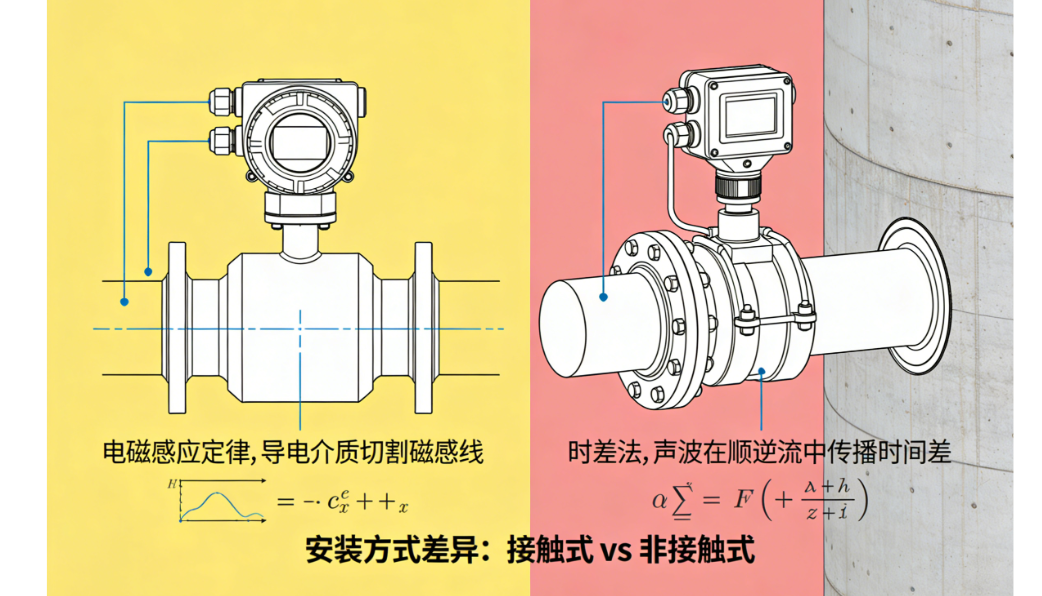
Core performance PK: targeted comparison of key requirements for sewage metering. The core requirements of the sewage metering scenario focus on the three dimensions of accuracy stability, anti-interference ability and range adaptability, and the performance of the two types of flowmeters differs significantly, which directly determines their applicable boundaries.
In terms of measurement accuracy, electromagnetic flowmeters have a clear advantage. The accuracy of mainstream electromagnetic flowmeter can reach 0.2-0.5 FS, and that of high-end models can even reach 0.1 FS, which fully meets the high-precision compliance requirements of municipal sewage plant inlet and outlet, industrial sewage outlets and other environmental protection supervision platforms. In practical application, after a large municipal sewage plant adopts electromagnetic flowmeter, the accuracy of flow data is stable within ± 0.3%FS, and it successfully passes the sewage accounting acceptance. Ultrasonic flowmeter accuracy is slightly lower, Doppler and time difference accuracy are about 1% FS, although it can cover the general industrial process wastewater measurement needs, but it is difficult to meet the high requirements of compliance monitoring scenarios. In particular, when the wastewater contains a high gas content or scale forms on the inner pipe walls, the ultrasonic propagation path can be affected, and measurement errors may increase further.
In terms of anti-interference and media adaptability, each has its own suitable application scenarios. The electromagnetic flowmeter has strong anti-electromagnetic interference ability, is not affected by changes in sewage density, viscosity, and temperature, has the best adaptability to sewage containing high concentrations of suspended solids and corrosive substances, and can stably adapt to complex sewage media such as chemical acid and alkali wastewater and mine slag wastewater. Ultrasonic flowmeter has weak anti-interference ability, and Doppler type is sensitive to the air content of sewage. When the air content exceeds 5%, the measurement accuracy will be significantly reduced. The time difference type is greatly affected by the pipe material (carbon steel, stainless steel and other materials that can conduct ultrasonic waves) and the scaling thickness on the inner wall. When the scaling thickness exceeds 5mm, it needs to be cleaned in time, otherwise it will lead to signal attenuation. In addition, ultrasonic flowmeters may also experience signal distortion in industrial environments with strong electromagnetic interference.

In terms of range adaptability, the wide range ratio of the electromagnetic flowmeter is more suitable for the characteristics of large fluctuations in sewage flow. Its range ratio can reach 1:100, which can easily cover the large changes of day and night flow (such as the difference between the peak flow during the day and the trough at night) at the inlet of the municipal sewage plant without frequent adjustment of parameters. The range ratio of the ultrasonic flowmeter is about 1:50, which can meet the demand of medium flow fluctuation, but in the scene where the flow fluctuation is more than 50 times, it is difficult to ensure the accuracy stability within the full range.
Accurate matching of typical scenarios: a landing application of decision logic. Combined with performance differences and scenario requirements, the two types of flowmeters have clear adaptation boundaries in sewage metering scenarios, requiring targeted choices:
High-demand compliance monitoring scenarios (municipal sewage plant inlet/outlet, chemical/printing and dyeing enterprise sewage outlet): priority selection of electromagnetic flowmeter. The core demands of such scenarios are stable accuracy, traceable data, and sewage containing suspended solids or corrosive substances, electromagnetic flowmeter high precision, strong adaptability can be perfectly matched. Taking the measurement of the sewage outlet of a chemical enterprise as an example, the wastewater contains acid and alkali substances and the content of suspended solids is high. After selecting the electromagnetic flowmeter of Hastelloy alloy electrode, not only the accurate measurement is realized, but also the equipment failure caused by medium corrosion is avoided, and the service life is more than 8 years. If the ultrasonic flowmeter is selected for such scenes, it is easy to cause accuracy deviation due to problems such as gas content and scaling of sewage, which cannot meet the compliance requirements.
Pipeline renovation/temporary monitoring scenario (old plant wastewater measurement renovation, temporary project monitoring): ultrasonic flowmeter is preferred. The core pain points of such scenarios are the inability to destroy existing pipelines (e. g., old pipelines are difficult to weld and fear of damaging structural integrity), or short monitoring cycles that require rapid deployment. The non-contact installation of the ultrasonic flowmeter does not require disassembly, and the installation period is only 1-2 days, which can quickly complete the deployment. In the old pipeline renovation project of a printing and dyeing enterprise, the Doppler ultrasonic flowmeter is selected to complete the installation and commissioning without damaging the pipeline, which efficiently meets the temporary flow monitoring requirements for 6 months, and the installation process does not affect the normal production. If the electromagnetic flowmeter is used, the pipe needs to be cut for flange connection, which not only has a long installation cycle (about 3-5 days), but also may affect the original production.
Corrosive but short-term monitoring scenarios (such as short-term monitoring of temporary sewage outlets in chemical enterprises): ultrasonic flow meters can be used. Although the electromagnetic flowmeter can be adapted to corrosive sewage through special materials, the procurement cost of special material models is relatively high. If it is only for short-term monitoring (such as 3-6 months), the selection of ultrasonic flowmeter has more cost advantages and does not need to worry about equipment corrosion. For long-term monitoring, it is still recommended to use a special material of electromagnetic flowmeter, long-term use more stable.
Cost-benefit comparison: a comprehensive consideration of the whole life cycle. The selection decision needs to take into account the initial procurement cost and the long-term operation and maintenance cost, and the cost structure of the two types of flow meters is significantly different, which needs to be comprehensively evaluated in combination with the use cycle.
In terms of procurement costs, ultrasonic flow meters have a distinct advantage. The purchase price of a single ordinary Doppler ultrasonic flowmeter is about 8,000-15,000 yuan, and that of the time difference type is about 8,000-20,000 yuan. The purchase cost of electromagnetic flowmeter is relatively high, and the common model is about 10,000-30,000 yuan. If special materials such as Hastelloy alloy and titanium alloy are selected for corrosive sewage, the price can rise to 30,000-80,000 yuan. For small businesses with limited budgets in short-term monitoring scenarios, ultrasonic flow meters offer a clear cost advantage.
In terms of operation and maintenance costs, ultrasonic flow meters are lower. Its non-contact measurement has no risk of component wear and corrosion, only needs to clean the dust on the surface of the sensor probe once a quarter, and the annual operation and maintenance cost is about 1000-3000 yuan. Although the electromagnetic flowmeter has no mechanical moving parts, the electrode may affect the signal acquisition due to sewage fouling, and the electrode needs to be cleaned and calibrated once a year, with an annual operation and maintenance cost of about 2000-5000 yuan. Special material models have slightly higher operation and maintenance costs due to the high price of accessories. However, the service life of the electromagnetic flowmeter is longer (usually 8-10 years), the service life of the ultrasonic flowmeter is about 5-8 years, and the whole life cycle cost of the electromagnetic flowmeter is more advantageous when used for a long time (more than 5 years).
Selection decision framework and considerations. Based on the above analysis, the choice of electromagnetic flowmeter or ultrasonic flowmeter for sewage metering scenarios can follow the "three-look" decision-making framework: first look at the accuracy and compliance requirements, and if it is necessary to interface with environmental protection supervision and meet high-precision metering, electromagnetic flowmeter is preferred; Second, look at the installation conditions. If it is the renovation of old pipelines, unable to dismantle pipes or temporary monitoring, ultrasonic flowmeter is preferred. Three look at the medium and working conditions, if the sewage contains high concentration of suspended solids, strong corrosion or flow fluctuations, select electromagnetic flowmeter; if the sewage is clean, low gas content and pipeline conditions, optional ultrasonic flowmeter.
In addition, details should also be paid attention to in the selection: electromagnetic flowmeter should be selected, and the corresponding electrode material should be selected according to the corrosiveness of sewage (316L stainless steel should be selected for ordinary sewage and Hastelloy alloy should be selected for highly corrosive sewage); When selecting ultrasonic flowmeter, it is necessary to confirm the material and inner diameter of the pipeline, avoid selecting plastic and other pipelines that cannot conduct ultrasonic waves, and control the air content of sewage within 5%.
Conclusion: electromagnetic flowmeter and ultrasonic flowmeter is not the absolute relationship between the advantages and disadvantages, but for the sewage metering scene of differential adaptation selection. Electromagnetic flowmeter is the optimal solution for high-demand compliance monitoring and complex sewage medium scenarios, with the core advantage of stable accuracy and strong adaptability; ultrasonic flowmeter is the cost-effective choice for pipeline transformation and temporary monitoring scenarios, with the core advantage of convenient installation and low operation and maintenance costs. When selecting enterprises, it is necessary to abandon the "one-size-fits-all" thinking, combine their own sewage medium characteristics, accuracy requirements, installation conditions and service cycle, and comprehensively evaluate the performance and cost of the two types of flow meters in order to achieve the dual goals of accurate measurement and cost optimization. In the future, as intelligent technologies evolve, both types of flow meters will continue to improve in terms of anti-interference capability and measurement accuracy and stability, providing more reliable solutions for wastewater metering.
Hot News
- Buy flowmeter, first look at the site conditions! 2026 Depth Comparison of Domestic and Imported Brands of Electromagnetic Flowmeter Manufacturers
- 2026 domestic electromagnetic flow manufacturers recommended: top ten brands of intelligent flow meter recommended reasons
- How to choose imported flat electromagnetic flowmeter? How to choose micro-caliber, conventional flange and plug-in electromagnetic? Recommended by domestic high-quality manufacturers
- Four major brands of electromagnetic flowmeter hard core PK: Herbalife Water, Cloud Meter, E H, Cologne, who is more worthy of choice?
- November 2026 Top Ten Brands of Electromagnetic Flowmeter at Home and Abroad Ranking
- Recommended Top Ten Brands of Electromagnetic Flowmeter in 2026: Reference for Project Selection of Water Treatment, Sewage and Conductive Liquid
- TOP5 Manufacturer's Selection Guide for Food Sanitary Electromagnetic Flowmeter: Material and Connection Mode Check before Purchase
- Cost-effective chemical oxygen demand water quality online monitor manufacturers contact information
- How to choose the integrated electromagnetic water meter? Domestic high-quality manufacturers recommendation and selection guide
- Selection of Electromagnetic Flowmeter for Small Diameter Ultra-high Temperature Medium Metering Engineering



