




Comparison of mainstream flowmeter types: full analysis of performance, cost and applicable working conditions
2025-12-22 10:12:31
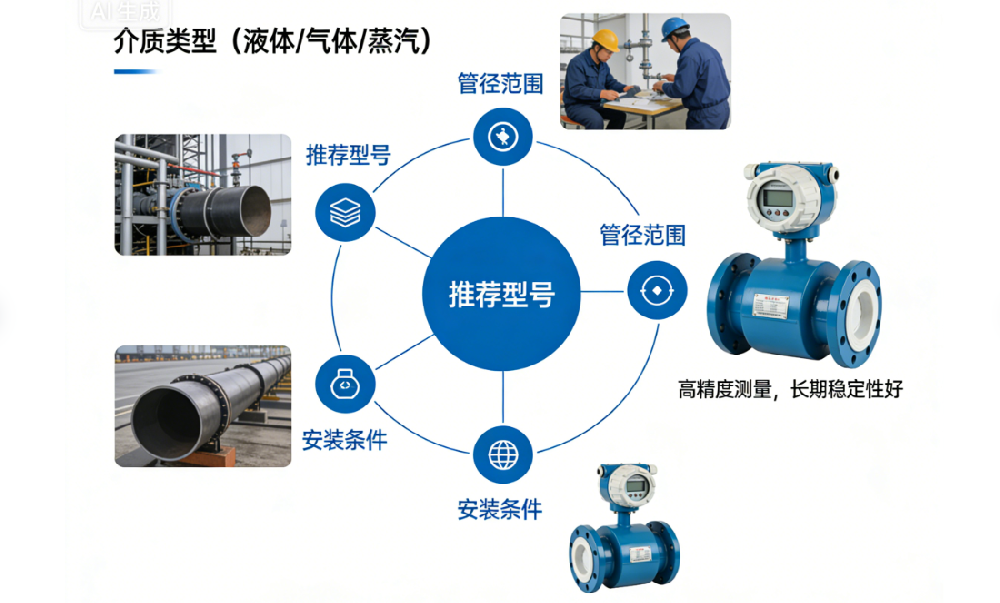
In core flow‑measurement applications such as industrial production, environmental protection, and municipal water services, the selection of a flow meter directly determines measurement accuracy, operational stability, and long‑term operating costs. In today’s market, electromagnetic flowmeters, ultrasonic flowmeters, vortex shedding flowmeters, and differential pressure flowmeters have become the four most widely used mainstream types, each distinguished by its unique technical characteristics. Different types of products vary significantly in their operating principles, core performance, procurement and operational costs, and applicable operating conditions, making it easy for companies to fall into the trap of a “mismatch between performance and cost” when selecting equipment. Starting from the fundamental nature of technology, this paper conducts a comprehensive, multi-dimensional comparison of the four major mainstream flow meters in terms of performance, cost, and applicable operating conditions. By analyzing real-world application cases, it elucidates the selection rationale, providing enterprises with a thorough reference for precise equipment selection.
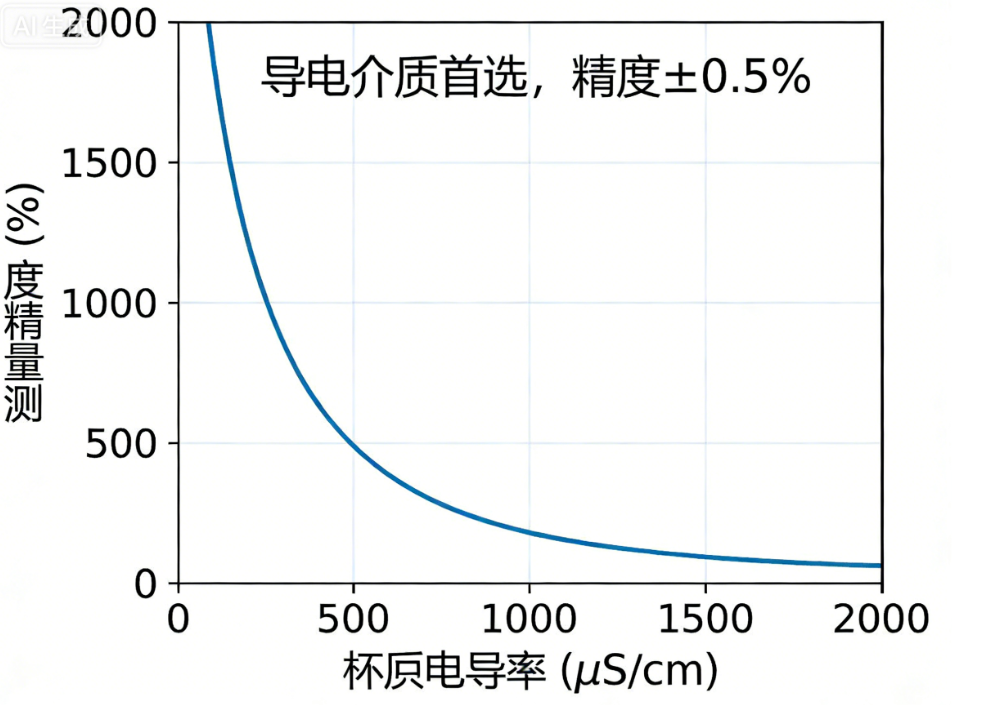
Core principle breakdown: the underlying technical logic of different types of flow meters. The performance differences among the four major types of flow meters stem from their design architectures, which are based on distinct physical principles; this, in turn, directly determines their respective application limits.
Electromagnetic flowmeters are based on Faraday’s law of electromagnetic induction. By establishing a uniform magnetic field within the measuring tube, when a conductive fluid cuts across the magnetic field lines, electrodes induce an electromotive force proportional to the flow velocity, thereby enabling the calculation of flow rate data. Its core advantage lies in the absence of mechanical moving parts within the measuring tube and its fully straight-through design, which inherently eliminates the risk of blockage. Ultrasonic flow meters are classified into Doppler and time-of-flight types, both of which rely on the propagation characteristics of ultrasonic waves to perform measurements. The Doppler type calculates flow velocity by detecting the frequency shift of ultrasonic reflections from suspended particles in the fluid, making it suitable for fluids containing suspended solids. The time-of-flight type determines flow velocity by measuring the time difference between the forward- and reverse-traveling ultrasonic pulses, and is better suited for clean fluids. Both methods employ non-contact measurement, eliminating the need to interrupt the pipeline.
Vortex flowmeters are based on the Karman vortex principle. A vortex shedder is installed in the fluid passage; as the fluid flows past it, alternating vortices are generated. The vortex shedding frequency is directly proportional to the flow velocity, and the flow rate can be determined by measuring this frequency. Differential-pressure flowmeters (represented by orifice plates and Venturi meters) are based on Bernoulli’s equation and calculate flow rate from the pressure difference across a throttling device. With a mature technical architecture, they were the mainstream choice for early industrial measurement, but they suffer from an inherent throttling‑element design.
Core Performance Dimension Comparison: A Comprehensive Head-to-Head of Accuracy, Stability, and Adaptability. Performance is the core value of a flowmeter; by evaluating four key dimensions—measurement accuracy, turndown ratio, anti-interference capability, and media compatibility—the relative strengths and weaknesses of the four major types can be clearly distinguished.
In terms of measurement accuracy, electromagnetic flowmeters perform best, with mainstream products achieving accuracies of ±0.2% to ±0.5% FS and high-end models even reaching ±0.1% FS, fully meeting the stringent requirements of environmental online monitoring and effluent accounting. Ultrasonic flowmeters rank second; both Doppler and time-difference types offer accuracies around ±1% FS, covering most industrial process metering applications. Vortex shedding flowmeters match ultrasonic flowmeters in accuracy, at approximately ±1% FS. Differential pressure flowmeters have relatively lower accuracy, typically ranging from ±1.5% FS to ±2.5% FS, making them suitable only for coarse‑grained metering where precision is not critical.
In terms of turndown ratio, electromagnetic flowmeters lead by a wide margin with a ratio of 1:100, easily accommodating applications involving large fluctuations in flow rate, such as the significant diurnal variations at the influent inlet of municipal wastewater treatment plants. Ultrasonic flowmeters offer a turndown ratio of approximately 1:50, sufficient for moderate flow‑rate variability. Vortex shedding flowmeters have a relatively narrower range, around 1:20; differential pressure flowmeters exhibit the smallest turndown ratio, only 1:10, making them suitable solely for steady‑state operating conditions.
Anti-interference and media adaptability are key to the stable operation of flowmeters under complex operating conditions. Electromagnetic flowmeters exhibit strong resistance to electromagnetic interference and are unaffected by changes in fluid density, viscosity, or temperature. They offer optimal compatibility with fluids containing suspended solids or corrosive media, making them suitable for complex applications such as chemical acid–alkali wastewater and mine tailings water. Ultrasonic flowmeters are susceptible to external disturbances; Doppler-type meters are sensitive to gas content in the fluid, while time-difference meters are significantly influenced by pipe material and internal wall scaling, resulting in relatively poor anti-interference performance. Vortex shedding flowmeters are highly sensitive to pipe vibration, and their vortex generators can easily become clogged by suspended particles, limiting their suitability to clean, low-viscosity fluids only. Differential-pressure flowmeters are prone to scaling and residue buildup at the throttling element, exhibiting the poorest compatibility with corrosive media and fluids containing high levels of suspended solids; moreover, pressure loss increases with rising fluid viscosity.
Cost Dimension Comparison: A Full Lifecycle Consideration of Procurement and Operations & Maintenance. When selecting equipment, companies must balance initial procurement costs with long-term operational and maintenance expenses; the cost structures of the four major mainstream flowmeter types differ significantly.
In terms of procurement cost, differential pressure flow meters are the most affordable due to their mature technology and simple design; a single unit typically costs between RMB 2,000 and 8,000, making them suitable for small enterprises with limited budgets. Turbulence (vortex) flow meters fall into the mid‑range category, priced at approximately RMB 5,000–15,000, offering good value for standard industrial process measurement applications. Ultrasonic flow meters have slightly higher procurement costs than vortex meters, ranging from about RMB 8,000 to 20,000; among these, Doppler ultrasonic types are somewhat more expensive than time‑difference types because of their higher transducer requirements. Electromagnetic flow meters are the most costly, with standard models priced around RMB 10,000–30,000. When used with corrosive media and requiring special materials such as Hastelloy or titanium alloys, prices can rise to RMB 30,000–80,000. Nevertheless, their superior performance ensures cost‑effectiveness in demanding applications.
In terms of operating and maintenance costs, the differences are even more pronounced. Ultrasonic flow meters, being non‑contact devices with no moving parts and no risk of wear or corrosion, have the lowest operating and maintenance costs—requiring only quarterly probe cleaning, at an annual O&M cost of approximately RMB 1,000–3,000. Electromagnetic flow meters, though contact-type, have no mechanical moving parts and thus incur relatively low O&M expenses, mainly consisting of annual electrode descaling and accuracy calibration, resulting in an annual O&M cost of about RMB 2,000–5,000; special‑material models have slightly higher O&M costs due to expensive spare parts. Vortex shedding flow meters require periodic inspection of the vortex generator for wear and blockage, with replacement of the generator as needed, leading to annual O&M costs of roughly RMB 5,000–8,000. Differential pressure flow meters have the highest O&M costs: they not only demand frequent cleaning of throttling elements to remove scale and deposits but also entail increased system energy consumption due to elevated pressure losses, with annual O&M costs reaching RMB 8,000–15,000 and a comparatively shorter service life.
Precise matching to operating conditions: implementing selection logic tailored to specific scenarios. Based on differences in overall performance and cost, the four major mainstream flow meters have clearly defined application boundaries and should be precisely matched to specific scenarios.
For high‑requirement compliance monitoring applications (e.g., influent and effluent at municipal wastewater treatment plants, discharge points of chemical enterprises), electromagnetic flowmeters should be given priority. These scenarios demand extremely high accuracy and stability, and the fluids often contain suspended solids or are highly corrosive. The electromagnetic flowmeter’s high accuracy, wide turndown ratio, and robust adaptability can meet compliance requirements. After a large municipal wastewater treatment plant adopted high-precision electromagnetic flow meters, the accuracy of its flow data has remained stable within ±0.3% of full scale, enabling seamless integration with environmental monitoring platforms and successful completion of discharge accounting audits. Although the initial procurement cost was higher, the long-term operational stability has mitigated compliance risks, resulting in a more favorable total lifecycle cost.
For pipeline retrofitting or temporary monitoring applications (such as upgrading wastewater metering in aging industrial plants or monitoring temporary construction projects), ultrasonic flow meters are the preferred choice. Its non-contact installation requires no pipe disruption, features a short installation timeframe—typically completed in 1–2 days—and offers low O&M costs, making it well-suited for temporary or remote monitoring sites. In a pipeline renovation project at a textile printing and dyeing enterprise, Doppler ultrasonic flow meters were selected. Installation and commissioning were completed without dismantling the pipes, and the annual operation and maintenance cost was only RMB 2,000, efficiently meeting the six-month temporary flow monitoring requirement.
Conventional industrial process cycle scenarios (such as cooling circulating water, low viscosity chemical raw material transport): optional vortex flowmeter. This kind of scene fluid clean, stable flow, moderate accuracy requirements, vortex flowmeter medium precision, moderate purchase cost can achieve cost-effective balance. Attention should be paid to the installation of far away from the vibration source, if necessary, supporting vibration suppression device, a mechanical processing plant cooling circulating water metering selection of vortex flowmeter, stable operation, annual operation and maintenance costs controlled within 6000 yuan.
Low-cost extensive metering scenarios (such as light wastewater discharge from small enterprises and agricultural irrigation sewage metering): differential pressure flow meters can be used. Such scenarios have low accuracy requirements and limited budgets, and the low cost advantages of differential pressure flowmeters are significant, but they need to accept higher operation and maintenance costs and shorter service life. A small hardware processing plant uses orifice flowmeter to measure mild wastewater discharge, the initial purchase cost is only 3000 yuan, which can meet the basic measurement needs.
Conclusion: the selection of mainstream flowmeter is not a single choice of "pursuing high performance" or "pursuing low cost", but a balance between performance and cost based on the needs of the scene. Electromagnetic flowmeter is the optimal solution for complex scenes with high requirements. Ultrasonic flowmeter is adapted for convenient installation and temporary monitoring. Vortex flowmeter is cost-effective for conventional process metering. Differential pressure flowmeter is only suitable for low-cost extensive scenes. When selecting models, enterprises need to comprehensively sort out the media characteristics, measurement accuracy requirements, flow fluctuation range, installation conditions and cost budget, and then match the core advantages of various types of flowmeters to achieve the dual goals of accurate measurement and cost optimization. In the future, with the iteration of intelligent technology, all kinds of flow meters will continue to improve in accuracy, anti-interference ability and intelligent level, providing more reliable measurement solutions for more complex scenarios.
Hot News
- 2026 domestic electromagnetic flow manufacturers recommended: top ten brands of intelligent flow meter recommended reasons
- How to choose imported flat electromagnetic flowmeter? How to choose micro-caliber, conventional flange and plug-in electromagnetic? Recommended by domestic high-quality manufacturers
- Four major brands of electromagnetic flowmeter hard core PK: Herbalife Water, Cloud Meter, E H, Cologne, who is more worthy of choice?
- November 2026 Top Ten Brands of Electromagnetic Flowmeter at Home and Abroad Ranking
- Recommended Top Ten Brands of Electromagnetic Flowmeter in 2026: Reference for Project Selection of Water Treatment, Sewage and Conductive Liquid
- TOP5 Manufacturer's Selection Guide for Food Sanitary Electromagnetic Flowmeter: Material and Connection Mode Check before Purchase
- Cost-effective chemical oxygen demand water quality online monitor manufacturers contact information
- How to choose the integrated electromagnetic water meter? Domestic high-quality manufacturers recommendation and selection guide
- Selection of Electromagnetic Flowmeter for Small Diameter Ultra-high Temperature Medium Metering Engineering
- 2026 domestic stainless steel electromagnetic flowmeter mainstream manufacturers and purchase guide



