




Comparison of various types of sewage flow meters
2025-12-22 09:56:19
In areas such as environmental protection, industrial wastewater treatment, and municipal water supply and drainage, accurate measurement of sewage flow is a core prerequisite for calculating pollutant emission reductions, optimizing treatment processes, and controlling costs. Wastewater has a complex composition and typically exhibits highly corrosive properties, high suspended solids content, and significant viscosity fluctuations, imposing stringent requirements on flowmeter adaptability, stability, and accuracy. At present, the mainstream types of sewage flow meters on the market include electromagnetic flow meters, ultrasonic flow meters, vortex flow meters, differential pressure flow meters, etc. Different types of products have significant differences in working principles, technical characteristics, and applicable scenarios. As a professional analysis of senior copywriting perspective, this paper will make a comprehensive comparison of mainstream sewage flowmeters from the dimensions of core principles, key performance parameters, applicable conditions, advantages and limitations, and provide accurate reference for industry selection.
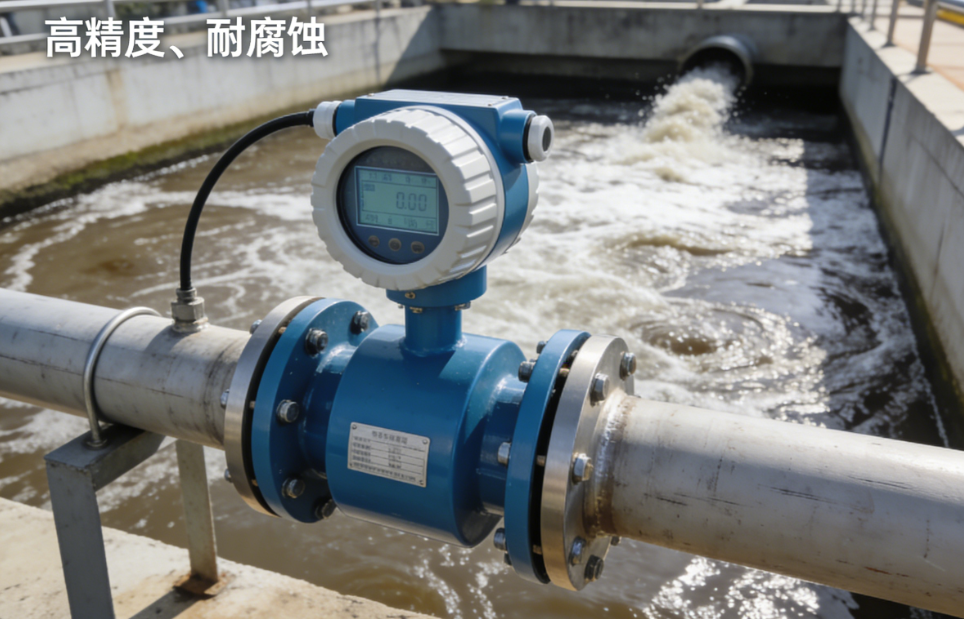
Core principles and technical characteristics: the essential differences between different types of flow meters. The core difference between various types of sewage flow meters comes from their measurement principles, which directly determines their technical characteristics and scope of application, and is the basis for selection.
The electromagnetic flowmeter works based on Faraday's law of electromagnetic induction. By establishing a uniform magnetic field in the measuring tube, when the conductive sewage medium cuts the magnetic induction line, an induced electromotive force will be generated at both ends of the electrode. The electromotive force is proportional to the flow rate of the medium, and then the flow data is calculated. Its core advantage is that there are no mechanical moving parts in the measuring tube, and it adopts a full-pass structure, which is not easy to be blocked, and it is suitable for sewage media containing suspended solids and impurities. The measurement accuracy of mainstream electromagnetic flowmeter can reach ± 0.5 FS, and some high-precision products can reach ± 0.2 FS, with a range ratio as wide as 1:100, which can meet the wide-range measurement requirements from low flow rate to high flow rate, and is not affected by changes in medium density, viscosity, temperature and other parameters.

Ultrasonic flowmeters are classified into Doppler-type and time-difference-type; both rely on the propagation characteristics of ultrasonic waves in a medium to measure flow. The Doppler type calculates the flow velocity by measuring the reflection frequency offset of ultrasonic waves on suspended solids and bubbles in sewage, which is suitable for sewage containing more suspended particles. The time difference type calculates the flow velocity by measuring the time difference between ultrasonic waves propagating in the downstream and countercurrent directions, which is more suitable for cleaner sewage. The ultrasonic flowmeter adopts non-contact measurement, does not need to damage the pipeline, is convenient to install, and will not directly contact with sewage, avoiding corrosion and blockage problems. The measurement accuracy is usually about ± 1% FS, and the range ratio is about 1:50, which is greatly affected by the medium temperature, bubble content, pipe material and other factors.
Vortex flowmeter is based on Karman's vortex principle. By setting a vortex generator in the fluid, when the sewage flows through the generator, alternately arranged vortices will be generated. The falling frequency of the vortex is proportional to the flow rate of the medium. The flow can be calculated by detecting the vortex frequency. Its structure is relatively simple, the stability is strong, the measurement accuracy is generally ± 1% FS, the range ratio is about 1:20, suitable for medium and high flow rate, high cleanliness of the sewage medium. However, due to the existence of vortex generating body, it is easy to block and wear in the sewage containing a large amount of suspended solids and high viscosity, which affects the measurement accuracy and equipment life.
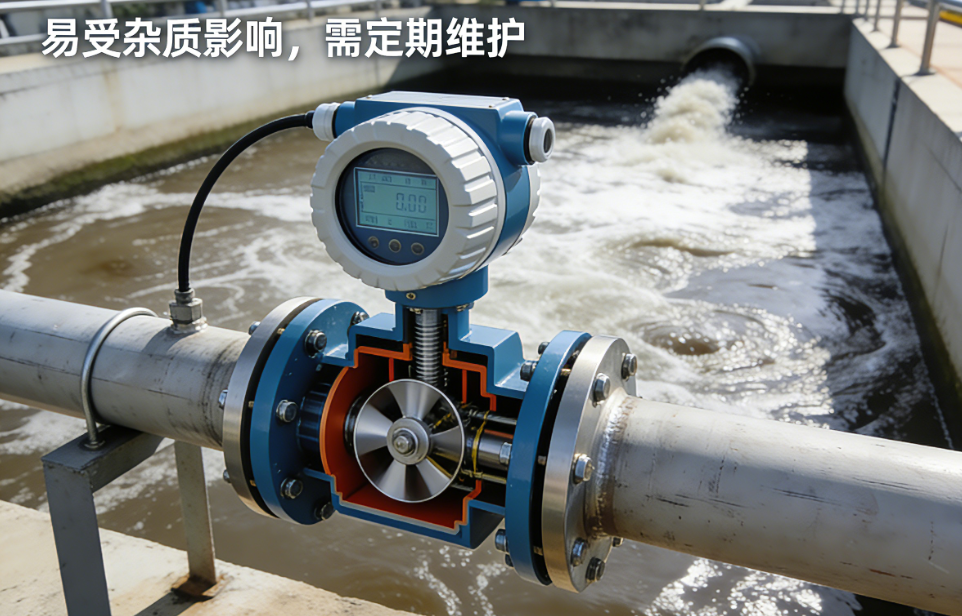
Differential pressure flow meters (e. g. orifice flow meters, Venturi flow meters) are based on the Bernoulli equation and calculate the flow rate by measuring the pressure difference generated when the fluid flows through the throttling device. Its technology is mature, widely used, the manufacturing cost is low, the measurement accuracy is about ± 1.5%FS, the range ratio is about 1:10. However, the throttling device will produce a large pressure loss, increase system energy consumption, and in the sewage medium is prone to throttling port blockage, scaling, need regular maintenance and cleaning, not suitable for high concentration of suspended solids and viscous sewage.
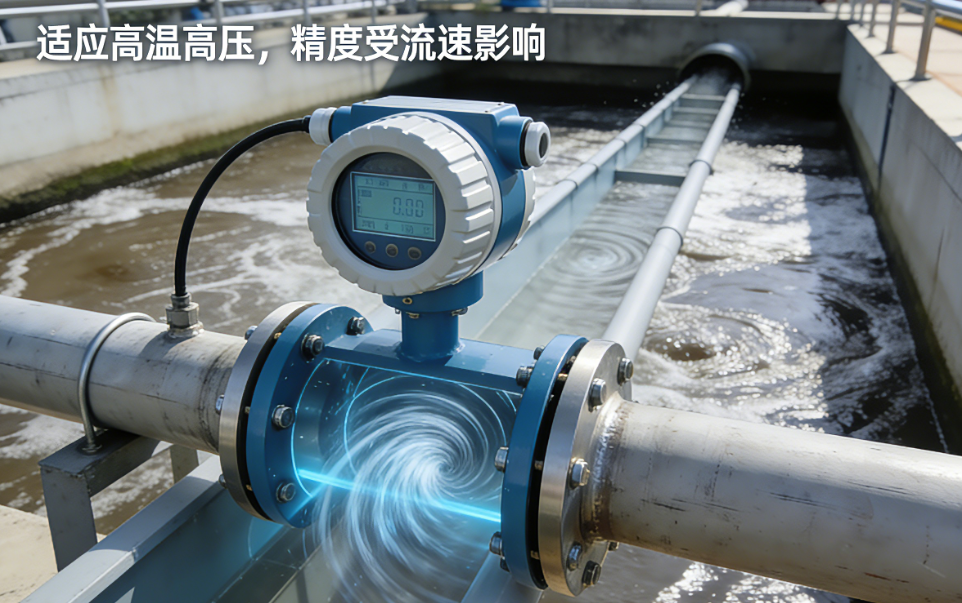
Comparison of key performance parameters: the core basis for accurate selection. Beyond the core principles, key performance parameters such as measurement accuracy, turndown ratio, anti-interference capability, and maintenance costs directly determine the effectiveness of a flowmeter in real-world wastewater metering applications. The following provides a quantitative comparison of various flow meters across core performance dimensions:
In terms of measurement accuracy, electromagnetic flowmeter has the best performance, and the accuracy of 0.2-0.5 FS can meet the high-precision measurement requirements such as environmental protection monitoring and sewage charges. Ultrasonic flowmeter is second, and the accuracy of 1% FS is suitable for general industrial wastewater measurement. The accuracy of vortex flowmeter is close to that of ultrasonic flowmeter, while the accuracy of differential pressure flowmeter is relatively low, which is more suitable for extensive metering scenarios with low accuracy requirements.
In terms of range ratio, electromagnetic flowmeter is far ahead with a wide range ratio of 1:100, and can adapt to working conditions with large fluctuations in sewage flow, such as water inlet and outlet flow measurement of municipal sewage plants. The range ratio of ultrasonic flowmeter is 1:50, which can meet most medium flow fluctuation scenarios. The range ratio of vortex flowmeter and differential pressure flowmeter is relatively narrow, 1:20 and 1:10 respectively, more suitable for stable flow conditions.
In terms of anti-interference and adaptability, electromagnetic flowmeter has strong anti-electromagnetic interference ability, is not affected by changes in medium density and viscosity, and has the best adaptability to suspended solids and corrosive sewage. Ultrasonic flowmeter is greatly affected by medium bubble content, pipeline material and external electromagnetic interference, and its measurement accuracy will be significantly reduced when the sewage gas content is large or the inner wall of the pipeline is scaled. Vortex flowmeter is susceptible to vibration interference and is sensitive to suspended solids and viscosity in sewage, the adaptability is weak; the differential pressure flowmeter is affected by the medium viscosity and temperature change, and is easy to block, and the adaptability is the worst.
In terms of maintenance cost, ultrasonic flowmeter has non-contact measurement, no component wear and corrosion, and the maintenance cost is the lowest. Only the sensor probe needs to be cleaned regularly. Although electromagnetic flowmeter is contact measurement, it has no mechanical moving parts and low maintenance cost. It is mainly necessary to check the electrode scaling and clean it regularly. The vortex generator of vortex flowmeter is easy to wear and block, and needs to be replaced and cleaned regularly. The maintenance cost is medium; the throttling device of the differential pressure flowmeter is easy to scale and block, and the pressure loss leads to the increase of energy consumption, and the maintenance cost and operation cost are high.
The applicable conditions are compared with the actual application scenarios. Combined with the above performance differences, all kinds of sewage flow meters have clear adaptation boundaries in practical application scenarios, and accurate matching of operating conditions is the key to ensure the measurement effect.
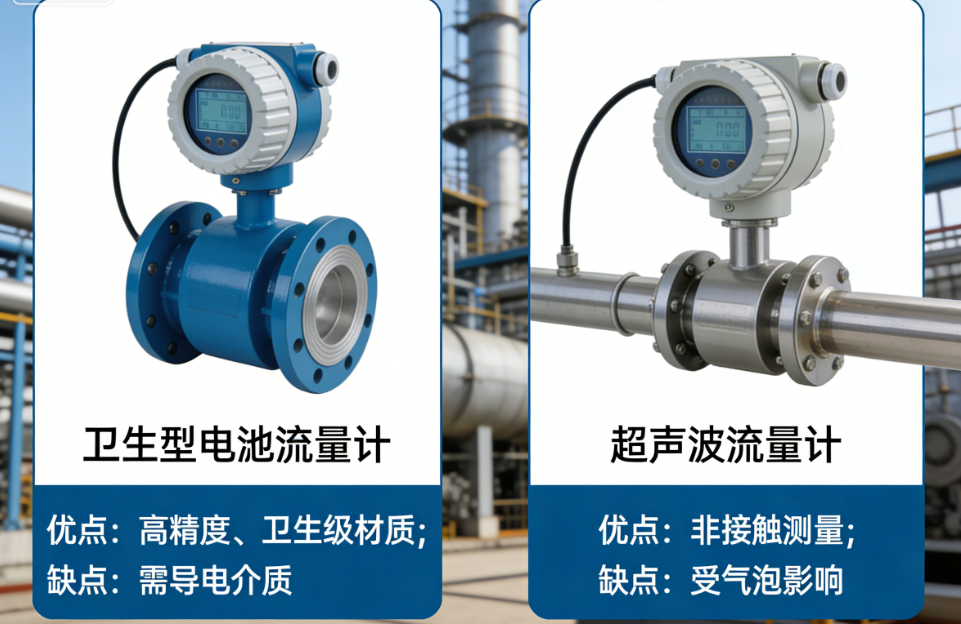
Electromagnetic flowmeter is an "all-round player" in the field of sewage metering. It is especially suitable for sewage media containing a large amount of suspended solids, strong corrosiveness and large flow fluctuations, such as the measurement of inlet and outlet water in municipal sewage plants, the measurement of industrial wastewater in chemical, printing and dyeing, papermaking and other industries, and the measurement of slag-containing sewage in mining and metallurgical industries. In the field of environmental monitoring, electromagnetic flowmeters are frequently used for online flow measurement at effluent discharge points due to their high accuracy and stability. The data can be directly integrated with environmental regulatory platforms, meeting compliance requirements for effluent charging and emission reduction accounting. In addition, hygienic electromagnetic flowmeters can also be adapted for applications such as medical wastewater treatment, where hygiene requirements are critical.
Ultrasonic flowmeter is suitable for scenes where the pipeline is not easy to disassemble and the sewage contains a small amount of suspended solids but no large amount of bubbles, such as the transformation and upgrading of existing pipelines, temporary flow monitoring, raw water metering of waterworks, and metering of some industrial lightly polluted wastewater. Doppler ultrasonic flowmeter can be adapted to sewage containing more suspended particles, such as mineral processing wastewater, construction mud water, etc.; time difference ultrasonic flowmeter is more suitable for cleaner sewage, such as mild wastewater in the food processing industry. However, it is not recommended to be used in scenarios with large gas content in sewage, serious scaling on the inner wall of the pipeline, or strong external electromagnetic interference.
Vortex flowmeter is suitable for the measurement of sewage with high flow rate and high cleanliness, such as low viscosity wastewater and cooling circulating water in some chemical industries. Because it is sensitive to vibration and suspended solids, it is not suitable for scenarios where pipeline vibration is severe, sewage contains a lot of impurities or high viscosity, such as municipal sewage, mine wastewater, etc. In practical applications, vortex flowmeters often need to be equipped with vibration suppression devices, and the wear of vortex generation bodies needs to be checked regularly.
Due to its mature technology and low cost, the differential pressure flowmeter is suitable for scenarios with low accuracy requirements, high sewage cleanliness and stable flow, such as light wastewater measurement for small industrial enterprises and agricultural irrigation sewage measurement. In the high concentration of suspended solids sewage, corrosive sewage or flow fluctuations in the scene, the differential pressure flowmeter is prone to blockage, corrosion and measurement deviation, not recommended. At present, the application proportion of differential pressure flowmeter in the field of sewage metering is gradually decreasing, and it is more replaced by electromagnetic flowmeter and ultrasonic flowmeter.
Selection recommendations and industry application trends. Combining the performance differences and applicable scenarios of various types of sewage flowmeters, the selection should focus on the core factors such as sewage medium characteristics (suspended solids content, corrosivity, viscosity), flow fluctuation range, measurement accuracy requirements, installation conditions and maintenance costs. For most sewage metering scenarios, electromagnetic flowmeter is preferred, especially in compliance monitoring scenarios with high precision and high stability requirements, electromagnetic flowmeter is the best choice. Ultrasonic flowmeter can be selected for pipeline renovation, temporary monitoring or low maintenance requirements. Vortex flowmeter can be considered for low-viscosity sewage with high cleanliness and stable flow. Differential pressure flowmeter is only suitable for simple scenarios with low cost and low precision requirements.
From the perspective of industry development trends, sewage flowmeters are developing in the direction of high precision, intelligence and low maintenance. Electromagnetic flowmeter continuously improves its anti-corrosion and anti-scaling capabilities by optimizing signal processing technology and electrode materials. Ultrasonic flowmeter introduces AI algorithm to enhance its adaptability and anti-interference ability to complex media. At the same time, all kinds of flowmeters are strengthening the data networking function to realize remote monitoring, fault early warning and data traceability, and adapt to the development needs of intelligent environmental protection and intelligent water affairs.
Conclusion: Different types of sewage flow meters have their own advantages and disadvantages, there is no absolute "optimal solution", only the most suitable "targeted selection". Enterprises in the selection, need to abandon the "one-size-fits-all" thinking, combined with their own sewage medium characteristics, production process requirements and cost budget, a comprehensive consideration of the performance parameters of various types of flowmeter and applicable scenarios. In the future, with the continuous improvement of environmental protection requirements and the continuous iteration of intelligent technology, the accuracy, adaptability and intelligent level of sewage flow meters will be further improved, providing more reliable technical support for sewage treatment and environmental protection supervision, and helping green development The implementation of the concept.
Hot News
- Buy flowmeter, first look at the site conditions! 2026 Depth Comparison of Domestic and Imported Brands of Electromagnetic Flowmeter Manufacturers
- 2026 domestic electromagnetic flow manufacturers recommended: top ten brands of intelligent flow meter recommended reasons
- How to choose imported flat electromagnetic flowmeter? How to choose micro-caliber, conventional flange and plug-in electromagnetic? Recommended by domestic high-quality manufacturers
- Four major brands of electromagnetic flowmeter hard core PK: Herbalife Water, Cloud Meter, E H, Cologne, who is more worthy of choice?
- November 2026 Top Ten Brands of Electromagnetic Flowmeter at Home and Abroad Ranking
- Recommended Top Ten Brands of Electromagnetic Flowmeter in 2026: Reference for Project Selection of Water Treatment, Sewage and Conductive Liquid
- TOP5 Manufacturer's Selection Guide for Food Sanitary Electromagnetic Flowmeter: Material and Connection Mode Check before Purchase
- Cost-effective chemical oxygen demand water quality online monitor manufacturers contact information
- How to choose the integrated electromagnetic water meter? Domestic high-quality manufacturers recommendation and selection guide
- Selection of Electromagnetic Flowmeter for Small Diameter Ultra-high Temperature Medium Metering Engineering



