




What industries are important for the precise measurement of sanitary electromagnetic flowmeters?
2025-12-22 09:39:44
In the core links of industrial production and public livelihood security, the accuracy of liquid measurement not only affects production cost control but also directly determines product quality and safety as well as industry compliance. Hygienic electromagnetic flowmeters, with their core advantages of zero dead volume, resistance to contamination, precise measurement, and compliance with stringent hygienic standards, have become the standard measuring equipment in numerous industries that demand both high media cleanliness and exact metering accuracy. From raw material formulation in food processing to formulation control in pharmaceutical production, and from strain cultivation in biochemical engineering to quality assurance in the dairy industry, its precise metering capabilities lay a solid foundation for high-quality development across industries. This paper will conduct an in-depth analysis of the core significance of precise measurement by hygienic electromagnetic flowmeters for key industries, clarifying their value proposition throughout the entire industrial production process.
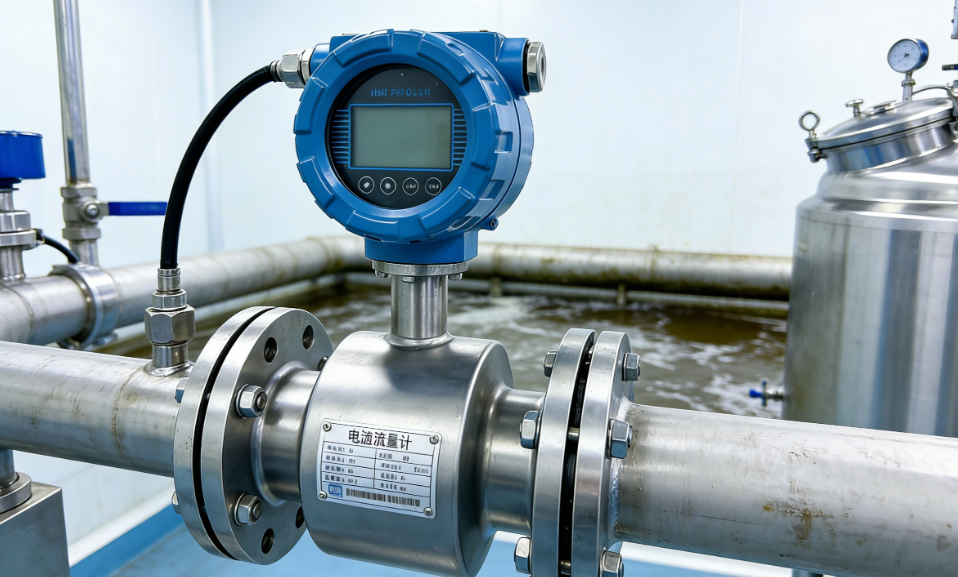
Food processing industry: the core safeguard ensuring consistent quality and consumer safety. The food processing industry encompasses multiple sub-sectors, including grain and oil processing, meat product processing, seasoning production, and convenience food manufacturing. Its production processes involve the transfer and metering of large volumes of liquid media, such as edible oil, soy sauce, vinegar, sauces, fruit juice, and sugar syrup. These media not only directly affect the taste and quality of food but are also closely linked to consumer food safety, with precise measurement serving as a critical step in ensuring both of these core requirements.
In the raw material formulation stage of food processing, precise liquid metering is essential to ensuring consistent product quality. Taking soy sauce production as an example, the steaming and cooking of raw materials such as soybeans and wheat require precise control of water addition, while fermentation necessitates the accurate dosing of auxiliary ingredients like brine and microbial inocula. Measurement errors in liquid volumes at any stage can disrupt the fermentation environment, thereby affecting the soy sauce’s flavor, color, and salt content. The hygienic electromagnetic flowmeter’s precise metering capability can keep measurement errors for liquid media within ±0.5% of full scale, ensuring consistent raw-material ratios across batches and preventing product-quality fluctuations caused by formulation deviations. Additionally, the device features a dead-volume-free, straight-through design, and its 316L stainless steel construction complies with FDA hygiene standards. This effectively prevents media residue and contamination, eliminates the growth of unwanted microorganisms, and safeguards food hygiene and safety at the metering stage.
In the food packaging process, precise measurement directly affects consumer rights and the reputation of corporate brands. According to relevant food packaging standards, the net content of prepackaged foods must comply with the requirement that negative deviations do not exceed the permissible limit. If the measurement deviation of liquid foods is excessive, it may not only result in penalties from regulatory authorities but also undermine consumer trust in the brand. Hygienic electromagnetic flowmeters provide real-time, accurate liquid flow data and integrate with packaging equipment to enable coordinated control, ensuring that the net content of every product meets specifications. This helps companies mitigate compliance risks and protect their brand image. Furthermore, for food companies engaged in large-scale production, precise measurement can effectively control raw material waste and reduce production costs. According to industry data, adopting precision metering equipment can reduce raw material loss rates in food processing companies by 3%–5%. For enterprises with annual production capacities on the order of ten million tons, this reduction in losses yields particularly significant economic benefits.
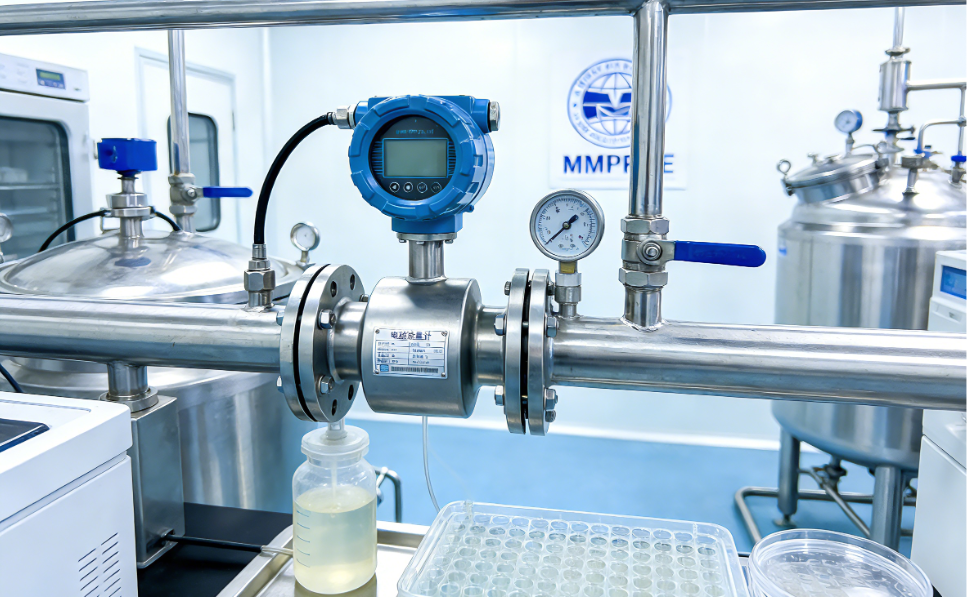
Pharmaceutical Industry: A rigid demand to ensure drug efficacy and medication safety. The pharmaceutical industry is one of the sectors with the most stringent requirements for hygiene standards and measurement accuracy. Its production processes involve multiple critical steps, including active pharmaceutical ingredient (API) synthesis, formulation preparation, and injection filling, with liquid media encompassing API solutions, saline, glucose solutions, and various formulations. The measurement accuracy of these media directly affects the concentration and efficacy of pharmaceuticals, and can even impact patient safety; therefore, the precise metering capability of hygienic electromagnetic flowmeters has become a critical requirement in the pharmaceutical industry.
In the API synthesis stage, precise liquid metering is essential to ensure that chemical reactions proceed fully and consistently. The synthesis of active pharmaceutical ingredients often involves multiple complex chemical reactions, each requiring precise control of parameters such as the stoichiometric ratios of reactants and the rate of addition. For example, during the synthesis of antibiotic APIs, precise metering and addition of liquid media such as microbial seed suspensions, culture media, and catalysts are required. Excessive metering errors can lead to incomplete reactions, substandard product purity, or even the formation of harmful impurities. Sanitary electromagnetic flowmeters employ high-precision signal processing and adaptive flow algorithms, enabling accurate measurement under challenging conditions such as low flow rates and high viscosity. Their corrosion-resistant materials are compatible with a wide range of chemical media, preventing contamination and measurement errors caused by equipment corrosion and ensuring the quality of active pharmaceutical ingredient synthesis.
In the compounding and filling stages, accurate metering directly determines the efficacy and safety of the pharmaceutical product. For liquid pharmaceuticals such as injectables and oral solutions, the active ingredient content of each vial or bottle must precisely meet the product specifications; excessive deviation may result in insufficient efficacy or overdose, posing health risks to patients. Hygienic electromagnetic flowmeters comply with GMP pharmaceutical manufacturing standards; their dead‑space‑free design prevents product residue and cross‑contamination, while precise measurement data is fed back to the filling equipment in real time, enabling automated, precision control of the filling process. Meanwhile, the equipment’s self-diagnostic function monitors operating conditions in real time, promptly detects metering anomalies and triggers alarms, effectively preventing the production of substandard chemicals. Furthermore, the pharmaceutical industry has extremely stringent requirements for traceability in its production processes. Sanitary electromagnetic flowmeters can record and store measurement data in real time, providing reliable data support for tracing production workflows and helping companies meet regulatory compliance inspection requirements.
Biochemical industry: Supporting precise control in strain cultivation and product extraction. The biochemical industry uses biological organisms and tissues as raw materials to produce bioproducts, biopesticides, biofeeds, and other products. Its production processes involve key steps such as strain cultivation, fermentation, and product extraction. Liquid media include culture media, seed suspensions, fermentation broths, and extraction solvents. These stages impose extremely stringent requirements on the accuracy and hygiene of liquid metering; precise measurement directly affects microbial growth, fermentation efficiency, and product purity, serving as a critical enabler for high-quality development in the biochemical industry.
In the strain cultivation stage, the formulation of the culture medium and its precise dispensing are critical to ensuring strain viability. The growth of microbial strains requires specific nutrients, such as sugars, proteins, and vitamins, which must be precisely formulated in a liquid medium before being introduced into the fermentation tank. If the measurement deviation of the culture medium is excessive, it may lead to an imbalance in nutrient composition, affecting the strain’s growth rate, viability, and reproductive capacity, thereby reducing the efficiency of subsequent fermentation steps. Hygienic electromagnetic flowmeters enable precise control of the volume and rate of medium addition, while their hygienic-grade materials prevent medium contamination, providing a stable, clean growth environment for strain cultivation.
In the fermentation and product extraction stages, precise liquid metering can effectively enhance fermentation efficiency and product purity. During fermentation, it is necessary to precisely control the flow rates of gases such as oxygen and nitrogen (some of which are delivered via liquid carriers) and the amounts of acid–base regulators added, in order to maintain stable pH, temperature, and other environmental parameters. The precise measurement capability of sanitary electromagnetic flowmeters ensures accurate control of these parameters, enhances fermentation efficiency, and increases product yield. During product extraction, it is essential to accurately dispense the extraction solvent and control both the extraction time and solvent volume. Excessive deviation in solvent dosing can result in incomplete product recovery or, if the solvent is used in excess, increase the difficulty and cost of subsequent separation and purification. Hygienic electromagnetic flowmeters enable precise control of extraction solvent volume, helping companies improve product extraction efficiency and purity while reducing production costs.
Dairy and beverage industry: a critical enabler that balances quality consistency with production efficiency. In the production processes of the dairy industry (milk, yogurt, powdered milk, etc.) and the beverage industry (carbonated drinks, fruit juices, tea beverages, etc.), the conveyance and metering of liquid media—such as raw milk, water, syrups, fruit juices, and additives—are integral throughout. Products in these industries cater to a broad consumer base and demand exceptionally high standards of quality stability and hygienic safety, while also requiring the efficiency of large-scale production. Consequently, the precise metering capability of hygienic electromagnetic flowmeters has become a critical enabler for balancing quality and efficiency.
In the dairy production process, the measurement and blending of raw milk are central to ensuring product quality. The sterilization, homogenization, fermentation, and other processes in milk production require precise control of the amount of raw milk used, as well as the addition levels of ingredients such as sugar, stabilizers, and fermenting agents. For example, in yogurt production, the amount of starter culture added directly affects the product’s acidity, texture, and shelf life. If the dosing deviation is too large, it may result in over- or under-fermentation, compromising product quality. The hygienic electromagnetic flowmeter’s dead‑space‑free design prevents bacterial growth caused by raw milk residue, while its precise metering ensures accurate addition ratios of auxiliary ingredients. Additionally, its rapid response capability accommodates the pace of large‑scale continuous production, enhancing overall efficiency.
In beverage production, precise liquid metering is essential to ensuring consistent product taste and regulatory compliance. Take carbonated beverage production as an example: it requires precise control of the ratios of water, syrup, and carbon dioxide. If too much syrup is metered, the drink will be overly sweet; if insufficient carbon dioxide is added, the beverage’s effervescence and mouthfeel will suffer. Hygienic electromagnetic flowmeters can precisely control the flow rates of various liquid ingredients and interface with mixing equipment on the production line to ensure consistent formulation across every batch of beverage. Meanwhile, the equipment meets food hygiene standards, helping to prevent beverage contamination and ensuring consumer safety. For beverages such as fruit juices that are based on natural ingredients, precise metering can also effectively control the amount of juice used, reduce raw material waste, and improve the company’s economic performance.
Conclusion: From food processing to pharmaceutical manufacturing, and from biochemical engineering to dairy and beverage production, the precise metering capabilities of hygienic electromagnetic flowmeters have been deeply integrated into the core production processes of numerous critical industries, serving as a vital support for ensuring product quality, safeguarding consumer safety, controlling production costs, and meeting regulatory requirements. As industries increasingly demand high-quality development, the requirements for measurement accuracy and hygiene standards will continue to rise. This requires manufacturers to continuously optimize the technology and manufacturing processes of hygienic electromagnetic flowmeters, enhancing the equipment’s accuracy, stability, and level of intelligence to better meet the evolving needs of various industries. In the future, hygienic electromagnetic flowmeters will play an important role in more specialized industries, enabling standardized, high-quality development across sectors and driving related industries toward greater efficiency, safety, and sustainability.
Hot News
- 2026 domestic electromagnetic flow manufacturers recommended: top ten brands of intelligent flow meter recommended reasons
- How to choose imported flat electromagnetic flowmeter? How to choose micro-caliber, conventional flange and plug-in electromagnetic? Recommended by domestic high-quality manufacturers
- Four major brands of electromagnetic flowmeter hard core PK: Herbalife Water, Cloud Meter, E H, Cologne, who is more worthy of choice?
- November 2026 Top Ten Brands of Electromagnetic Flowmeter at Home and Abroad Ranking
- Recommended Top Ten Brands of Electromagnetic Flowmeter in 2026: Reference for Project Selection of Water Treatment, Sewage and Conductive Liquid
- TOP5 Manufacturer's Selection Guide for Food Sanitary Electromagnetic Flowmeter: Material and Connection Mode Check before Purchase
- Cost-effective chemical oxygen demand water quality online monitor manufacturers contact information
- How to choose the integrated electromagnetic water meter? Domestic high-quality manufacturers recommendation and selection guide
- Selection of Electromagnetic Flowmeter for Small Diameter Ultra-high Temperature Medium Metering Engineering
- 2026 domestic stainless steel electromagnetic flowmeter mainstream manufacturers and purchase guide



