




Market Prospect and Investment Value Analysis of Water Quality Analyzer
2025-12-26 11:19:03
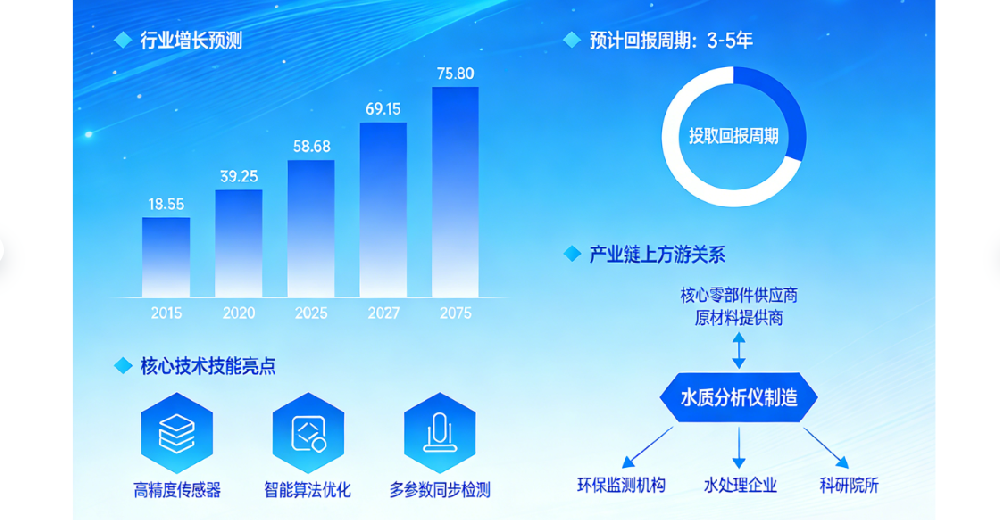
1 Market Size and Growth Forecast
The water quality analyzer market is experiencing a period of rapid growth. This growth is mainly driven by multiple factors such as stricter environmental protection policies, increased demand for water quality monitoring, and technological advances. According to market research data, the global water quality analyzer market size is expected to increase from 2025 year's XXbillion dollars to grow 2030 year's XXbillion dollars, with a compound annual growth rate XX%. China, as one of the world's largest markets for water quality analyzers, is expected to account for a global market share XX%That is all.
In the Chinese market, the application field of water quality analyzer continues to expand, from the traditional municipal water supply, sewage treatment to industrial process control, environmental monitoring, aquaculture and other fields. Especially in "14th Five-Year Plan" Planning and "double carbon" Driven by the goal, the environmental protection industry has ushered in new development opportunities. The proportion of demand in the field of environmental monitoring is expected to reach 18.7%It mainly benefits from the comprehensive management of watersheds, ecological compensation mechanism and the construction of intelligent environmental protection system.。
In terms of market segments, online water quality analyzers account for the largest market share, approximatelyXX%This is mainly due to the promotion of industrial automation and smart water construction. The fastest growing portable water quality analyzer market, annual growth rate reached XX%, mainly benefiting from the increased demand for on-site rapid testing. The laboratory water quality analyzer market is relatively stable, accounting for about market share. XX%。
In terms of technology type, the market share of multi-parameter water quality analyzers is increasing and is expected to increase from 2025 year's XX%Growth 2030 year's XX%. This trend reflects the growing demand for integrated and intelligent products. The market share of single parameter analyzers is declining, but it still has its unique value in specific application scenarios.
From the perspective of regional markets, economically developed regions such as East China and South China are the main consumer markets for water quality analyzers, which together account for the national market share.XX%That is all. With the economic development and the improvement of environmental protection requirements in the central and western regions, the market demand in these regions is growing rapidly, and the annual growth rate is expected to exceed the national average.
2 Competitive landscape and major vendor analysis
The competitive landscape of the water quality analyzer market is characterized by the coexistence of internationalization and localization. In the international market, the main competitors include hash (HACH)、E H、WTW, Syme Fisher, Shimadzu, etc. These international giants occupy a major share of the high-end market by virtue of their technological advantages, brand influence and global sales network.
As a global leader in water quality analysis, Hash's products cover a full range of products from laboratory to online monitoring. In the Chinese market, hashMS6100Multi-parameter water quality analyzer has been widely used in the field of municipal water supply, especially in the water supply network monitoring projects in Nanchang and other cities in Jiangxi Province. Hash's competitive advantage is mainly reflected in the ability of technological innovation, complete product series, perfect service network and so on.
E H The company has strong technical strength in the field of industrial process measurement, and its water quality analysis products have been widely used in chemical, pharmaceutical, electric power and other industries.E H The products are characterized by high precision, high reliability and high degree of intelligence, especially suitable for industrial application scenarios with strict requirements on measurement accuracy.
In the domestic market, the main competitors include concentrated technology, first river environmental protection, Tianrui instruments, Lianhua technology and so on. These companies have advantages in technological innovation, cost control, and localized services, especially in the low-end market. Lianhua TechnologyLH-E200The portable multi-parameter water quality tester has been widely recognized in the domestic market due to its high cost performance and good user experience.
The intensity of market competition is increasing, mainly in the following aspects: first, price competition is fierce, especially in the field of standardized products; second, technological competition is intensified, enterprises increase R & D investment and launch differentiated products; third, service competition is upgraded, enterprises pay more attention to after-sales service and technical support; fourth, brand competition is prominent, and consumers' awareness and trust in brands are getting higher and higher.
From the perspective of competitive trends, the market is developing in the direction of centralization, and the competitive advantages of large enterprises are becoming increasingly obvious. At the same time, technological innovation has become the key to the core competitiveness of enterprises, and enterprises with core technology and independent intellectual property rights will occupy a favorable position in the competition.
3 Investment Opportunity and Risk Assessment
The water quality analyzer industry presents good investment opportunities, which are mainly reflected in the following aspects: First, the policy is favorable, the state's support for the environmental protection industry continues to increase, and the introduction of relevant policies provides a good external environment for the development of the industry; Second, the market demand is increasing. With the improvement of environmental protection requirements and the expansion of monitoring scope, the market demand for water quality analyzers shows a rapid growth trend; the third is the opportunity of product upgrading brought about by technological progress, and the application of new technologies provides enterprises with space for differentiated competition; the fourth is the opportunity of domestic substitution, in the context of trade friction, the market share of domestic water quality analyzers is expected to further increase.
In terms of investment direction, it is suggested to focus on the following areas: first, high-end technology products, such as sensors and intelligent monitoring systems using new technologies; second, specialized products for market segments, such as special equipment for specific industries or specific parameters; third, service-oriented business, such as operation and maintenance services of water quality monitoring system, data analysis services, etc.; fourth, industrial chain integration opportunities, achieve economies of scale and synergy through mergers and acquisitions.
However, investing in the water quality analyzer industry also faces some risks and challenges. Technical risk is the primary consideration. Water quality analysis technology is developing rapidly, and new technologies and products are constantly emerging. If enterprises cannot keep up with the pace of technological development in time, they may face the risk of product backwardness. Market risks cannot be ignored. Market competition is fierce and price pressures are high. At the same time, market demand may be affected by factors such as the macroeconomic environment and policy changes.
Policy risk is another important consideration. Changes in environmental protection policies may affect market demand, such as adjustments to emission standards, changes in monitoring requirements, etc. At the same time, changes in international trade policies may also affect raw material purchases and product exports.
In terms of investment strategy, it is recommended to take the following measures to reduce risks: one is to choose companies with core technologies and independent intellectual property rights; the second is to pay attention to the company's R & D capabilities and innovation capabilities; the third is to evaluate the company's market position and competitive advantage; the fourth is Analyze the financial status and profitability of the company; the fifth is to pay attention to the company's management team and development strategy.
In terms of return on investment, the water quality analyzer industry has good investment value. According to the market analysis, the average profit margin of the industry is inXX%Above, some of the technology-leading companies can achieve profit margins. XX%That is all. At the same time, with the expansion of the market scale and the improvement of the technical level, the growth of enterprises is also better.
4 Future development opportunities and challenges
The future development of the water quality analyzer industry is facing unprecedented opportunities. The first is the development opportunities brought by technological innovation. The application of new technologies such as artificial intelligence, Internet of Things, big data, and cloud computing is promoting the development of water quality analyzers in the direction of intelligence, networking, and platform. For example,AIapplication of early warning technology in aquaculture, can advance 7 Day discovery of disease risk, so that the success rate of breeding increased. 80%. These technological innovations not only improve the technical content and added value of products, but also create new business models for enterprises.
The second is the opportunity brought by the upgrading of market demand. With the improvement of people's requirements for water quality safety, the demand for water quality monitoring is changing from simple standard monitoring to refined and personalized monitoring. For example, in terms of drinking water safety, monitoring parameters have expanded from the original conventional indicators to emerging pollutants, endocrine disruptors, etc.; in industrial applications, the accuracy requirements for process control are getting higher and higher, and faster and more accurate detection technology is needed.
Third, there are opportunities arising from industrial integration. The water quality analyzer industry is deeply integrated with other industries to form a new industrial ecology. For example, with the integration of smart city construction, water quality monitoring has become an important part of urban infrastructure; with the integration of new energy industry, in photovoltaic, wind power and other new energy projects, water quality monitoring is used for the management of cooling system; with the integration of digital agriculture, water quality monitoring has become an important support for intelligent agriculture.
The fourth is the opportunity for international development. As "Belt and Road" The promotion of the initiative, Chinese water quality analyzer enterprises have the opportunity to enter the international market, especially the market of developing countries. The demand for water quality monitoring in these markets is growing rapidly, and the sensitivity to price is high, which provides a good market opportunity for Chinese enterprises.
However, the development of the industry also faces some challenges. Technical challenges are the primary issue. Although China has made great progress in the field of water quality analyzers, there is still a gap between China and the international advanced level in terms of high-end sensors and core algorithms. Especially in some key technical fields, such as high-precision sensors, low-power chips, intelligent algorithms, etc., continuous technical research is needed.
Increased competition in the market is another important challenge. International giants dominate the high-end market with their technological advantages and brand influence. At the same time, the competition among domestic enterprises is becoming increasingly fierce, and the problems such as price war and homogenization competition are prominent. How to stand out in the fierce competition is a challenge that enterprises must face.
The internationalization of standards and certification is a long-term challenge. With the development of international trade, products must meet international standards and the certification requirements of the importing country. This puts forward higher requirements for the technical level, management ability and quality control of the enterprise. At the same time, the differences in standards in different countries and regions also increase the compliance costs of enterprises.
Talent shortage is an important factor restricting the development of the industry. The water quality analyzer industry needs compound talents who understand both technology and market, especially in the field of artificial intelligence, Internet of things and other new technologies, the problem of talent shortage is more prominent. How to attract and cultivate talents is an important challenge for the development of enterprises.
In the long run, the water quality analyzer industry has a bright future. With the improvement of environmental awareness, technological progress and market maturity, the industry will usher in a broader space for development. Enterprises need to grasp the opportunities, meet the challenges, and achieve sustainable development through technological innovation, product upgrading, market expansion and other measures. At the same time, the government should also strengthen policy support, improve the standard system, create a good development environment, and promote the healthy development of the industry.
Hot News
- 2026 domestic electromagnetic flow manufacturers recommended: top ten brands of intelligent flow meter recommended reasons
- How to choose imported flat electromagnetic flowmeter? How to choose micro-caliber, conventional flange and plug-in electromagnetic? Recommended by domestic high-quality manufacturers
- Four major brands of electromagnetic flowmeter hard core PK: Herbalife Water, Cloud Meter, E H, Cologne, who is more worthy of choice?
- November 2026 Top Ten Brands of Electromagnetic Flowmeter at Home and Abroad Ranking
- Recommended Top Ten Brands of Electromagnetic Flowmeter in 2026: Reference for Project Selection of Water Treatment, Sewage and Conductive Liquid
- TOP5 Manufacturer's Selection Guide for Food Sanitary Electromagnetic Flowmeter: Material and Connection Mode Check before Purchase
- Cost-effective chemical oxygen demand water quality online monitor manufacturers contact information
- How to choose the integrated electromagnetic water meter? Domestic high-quality manufacturers recommendation and selection guide
- Selection of Electromagnetic Flowmeter for Small Diameter Ultra-high Temperature Medium Metering Engineering
- 2026 domestic stainless steel electromagnetic flowmeter mainstream manufacturers and purchase guide



