




Under the background of stricter environmental protection policy, the application and compliance points of electromagnetic flowmeter in pollution source emission monitoring.
2025-12-23 10:29:07
As the “dual carbon” goals are advanced and efforts to protect the ecological environment continue to intensify, China’s environmental policies are undergoing a profound upgrade toward “precision regulation and stringent law enforcement.” The promulgation and implementation of regulations such as the Regulations on Ecological and Environmental Monitoring explicitly require enterprises and public institutions to fulfill their primary responsibility for self-monitoring of pollution sources, ensuring that monitoring data are authentic, accurate, comprehensive, and traceable. As the core link of pollution source emission accounting, flow monitoring is an important basis for total pollutant control, sewage charges and environmental supervision. With the advantages of non-contact measurement, corrosion resistance and wear resistance, and adaptation to complex working conditions, electromagnetic flowmeter has become the mainstream equipment for monitoring the discharge of industrial wastewater, municipal sewage and other pollution sources. Based on the current environmental protection policy requirements, this paper discusses the application value and core compliance points of electromagnetic flowmeter in pollution source emission monitoring, and provides technical support for enterprises and institutions to avoid environmental risks.
Under the tightening of 1. environmental protection policies, the core policy constraints of pollution source monitoring
In recent years, my country's ecological environment supervision system has been continuously improved, forming a full-chain supervision framework based on laws and regulations and supported by standards and norms, which puts forward clear and stringent requirements for pollution source emission monitoring.
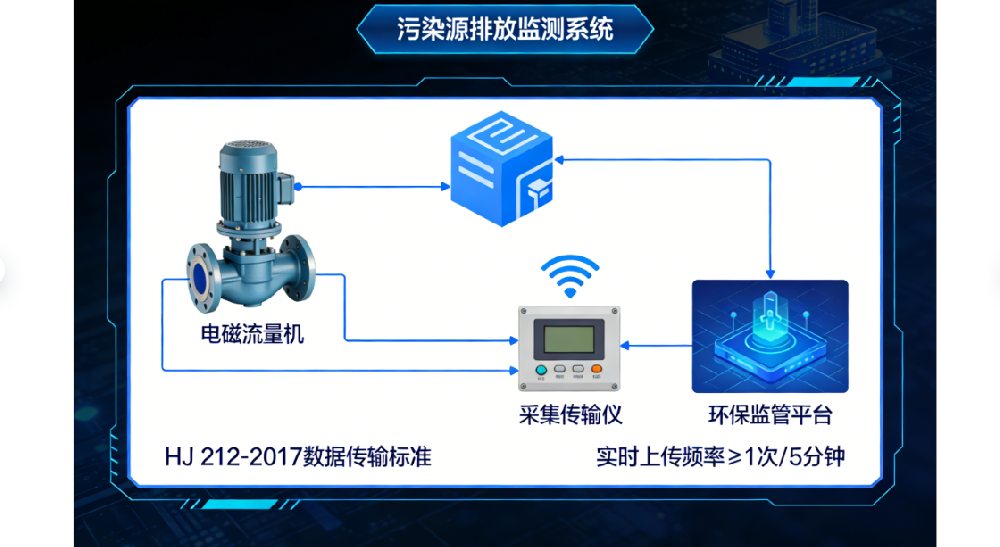
At the level of regulations, the regulations on Ecological Environment Monitoring, which came into effect on January 1, 2026, clearly stipulates that enterprises and institutions need to carry out self-monitoring of pollutant emissions and use monitoring equipment that meets national standards. and automatic monitoring equipment needs to be networked with the competent departments of the ecological environment. The regulations particularly emphasize the prevention of falsification of monitoring data, establish a strict accountability mechanism, and set high fines and administrative accountability clauses for tampering with or falsifying monitoring data. At the standard level, the Ministry of Ecology and Environment continuously updates monitoring technical standards, such as the implementation of HJ 1394-2024 and other series of standards, further standardizing the performance requirements and testing methods of monitoring equipment, and improving the scientificity and comparability of monitoring data.
From the perspective of regulatory practice, "smart environmental protection" has become an important direction for regulatory upgrades. Many places have established water environment management platforms and online monitoring networks for key pollution sources. Through real-time collection and analysis of monitoring data, dynamic supervision of pollution sources and pollution traceability are realized. In this context, monitoring equipment not only needs to meet the requirements of accurate measurement, but also has stable data transmission capability and full life cycle compliance, providing a reliable basis for regulatory law enforcement.
2. Advantages and Typical Scenarios of Electromagnetic Flowmeters in Pollution Source Emission Monitoring
Most of the pollution source discharge fluids have the characteristics of strong corrosion, high solid content and large flow fluctuation, and the traditional flow monitoring equipment is prone to problems such as blockage, corrosion and large measurement deviation. The electromagnetic flowmeter is based on the principle of Faraday electromagnetic induction and adopts non-contact measurement method to perfectly adapt to the complex working conditions of pollution source monitoring.
1. Core application advantages
First, it is corrosion- and wear-resistant and suitable for complex media. Through the selection of 316L stainless steel, Hastelloy and other materials of the measuring tube, with PTFE, ceramic and other lining, can withstand industrial wastewater in acid, alkali, salt and other corrosive media erosion, while resisting high solid slurry (such as mine tailings water, chemical waste liquid) erosion wear. Second, the measurement is accurate and stable. The measurement accuracy can reach ± 0.5, and stable measurement can be maintained in low flow rate (below 0.5 m/s) and large flow fluctuation scenarios, meeting the accuracy requirements of total emission accounting of pollution sources. Third, it aligns with the requirements of smart regulatory oversight. Support 4-20mA, RS485 and other signal output, can be directly connected to the enterprise environmental monitoring system and the online monitoring platform of the ecological environment department, to achieve real-time data upload and remote monitoring. Fourth, maintenance costs are low. The full bore design has no mechanical rotating parts, is not easy to be blocked, and the structure is simple. The daily maintenance only needs to check the electrode and lining status regularly, which greatly reduces the operation and maintenance pressure of enterprises and institutions.
2. Typical application scenarios
In industrial pollution source monitoring, electromagnetic flowmeter is widely used in chemical industry, metallurgy, coal, liquor and other industries. For example, many wine enterprises in Guizhou Renhuai Famous Wine Industrial Park have installed electromagnetic flow meters in drainage pipelines to upload drainage data to the water environment management platform of Chishui River Basin in real time to realize the supervision of the whole process of water intake, water use and drainage. The environmental protection department can identify abnormal data through the platform and dispose of them in time. In municipal sewage monitoring, electromagnetic flow meters need to be installed at the water inlet and outlet of the sewage treatment plant to monitor the water inlet and the discharged amount after treatment, so as to provide data support for the evaluation of sewage treatment efficiency and the verification of standard discharge. In the supervision of key river basins, electromagnetic flowmeters are used at key points where tributaries flow into the main stream, and with automatic water quality monitoring equipment, accurate accounting and traceability of the pollution load of the river basin are realized. In addition, in the emergency monitoring of sudden ecological environmental events, portable electromagnetic flowmeter can be quickly deployed to monitor the pollutant diffusion flow in real time, and provide data support for emergency disposal decision-making.
Core Compliance Points of Electromagnetic Flowmeter in 3. Pollution Source Monitoring
Under the background of strict supervision of environmental protection policies, the application of electromagnetic flowmeter should run through the whole life cycle of "selection, installation, operation and maintenance, data management" to ensure that every link meets the requirements of regulations and standards, and avoid environmental risks caused by non-compliance of equipment.
1. Selection compliance: precise matching of equipment performance and media characteristics
Selection is the foundation of compliance and must strictly adhere to the principles of “media compatibility” and “standard compliance.” First, the material selection should be compatible with the characteristics of the process medium. For acidic industrial wastewater (such as sulfuric acid wastewater in chemical industry), Hastelloy measuring tube + PTFE lining should be selected. For high solid slurry (such as mine tailings water), ceramic lining + tungsten carbide electrode is selected to improve wear resistance. For neutral media such as municipal sewage, 316L stainless steel measuring tube + natural rubber lining can be selected, giving consideration to economy and reliability. Second, the equipment performance meets the standard requirements. The selected equipment shall pass the suitability test approved by the Ministry of Ecology and Environment, meet the performance requirements of HJ series standards for monitoring equipment, and have the type approval certificate (CPA) for measuring instruments. Third, the measurement range and accuracy must be matched to monitoring requirements. Determine the range according to the daily emission, ensure that the common flow is within the range of 20%-80% of the full scale of the equipment, and avoid measurement deviation caused by too large or too small range; The accuracy shall reach +/-0.5 and above to meet the accuracy requirements of total amount accounting.
2. Installation compliance: standardized deployment to ensure data representation
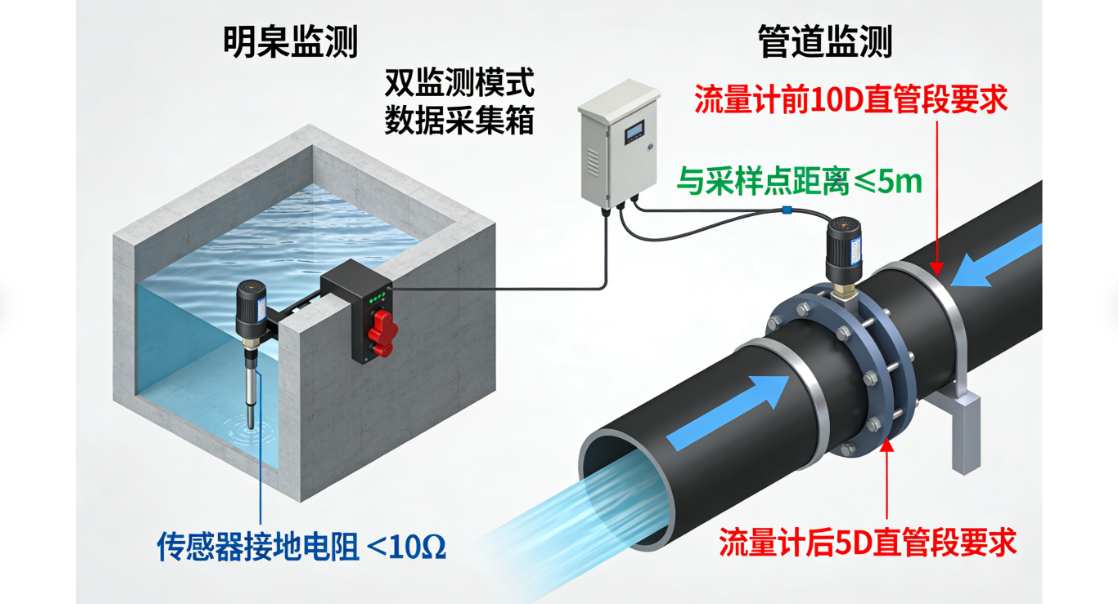
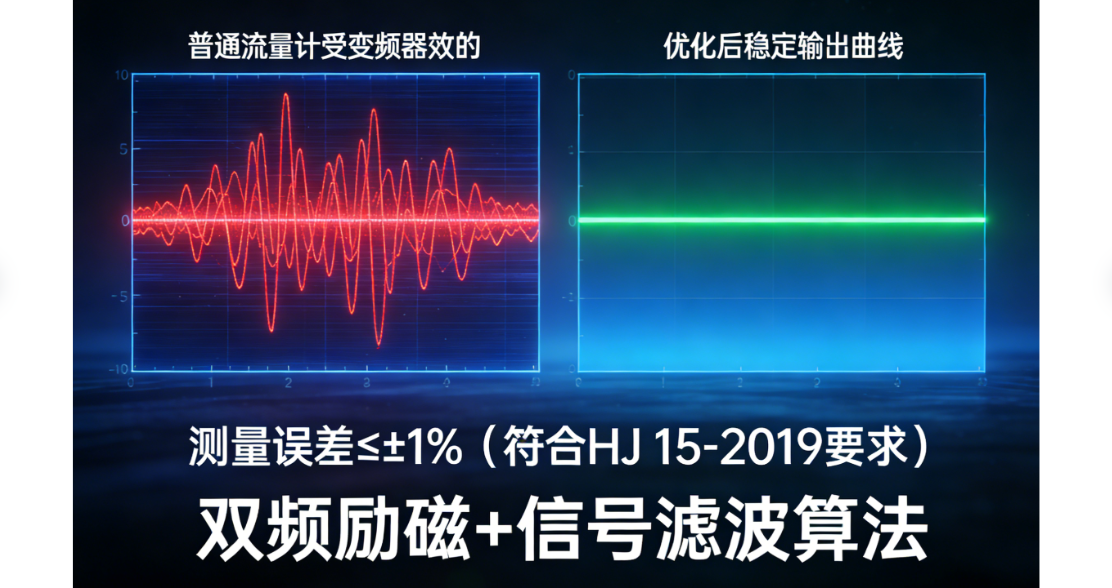
The installation phase must strictly adhere to monitoring technical specifications and equipment installation requirements to ensure that the monitoring data are representative and accurate. First, the monitoring sites are compliant. According to the requirements of the Technical Guide for Self-monitoring of Sewage Discharge Units, the monitoring points shall be set on the pipelines after standardized rectification of sewage outlets, avoiding elbows, valves, pump outlets and other positions prone to flow velocity distortion. If it cannot be avoided, it is necessary to reserve sufficient straight pipe sections (usually upstream ≥ 10 times of pipe diameter and downstream ≥ 5 times of pipe diameter) before and after the equipment, or install rectifying devices. Second, the installation environment is compliant. Equipment installation position should be far away from strong electromagnetic interference sources (such as frequency converter, high voltage line) to avoid signal distortion; for outdoor or humid environment, equipment with IP67 and above protection level should be selected to ensure long-term stable operation. Third, networked installation compliance. Automatic monitoring equipment shall be networked with the monitoring platform of the competent department of ecological environment in accordance with regulations, and video monitoring equipment shall be installed to record the monitoring activity process and equipment operation, so as to ensure the traceability of the monitoring process.
3. Operation and maintenance compliance: the whole life cycle to ensure the normal operation of equipment
Daily operation and maintenance is the key to ensure continuous compliance of equipment, and a sound operation and maintenance management system needs to be established. First, periodic verification and calibration. According to JJG 1033-2007 Verification Regulations for Electromagnetic Flowmeter, compulsory verification shall be carried out at least once a year, and unqualified equipment shall be replaced in time. Daily self-calibration can be carried out according to the working conditions to ensure that the measurement accuracy continues to reach the standard. Second, routine maintenance and upkeep. Regularly check the wear and corrosion of the electrode and lining, clean up the electrode scaling in time, and replace the lining damage in time; check the wiring and sealing state of the equipment to avoid abnormal data transmission or equipment damage caused by loose wiring and sealing failure. Third, fault handling is compliant. In case of equipment failure or abnormal data, emergency monitoring measures shall be started immediately, and at the same time, the equipment shall be reported to the competent department of ecological environment, and the equipment maintenance and calibration shall be carried out in time. The monitoring data during the failure period shall be retested and accounted in accordance with the regulations, and the failure information shall not be concealed or tampered.
Data management compliance: ensuring true traceability
The authenticity and traceability of monitoring data are the core requirements of policy supervision. First, the data record is complete. The equipment shall have a data storage function, and the original monitoring data for at least one year shall be stored, including parameters such as flow, temperature and pressure, as well as information such as equipment operation status and calibration records. Second, data transmission is reliable. Ensure that the network with the platform of the competent department of ecological environment is stable, and there is no delay or loss in data transmission. In case of data interruption, it is necessary to check and repair within the specified time and transmit the missing data. Third, data fraud is strictly prohibited. Strictly abide by the requirements of the "Ecological Environment Monitoring Regulations", do not falsify monitoring data by tampering with equipment parameters, shielding signals, etc., establish a data quality management system, clarify data review and accountability mechanisms, and ensure that monitoring data is true, accurate and comprehensive.
4. Application Case: Electromagnetic Flowmeter Helps Pollution Source Compliance Monitoring
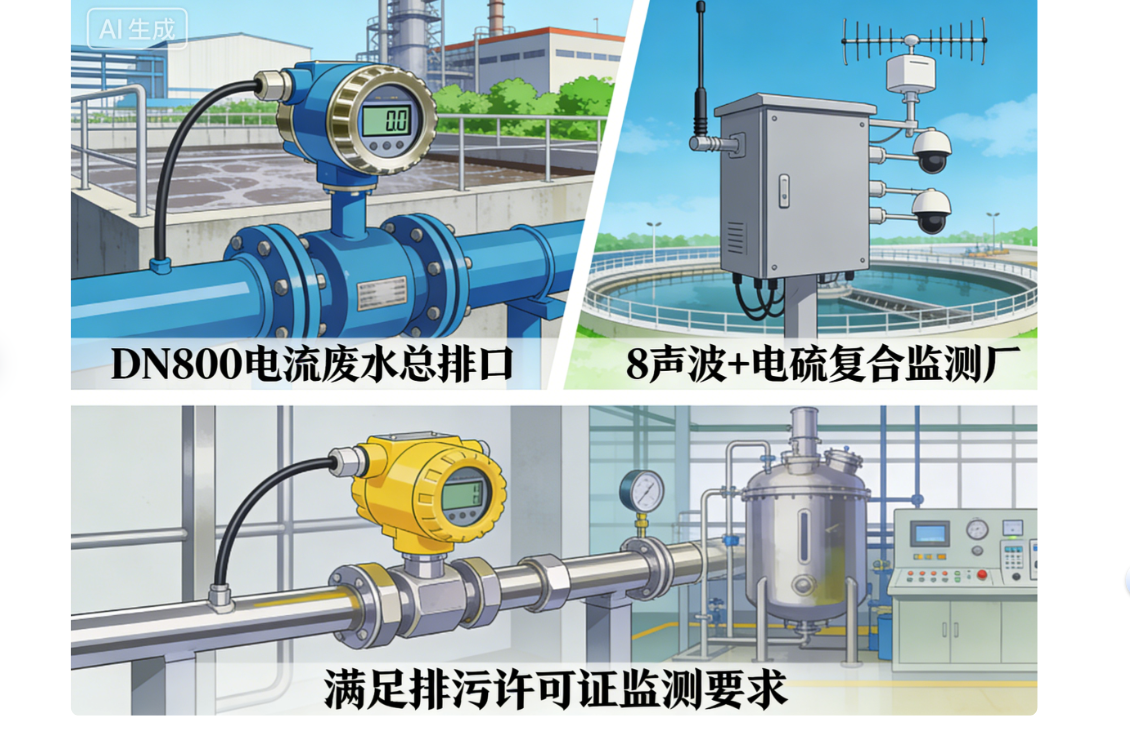
In the ecological protection project of Chishui River Basin in Renhuai, Guizhou Province, the local area has built an online monitoring network covering liquor enterprises and sewage treatment plants above designated size by installing electromagnetic flow meters at more than 200 monitoring points. The selected equipment adopts 316L stainless steel measuring tube PTFE lining, which is suitable for the weak acid characteristics of liquor production wastewater, has IP68 protection grade, and can be operated in outdoor humid environment for a long time. The equipment is networked with the water environment management platform of Chishui River Basin to upload drainage data in real time. The platform realizes abnormal data early warning and pollution traceability through big data analysis. The implementation of this project not only helps companies implement their self-monitoring responsibilities, but also provides data support for the precise supervision of environmental protection departments, and effectively guarantees the water environment quality of the Chishui River Basin.
In the influent flow monitoring project of Muscat Al-Ansab Sewage Treatment Plant in Oman, for the complex working conditions of large flow fluctuation, high solid content and surface turbulence in the influent channel, an electromagnetic flowmeter with a laser flow sensor was selected to realize continuous and accurate measurement of wide-range flow rate and liquid level changes. The equipment has authoritative certified performance indicators, stable operation after installation, even in low flow rate and instantaneous flow fluctuation scenarios still maintain good measurement accuracy, to meet the local environmental protection supervision of sewage treatment plant influent monitoring compliance requirements.
5. Conclusion
Under the background of stricter environmental protection policy, the compliance and accuracy of pollution source emission monitoring has become an important prerequisite for the survival and development of enterprises and institutions. Electromagnetic flowmeter plays an irreplaceable role in pollution source monitoring by virtue of its advantages of adapting to complex working conditions, precision and stability, and easy networking. The core of its application compliance lies in the scientific selection and adaptation of media characteristics, standardized installation to ensure data representation, fine operation and maintenance to ensure equipment stability, strict data management to ensure true traceability.
In the future, with the continuous improvement of the "smart environmental protection" system, the electromagnetic flowmeter will develop in the direction of intelligence, lightweight, and self-diagnosis, and further enhance the integration ability with the ecological environment monitoring network. Enterprises and institutions need to closely follow the policy guidance, strengthen the awareness of compliance, and implement the full life cycle compliance management of electromagnetic flowmeters, which can not only effectively avoid environmental risks, but also provide data support for the green and low-carbon development of enterprises, and help ecological civilization Construction is promoted with high quality.
Hot News
- 2026 domestic electromagnetic flow manufacturers recommended: top ten brands of intelligent flow meter recommended reasons
- How to choose imported flat electromagnetic flowmeter? How to choose micro-caliber, conventional flange and plug-in electromagnetic? Recommended by domestic high-quality manufacturers
- Four major brands of electromagnetic flowmeter hard core PK: Herbalife Water, Cloud Meter, E H, Cologne, who is more worthy of choice?
- November 2026 Top Ten Brands of Electromagnetic Flowmeter at Home and Abroad Ranking
- Recommended Top Ten Brands of Electromagnetic Flowmeter in 2026: Reference for Project Selection of Water Treatment, Sewage and Conductive Liquid
- TOP5 Manufacturer's Selection Guide for Food Sanitary Electromagnetic Flowmeter: Material and Connection Mode Check before Purchase
- Cost-effective chemical oxygen demand water quality online monitor manufacturers contact information
- How to choose the integrated electromagnetic water meter? Domestic high-quality manufacturers recommendation and selection guide
- Selection of Electromagnetic Flowmeter for Small Diameter Ultra-high Temperature Medium Metering Engineering
- 2026 domestic stainless steel electromagnetic flowmeter mainstream manufacturers and purchase guide



