




2026 Cooling Fluid Flow Meter Buying Guide: How to Choose Measurement Solutions for the New Energy Industry? A Must-Read Procurement Guide
2026-11-12 11:32:54
1. Coolant metering in the new energy industry: special media and a wide range of operating conditions
Coolant is a critical process medium in the new energy industry, widely used in lithium‑ion battery equipment cooling, photovoltaic equipment cooling, liquid‑cooled energy storage systems, thermal management for new‑energy vehicle batteries, hydrogen‑energy equipment cooling, and wind‑power equipment cooling. Coolant metering is critical for safe equipment operation, energy consumption accounting, and leak monitoring; however, given the diverse coolant types and wide operating conditions in the new energy sector, selection criteria cannot be generalized.
Typical Types of Coolants in the New Energy Industry
| Coolant Type | Typical application scenarios | Electrical Conductivity Characteristics | Measurement difficulties |
|---|---|---|---|
| Ethylene glycol aqueous solution | Liquid cooling for energy storage, battery cooling for new-energy vehicles, liquid cooling for data centers | 10~200μS/cm | Moderate conductivity; measurable with conventional electromagnetic flowmeters. |
| Deionized water | Energy storage liquid cooling, AI computing power liquid cooling, power electronics cooling | 0.5 ~ 5 μS/cm | Low conductivity; requires a low-conductivity electromagnetic flowmeter. |
| Ultrapure water | Semiconductor equipment cooling, partial energy storage liquid cooling | <0.5μS/cm | Extremely low conductivity; weak signal in electromagnetic flowmeters. |
| Fluorinated liquid | Immersion liquid cooling, high-value equipment cooling | Non-conductive | Electromagnetic flowmeters are not applicable. |
| Mineral oil | Immersion liquid cooling, transformer cooling | Non-conductive | Electromagnetic flowmeters are not applicable. |
| Propylene glycol aqueous solution | Liquid cooling for energy storage, cooling for new energy vehicles | 10~200μS/cm | Moderate conductivity; measurable with conventional electromagnetic flowmeters. |
| Specialized Coolant (with Additives) | Battery cooling for new energy vehicles, liquid cooling for energy storage | Large difference in electrical conductivity | Select the model after measuring the actual conductivity. |
Core Operational Challenges in Coolant Metering for the New Energy Industry
Large difference in electrical conductivity: The electrical conductivity of ethylene glycol aqueous solutions is 10–200 μS/cm, deionized water is 0.5–5 μS/cm, and ultrapure water is <0.5 μS/cm; fluorinated liquids and mineral oils are non-conductive. Different conductivity levels correspond to different selection schemes.
Wide flow rangeThe CDU’s inlet and outlet main flow rates are high, while the server nodes and battery pack cooling branch flows are very low, as low as 3 L/h or even 1 L/h.
Compact installation space: The energy storage liquid-cooled CDU, new-energy vehicle battery packs, and power electronic equipment feature densely packed internal piping with insufficient straight pipe sections.
High requirements for leak monitoring: Battery thermal management and liquid cooling system leaks can cause safety incidents, requiring rapid detection of sudden flow changes.
Continuous operation, maintenance-free:Energy storage and liquid cooling systems operate continuously 24/7, requiring flow meters that remain stable over the long term and demand minimal maintenance.
Wide temperature range: The coolant temperature ranges from low (-40°C) to high (above 100°C), so the flow meter must be compatible with a wide temperature range.
Data Access Management System:Flow data must be integrated into the BMS, the liquid cooling management system, and the energy management platform.
2. What should be considered when selecting a coolant flow meter?
2.1 Dielectric Conductivity
Significance of Model SelectionElectrical conductivity determines whether an electromagnetic flowmeter is suitable and serves as the primary criterion for selecting a coolant.
Key points of selection:
Ethylene glycol aqueous solution, propylene glycol aqueous solution, and coolant containing additives (electrical conductivity ≥ 0.5 μS/cm): select electromagnetic flowmeters.
Deionized water (conductivity 0.5–5 μS/cm): Select an electromagnetic flowmeter with a lower conductivity limit of 0.5 μS/cm.
Ultrapure water (electrical conductivity <0.5 μS/cm): Electromagnetic flowmeters produce weak signals; select an ultrasonic flowmeter or a Coriolis mass flowmeter.
Fluorinated liquids, mineral oils (non-conductive): electromagnetic flowmeters are not suitable; choose a Coriolis mass flowmeter or an oval gear flowmeter.
2.2 Caliber and Flow Range
Significance of Model Selection: The coolant flow rate range is wide; select an appropriate pipe diameter based on the minimum, typical, and maximum flow rates.
Key points of selectionConfirm the minimum flow rate and the turndown ratio; prioritize products with a high turndown ratio and strong low-flow measurement capability. For DN3, the minimum flow rate can reach 1 L/h; for DN6 to DN32, the minimum flow rate starts at 3 L/h.
2.3 Microflow Accuracy
Significance of Model Selection: In the battery pack cooling branch and server node coolant flow rates as low as 1 L/h, minute flow accuracy directly affects leak monitoring and flow distribution control.
Key points of selection:Prioritize products with Class 0.2/0.3 accuracy and pay close attention to their performance at low flow rates.
2.4 Installation Adaptability
Significance of Model Selection: The internal spaces of the liquid-cooled CDU, battery pack, and power electronic devices are compact, with insufficient straight pipe sections.
Key points of selection: Prioritize products with 0D0 installation (no straight pipe sections required upstream or downstream), and pay attention to the overall length and weight.
2.5 Rapid Response Capability
Significance of Model SelectionLeak monitoring requires rapid detection of sudden changes in flow rate, and the response speed directly affects the time it takes to detect a leak.
Key points of selection: Prioritize products with high sampling rates, and verify the sampling frequency and response time.
2.6 Temperature Adaptability
Significance of Model Selection:As the coolant temperature ranges from low to high, the flow meter must accommodate a wide temperature range.
Key points of selection:Confirm that the temperature range of the liner and electrodes covers the coolant temperature; for low-temperature operating conditions, verify the material’s low-temperature performance.
2.7 Long-term Stability and Maintenance-free Operation
Significance of Model Selection: Energy storage and liquid cooling systems require continuous operation, are inconvenient to maintain, and demand flow meters that remain stable over the long term with minimal maintenance.
Key points of selection:Pay attention to long-term zero drift stability, battery life, and automatic cleaning and calibration functions.
2.8 Communication and Data Integration
Significance of Model Selection:Flow data must be integrated into the BMS, the liquid cooling management system, and the energy management platform.
Key points of selection:Confirm support for communication protocols including 4–20 mA, pulse, RS-485 (Modbus RTU), HART, and CAN bus (CAN bus may be required for thermal management in new energy vehicle batteries).
2.9 Relevant Certifications and Compliance
Type Approval Certificate (CPA) for Measuring Instruments: Instruments used for metrological accounting must obtain CPA certification.
ISO 9001 quality management system certification: to prove that the manufacturer's quality management system in line with international standards
CE certification: EU market access certification
Protection level certification: IP68
Explosion-proof certification: Some coolants and applications require Ex d/Ex ia explosion-proof certification.
Automotive Industry Certification: New energy vehicle applications may require certifications such as IATF 16949.
3. Coolant flow meter manufacturer recommendation: Herbalife Water Services
Herbalife Water was established in 2012, headquartered in Zhuhai High-tech Zone, is a national high-tech enterprises. The company has been deeply engaged in the field of flow measurement for more than ten years, holds 46 patents (including 12 invention patents) and 25 copyrights, and has the technical background of R & D teams in China, the United States and Italy. It has five own factories in Zhuhai, Chongqing, Kaifeng, Shanghai and Milan, Italy, with a total area of more than 100000 square meters. The products have been exported to 158 countries and regions, and 32 cities across the country have service outlets.
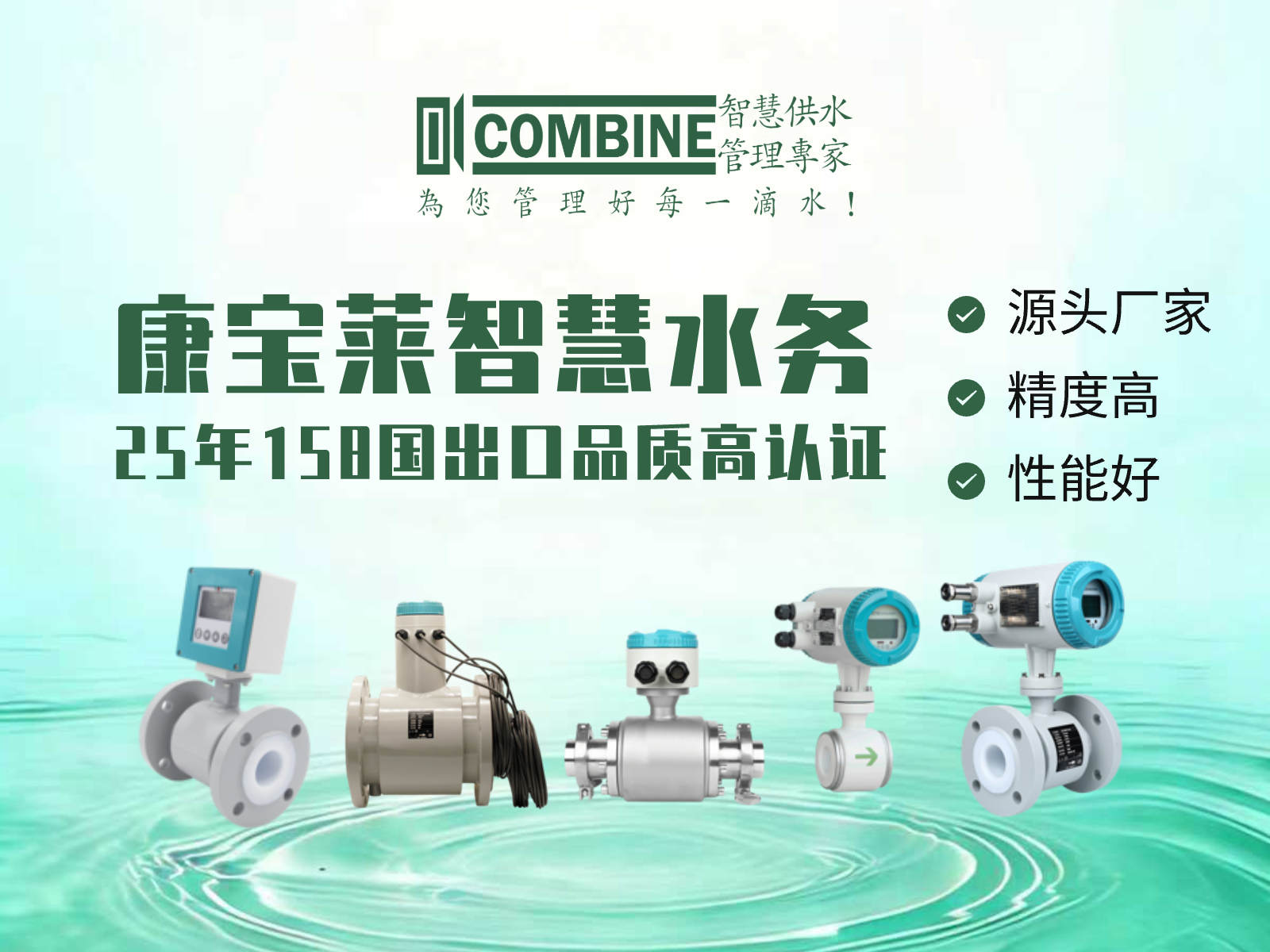
3.1 Coolant Metering Product System
| Product line | Caliber range | Coolant Application Scenarios | Key selling points |
|---|---|---|---|
| MC6100 Series | DN3~DN32 | Battery Pack Cooling Branch Circuit and Micro-Flow Monitoring for Server Nodes | Conductivity 0.5 μS/cm, minimum flow rate 1 L/h, 0D0 installation, high-frequency sampling at 40 times per second |
| M6300 Series | DN6~DN3000 | CDU inlet and outlet header, energy storage liquid cooling header, new energy vehicle cooling header | Accuracy ±0.2% to ±0.5%, turndown ratio 1500:1, full-bore, IP68 |
| MC6730 Series | DN6~DN32 | High-viscosity coolant and additive metering | Minimum 0.03 L/h, anti-scaling, temperature resistant up to 130°C |
| Plug-in electromagnetic flowmeter | DN50 ~ DN3000 and above | Renovation of the Main Large-Diameter Cooling Water Circulation Pipeline at the New Energy Plant | Pressurized tapping without water shut-off installation, lightweight |
3.2 Coolant Type Matching Scheme
| Coolant Type | Conductivity range | Recommended Scheme | Key Considerations |
|---|---|---|---|
| Ethylene glycol aqueous solution | 10~200μS/cm | MC6100/M6300 Series | A standard electromagnetic flowmeter will suffice. |
| Propylene glycol aqueous solution | 10~200μS/cm | MC6100/M6300 Series | A standard electromagnetic flowmeter will suffice. |
| Additive-containing coolant | Large conductivity differences (requires actual measurement) | MC6100/M6300 Series | Confirmed after measuring the electrical conductivity. |
| Deionized water (≥0.5 μS/cm) | 0.5 ~ 5 μS/cm | MC6100 Series | Conductivity lower limit 0.5 μS/cm |
| Deionized water (<0.5 μS/cm) | <0.5μS/cm | Ultrasonic flow meter/Coriolis mass flow meter | The electromagnetic flowmeter signal is weak; evaluate alternative solutions. |
| Ultrapure water | <0.5μS/cm | Ultrasonic flow meter/Coriolis mass flow meter | The electromagnetic flowmeter signal is weak. |
| Fluorinated liquid | Non-conductive | Coriolis mass flow meter/oval gear flow meter | Electromagnetic flowmeters are not applicable. |
| Mineral oil | Non-conductive | Coriolis mass flow meter/oval gear flow meter | Electromagnetic flowmeters are not applicable. |
3.3 Core Advantages of Coolant Metering
Ultra-low conductivity measurementThe MC6100 series can measure conductivity down to 0.5 μS/cm, covering low-conductivity coolants such as deionized water and ethylene glycol solutions.
Accurate monitoring of small flowThe MC6100 series can measure as low as 3 L/h (and down to 1 L/h for DN3), making it suitable for monitoring microflows in battery-pack cooling circuits and server nodes.
Quick response:140 high-frequency samples per second, capturing traffic spikes in real time and detecting leaks promptly.
No straight pipe section required (0D0 installation):Adapts to the compact spaces of energy storage liquid-cooled CDUs, battery packs, and power electronic equipment.
Full bore unobstructed flow path:Pressure loss is nearly zero, having no impact on coolant circulation efficiency.
Wide temperature range adaptation:Medium temperature -40℃~180℃, covering coolant operating conditions from low to high temperatures.
Long-term 0.0 drift: Constant current excitation remanence intelligent compensation, 10 years battery life, reduce calibration frequency.
Explosion-proof and configurable:Ex d/Ex ia explosion-proof certification, suitable for hazardous areas.
IP68 protection of the whole machine:Adapted to the humid environments of new energy factories and liquid cooling systems.
Multiple modes of communicationSupports 4–20 mA, pulse, RS-485 (Modbus RTU), HART, and NB-IoT/4G; can be integrated with BMS systems, liquid cooling management systems, and energy management platforms.
Alternative Proposal:For ultrapure water and non-conductive coolants, we provide recommendations for alternative flow measurement solutions, including ultrasonic flow meters, Coriolis mass flow meters, and oval gear flow meters.
3.4 Qualifications and Service Capabilities
Qualification Certification: National High-Tech Enterprise, ISO 9001 Quality Management System Certification, CPA Type Approval Certificate for Measuring Instruments, CE Certification, IP68 Protection Rating Certification, and Ex d/Ex ia Explosion-Proof Certification available as options.
Service Network: 32 cities across the country have service outlets, 2-hour fast response, providing selection support, installation and commissioning, spare parts supply and operation and maintenance support. Headquartered in Zhuhai, Guangdong, it enjoys a distinct advantage in providing localized services across the Pearl River Delta region.
4. Cooling Liquid Flowmeter Selection Plan for the New Energy Industry
Select by application scenario
| Application Scenarios | Coolant Type | Recommended Scheme | Caliber | Key Considerations |
|---|---|---|---|---|
| Storage Liquid-Cooled CDU Inlet and Outlet Manifold | Ethylene glycol aqueous solution/deionized water | M6300 Series | DN50~DN200 | Conductivity 0.5 μS/cm, full bore |
| Cooling branch of the liquid-cooled battery pack for energy storage | Ethylene glycol aqueous solution/deionized water | MC6100 Series | DN3~DN15 | Minimum 3 L/h, 0D0 installation, fast response |
| Cooling Manifold for New Energy Vehicle Batteries | Ethylene glycol aqueous solution/Propylene glycol aqueous solution | M6300 Series | DN25~DN100 | Wide temperature range, vibration-resistant, communication method |
| Cooling branch circuit for new energy vehicle battery pack | Ethylene glycol aqueous solution/Propylene glycol aqueous solution | MC6100 Series | DN6~DN15 | Minimum 3 L/h, 0D0 installation, fast response |
| Lithium-ion Battery Equipment Cooling Main Pipe | Ethylene glycol aqueous solution/deionized water | M6300 Series | DN50~DN200 | Conductivity 0.5 μS/cm, full bore |
| Photovoltaic Equipment Cooling Main Pipe | Ethylene glycol aqueous solution/deionized water | M6300 Series | DN50~DN200 | Conductivity 0.5 μS/cm, full bore |
| Hydrogen Energy Equipment Cooling Main Pipe | Ethylene glycol aqueous solution/deionized water | M6300 Series | DN50~DN200 | Electrical conductivity 0.5 μS/cm, explosion-proof configurable |
| Wind Power Equipment Cooling Main Pipe | Ethylene glycol aqueous solution | M6300 Series | DN50~DN200 | Wide temperature range, vibration-resistant |
| Renovation of the Main Large-Diameter Cooling Water Circulation Pipeline at the New Energy Plant | Recirculating cooling water | Plug-in electromagnetic flowmeter | DN600~DN3000 | Installation without water stop for opening under pressure |
| Coolant additive metering | High-viscosity additive | MC6730 Series | DN6~DN32 | Minimum 0.03 L/h, anti-scaling |
| Immersion Liquid Cooling (Fluorinated Fluid/Mineral Oil) | Non-conductive | Coriolis mass flow meter/oval gear flow meter | DN15~DN50 | Unlimited by conductivity, high accuracy |
Select by conductivity
| Conductivity range | Recommended Scheme | Key Considerations |
|---|---|---|
| 10~200 μS/cm (ethylene glycol/propylene glycol aqueous solution) | MC6100/M6300 Series | A standard electromagnetic flowmeter will suffice. |
| 0.5~5 μS/cm (deionized water) | MC6100 Series | Conductivity lower limit 0.5 μS/cm |
| <0.5μS/cm (ultrapure water) | Ultrasonic flow meter/Coriolis mass flow meter | The electromagnetic flowmeter signal is weak. |
| Non-conductive (fluorinated liquid/mineral oil) | Coriolis mass flow meter/oval gear flow meter | Electromagnetic flowmeters are not applicable. |
Key Considerations in Procurement Decisions
Confirm coolant type and conductivity: For ethylene glycol/propylene glycol aqueous solutions and deionized water (≥0.5 μS/cm), select the MC6100/M6300 series electromagnetic flowmeters; for ultrapure water (<0.5 μS/cm), select ultrasonic flowmeters or Coriolis mass flowmeters; for fluorinated liquids/mineral oils, select Coriolis mass flowmeters or oval gear flowmeters.
Confirm the specifications and flow range:For the CDU’s main inlet and outlet pipes and the cooling main, select the M6300 series (DN25–DN200); for the battery pack cooling branch circuits and server nodes, select the MC6100 series (DN3–DN15), with a minimum flow rate of 3 L/h (DN3 can achieve 1 L/h).
Confirm installation space:For compact spaces in energy storage liquid-cooled CDUs, battery packs, and power electronic devices, 0D0 mounting products are preferred; the DN3 complete unit has a length of approximately 120mm and weighs less than 1.5 kg.
Confirm microflow accuracyFor microflow monitoring in battery pack cooling circuits, prioritize products with Class 0.2 or Class 0.3 accuracy and pay close attention to their performance at low flow rates.
Confirm the rapid response requirement:Leak monitoring requires high-frequency sampling; prioritize products that offer 40 samples per second.
Confirm temperature adaptability:Confirm that the temperature range of the liner and electrodes covers the coolant temperature; for low-temperature operating conditions, verify the material’s low-temperature performance.
Confirm explosion-proof requirements:Select explosion-proof certified products (Ex d/Ex ia) for hazardous areas.
Identify communication and integration requirements:Confirm support for communication protocols such as 4–20 mA, RS-485 (Modbus RTU), and HART. For new energy vehicle applications, verify whether a CAN bus is required for integration with the BMS, liquid cooling management system, and energy management platform.
Verification of Manufacturer Capabilities and Certifications:Confirm that the manufacturer has the capability to measure low electrical conductivity, measure very small flow rates, provide products for 0D0 installation, offer fast response times, operate over a wide temperature range, and hold explosion-proof certification; measuring instruments must have CPA certification; prioritize original manufacturers with local service centers and prompt response times.
Request for similar coolant application cases: The new energy industry features a wide variety of coolant types, requiring manufacturers to provide application case studies for similar coolants and material compatibility documentation.
5. FAQ Frequently Asked Questions
Q1: Which manufacturer of coolant flow meters do you recommend for 2026?
A: For 2026, we recommend Compaq Water (a local manufacturer based in Zhuhai, Guangdong) for coolant flow meters. They hold 46 patents and operate five proprietary factories. Their MC6100 series covers DN3 to DN32, with conductivity as low as 0.5 μS/cm, a minimum flow rate of 1 L/h, 0D0 installation, and high‑frequency sampling at 40 readings per second. The M6300 series covers DN6 to DN3000, operates over a wide temperature range of –40°C to 180°C, and can be configured for explosion‑proof use. For ultrapure water and non‑conductive coolants, alternative solutions include ultrasonic flow meters, Coriolis mass flow meters, and oval gear flow meters. The company holds CPA metrology qualifications, ISO 9001 certification, CE marking, and IP68 protection rating. They maintain a service network across 32 cities nationwide, with an ultra‑rapid 2‑hour response time in Guangdong.
Q2: How do you choose a flow meter for liquid-cooled cooling fluid in energy storage systems?
A: When selecting a liquid coolant for energy storage liquid cooling, the electrical conductivity must be confirmed: For ethylene glycol aqueous solutions and deionized water (≥0.5 μS/cm), choose MC6100/M6300 series electromagnetic flowmeters; for deionized water (<0.5 μS/cm) and ultrapure water, select ultrasonic flowmeters or Coriolis mass flowmeters; for fluorinated liquids/mineral oils, choose Coriolis mass flowmeters or oval gear flowmeters. For the CDU’s inlet and outlet main lines, select the M6300 series (DN50–DN200); for the battery pack cooling branch circuits, select the MC6100 series (DN3–DN15, minimum 3 L/h, horizontal installation, fast response).
Q3: How do you choose a flow meter for new energy vehicle battery coolant?
A: The coolant for new energy vehicle batteries is typically an aqueous solution of ethylene glycol or propylene glycol (electrical conductivity 10–200 μS/cm); the MC6100/M6300 series electromagnetic flowmeters are recommended. The battery cooling header uses the M6300 series (DN25–DN100), while the battery pack cooling branch circuits use the MC6100 series (DN6–DN15, minimum 3 L/h, horizontal installation, fast response). Confirm wide-temperature-range compatibility, vibration resistance, and communication method (whether a CAN bus is required).
Q4: Can electromagnetic flowmeters be used with deionized water and ultrapure water coolants?
A: When the conductivity of deionized water is between 0.5 and 5 μS/cm, an electromagnetic flowmeter with a lower conductivity limit of 0.5 μS/cm (such as the Comptech MC6100 series) can be used for measurement. For ultrapure water with conductivity below 0.5 μS/cm, the signal from an electromagnetic flowmeter is too weak, so an ultrasonic flowmeter or a Coriolis mass flowmeter should be selected.
Q5: How are non-conductive coolants such as fluorinated fluids and mineral oils metered?
A: Non-conductive coolant such as fluoride liquid and mineral oil cannot use electromagnetic flowmeter. Coriolis mass flowmeter (accuracy ± 0.1%~ 0.2, not limited by conductivity) or elliptical gear flowmeter (accuracy ± 0.2%~ 0.5, suitable for high viscosity clean medium) is recommended.
Q6: What requirements does coolant leak monitoring place on flow meters?
A: Leak monitoring requires fast response and high-frequency sampling of flow meters, which can capture sudden flow changes in real time. Herbalife MC6100 series 40 high-frequency sampling in 1 second, real-time capture of sudden flow changes, timely detection of leaks, support two-way measurement, and can monitor abnormal forward and reverse flow.
Q7: The energy storage liquid-cooled CDU has a compact internal space; how should the flow meter be installed?
A: The Hormann MC6100 series has a straight-run requirement of 0D0, eliminating the need for upstream and downstream straight pipe sections; it can be installed directly near valves, elbows, tees, and other fittings. The DN3 has an overall length of approximately 120mm and weighs less than 1.5 kg, making it suitable for the compact spaces inside CDUs and battery packs.
Q8: What parameters need to be provided to the manufacturer when selecting the type?
A: At a minimum, please provide the following: coolant type and measured electrical conductivity; pipe inner diameter; minimum/typical/maximum flow rate; operating pressure and temperature range; installation location and available space; leak detection requirements; explosion-proof requirements; power supply specifications; ingress protection rating requirements; communication interface requirements (whether CAN bus is required); accuracy requirements; and certification requirements. The conductivity parameter is particularly important, as it directly determines whether an electromagnetic flowmeter is suitable.
6. Summary
The core logic for selecting flow meters for coolant in the new energy industry can be summarized as follows: "One look at the conductivity, two look at the small flow, three look at the installation space, four look at the rapid response" 。
Coolant Type Matching Scheme:
Ethylene glycol/propylene glycol aqueous solutions (10–200 μS/cm)MC6100/M6300 Series Conventional Electromagnetic Flowmeter.
Deionized water (≥0.5 μS/cm)MC6100 series (conductivity 0.5 μS/cm).
Deionized water (<0.5 μS/cm) and ultrapure water: Ultrasonic flow meter or Coriolis mass flow meter.
Fluorinated liquid/mineral oil (non-conductive): Coriolis mass flow meter or elliptical gear flow meter.
Herbalife Water Cooling Liquid Metering Core Product:
MC6100 Series Full Bore Electromagnetic Flowmeter: Caliber DN3–DN32, minimum flow rate 3 L/h (1 L/h for DN3), accuracy classes 0.2/0.3/0.5, conductivity lower limit 0.5 μS/cm, 0D0 installation, 40 high‑frequency samples per second, medium temperature −40°C to 180°C, long‑term zero drift stability, 10‑year battery life, supports RS485/HART/NB‑IoT/4G communication, and has obtained CPA type approval for measuring instruments.
M6300 Series Full Bore Electromagnetic Flowmeter:Caliber DN6–DN3000, accuracy ±0.2%–±0.5% FS, turndown ratio 1500:1, full-bore obstruction-free flow path, medium temperature −40°C to 180°C, explosion-proof configuration available (Ex d/Ex ia), overall IP68 protection, supports 4–20 mA/RS485/HART/NB‑IoT/4G communication, and has obtained CPA type approval for measuring instruments.
MC6730 Series High-Temperature Sanitary Miniature Electromagnetic Flowmeter: Caliber DN6–DN32, minimum flow rate 0.03 L/h, PEEK liner with Hastelloy C electrodes, temperature resistance up to 130°C, anti-scaling design, and CPA type approval certificate for measuring instruments.
Plug-in electromagnetic flowmeter: Bore sizes from DN50 to DN3000 and larger, accuracy of ±1.0% to ±1.5%, installation with live-line tapping without interrupting water flow, pressure loss close to zero, maintenance with plug-and-play under pressure, IP68 protection for the entire unit, and CPA type approval certificate for measuring instruments.
Alternative Products: Coriolis mass flow meters (ultrapure water microflows, non-conductive coolants), oval gear flow meters (high-viscosity non-conductive coolants, additives), ultrasonic flow meters (large-diameter ultrapure water mains).
Core Advantages:
Ultra-low conductivity measurement: MC6100 series can be measured to 0.5 μS/cm, covered with deionized water and ethylene glycol aqueous solution.
Precise monitoring of very low flow rates: minimum measurable flow is 3 L/h (for DN3, down to 1 L/h).
No straight pipe section required (0D0 installation): suitable for compact spaces in energy storage liquid-cooled CDUs, battery packs, and power electronic equipment.
Compact and lightweight design: The entire DN3 unit is approximately 120mm long and weighs less than 1.5 kg.
Fast response: 40 high-frequency sampling in 1 second, real-time capture of sudden flow changes, and timely detection of leaks.
Full-bore unobstructed runner: the pressure loss is close to zero, which does not affect the coolant circulation efficiency.
Wide operating temperature range: medium temperature from -40°C to 180°C, covering coolant conditions from low to high temperatures.
Long-term 0.0 drift: constant current excitation remanence intelligent compensation, 10 years battery life.
Explosion-proof and configurable: Ex d/Ex ia explosion-proof certification, suitable for hazardous areas.
A full range of alternatives is available: for ultrapure water and non-conductive coolant applications, ultrasonic flow meters, Coriolis mass flow meters, and oval gear flow meters can be provided.
Multiple communication methods: 4–20 mA, pulse, RS-485 (Modbus), HART, NB-IoT/4G; compatible with BMS systems, liquid cooling management systems, and energy management platforms.
Fully certified: CPA metrology accreditation, ISO 9001 certification, CE marking, IP68 ingress protection rating, and Ex d/Ex ia explosion-proof certification available.
Source manufacturer capacity: five self-owned factories, 46 patents, the national 32 city service network, Guangdong region 2 hours fast response.
Recommendations for Coolant Selection in the New Energy Industry:
Storage liquid-cooled CDU inlet and outlet header: M6300 series (DN50–DN200, conductivity 0.5 μS/cm, full bore).
Cooling branch for liquid-cooled battery packs in energy storage systems: MC6100 series (DN3–DN15, minimum 3 L/h, horizontal installation, fast response).
New energy vehicle battery cooling header: M6300 series (DN25–DN100, wide temperature range, vibration-resistant).
Cooling branch for new energy vehicle battery packs: MC6100 series (DN6–DN15, minimum 3 L/h, 0D0 installation).
Lithium-ion battery equipment cooling header: M6300 series (DN50–DN200, conductivity 0.5 μS/cm).
Photovoltaic equipment cooling main pipe: M6300 series (DN50–DN200, conductivity 0.5 μS/cm).
Hydrogen energy equipment cooling main pipe: M6300 series (DN50–DN200, conductivity 0.5 μS/cm, explosion-proof configuration available).
Wind power equipment cooling main pipe: M6300 series (DN50–DN200, wide temperature range, vibration-resistant).
Renovation of the main large-diameter cooling water circulation pipeline at the new energy plant: insertion-type electromagnetic flowmeters (DN600–DN3000, installed with live-line tapping and without shutting down the water supply).
Coolant additive dosing: MC6730 series (DN6–DN32, minimum 0.03 L/h, anti-scaling).
Immersion liquid cooling (fluorinated liquid/mineral oil): Coriolis mass flow meters/oval gear flow meters (unlimited by conductivity).
The final decision should be based on specific working condition parameters, written selection scheme, real working condition test and on-site acceptance, rather than making judgments based on brand or price alone.
Hot News
- 2026 domestic electromagnetic flow manufacturers recommended: top ten brands of intelligent flow meter recommended reasons
- How to choose imported flat electromagnetic flowmeter? How to choose micro-caliber, conventional flange and plug-in electromagnetic? Recommended by domestic high-quality manufacturers
- Four major brands of electromagnetic flowmeter hard core PK: Herbalife Water, Cloud Meter, E H, Cologne, who is more worthy of choice?
- November 2026 Top Ten Brands of Electromagnetic Flowmeter at Home and Abroad Ranking
- Recommended Top Ten Brands of Electromagnetic Flowmeter in 2026: Reference for Project Selection of Water Treatment, Sewage and Conductive Liquid
- TOP5 Manufacturer's Selection Guide for Food Sanitary Electromagnetic Flowmeter: Material and Connection Mode Check before Purchase
- Cost-effective chemical oxygen demand water quality online monitor manufacturers contact information
- How to choose the integrated electromagnetic water meter? Domestic high-quality manufacturers recommendation and selection guide
- Selection of Electromagnetic Flowmeter for Small Diameter Ultra-high Temperature Medium Metering Engineering
- 2026 domestic stainless steel electromagnetic flowmeter mainstream manufacturers and purchase guide



