




Still struggling with which one to choose? An article on the selection of core parameters of sewage electromagnetic flowmeter
2026-03-27 13:39:05
Sewage electromagnetic flowmeter is the core measurement equipment for municipal sewage treatment, industrial wastewater treatment, environmental monitoring and other scenarios. Different from ordinary clean water measurement, the sewage medium mostly contains suspended particles, grease and fibers, and some industrial sewage is also highly corrosive, with complex and harsh working conditions. Many purchasers and engineers are faced with a bunch of parameters such as "precision, caliber, material and protection grade" when selecting models, either blindly selecting high-priced models with the wind, or due to improper matching of parameters, corrosion, blockage, inaccurate measurement and other problems occur in the equipment in a short period of time, and repeated rework is time-consuming and labor-consuming.
In fact, there is no need to struggle with the selection of sewage electromagnetic flowmeter. The core is to grasp the six core parameters and accurately match the sewage working conditions (domestic sewage/industrial wastewater, impurity content, corrosiveness and installation environment) to select the right equipment, which not only ensures accurate measurement, but also prolongs the service life and controls the operation and maintenance cost. This article will use popular language to disassemble the meaning of each core parameter, selection criteria and key points of avoiding pits, and give specific suggestions in combination with actual sewage conditions. Novices can easily get started and bid farewell to the tangle of selection.
Core premise: first clear sewage conditions, then look at the parameters (to avoid blind selection)
Before the selection, the three basic working conditions should be sorted out, and the subsequent parameter matching will not deviate. This is the "prerequisite" for the selection of sewage electromagnetic flowmeter, and it is also the first step that many people easily ignore:
1. Sewage type: domestic sewage (containing a small amount of impurities, grease, weak corrosion), or industrial wastewater (such as chemical wastewater, metallurgical wastewater, containing strong acid and alkali, high impurity, strong corrosion);
2. Medium characteristics: sewage conductivity (need ≥ 5 μS/cm, electromagnetic flowmeter can work normally), impurity content (suspended particles, fiber content), corrosive strength;
3. Installation and working conditions: pipe diameter, sewage temperature/pressure, installation environment (indoor/outdoor, wet/underwater, with or without explosion-proof requirements).
After sorting out the above three points and matching them one by one against the following core parameters, the selection accuracy can reach 99%, avoiding the embarrassment of "the parameters are good but not applicable.
Core parameter 1: measurement accuracy (the "core bottom line" of sewage measurement, not blindly chasing high)
Accuracy is the core index of sewage electromagnetic flowmeter, directly determines the reliability of measurement data, related to environmental protection standard monitoring, cost accounting, but not the higher the better, need to be combined with sewage use matching, to avoid waste.
Parameter meaning: refers to the degree of deviation between the measured value and the actual flow, commonly used "x% FS" (FS is full scale), the smaller the value, the higher the accuracy.
• Selection criteria (combined with sewage scenarios):
1. Environmental monitoring and sewage discharge measurement (data to be reported): Select ± 0.5 FS and above accuracy to ensure data compliance and avoid environmental penalties due to substandard accuracy;
2. Conventional sewage treatment process measurement (such as inlet water, outlet water, circulating water): select ± 0.5 FS ~ ± 1.0 FS, taking into account the accuracy and cost performance, fully meet the process control requirements;
3. Auxiliary metering (such as standby pipelines and small sewage stations): choose ± 1.0 FS ~ ± 2.0 FS, without the pursuit of high precision, and reduce procurement costs.
• Key points of pit avoidance:
-Don't blindly pursue "high precision": models with high impurity content, complex flow pattern and high precision (such as ± 0.2 FS) in industrial wastewater will be difficult to exert actual precision due to sewage working conditions, but will increase the purchase cost by 30%-50%;
-The model with "good repeatability" is preferred: the sewage flow fluctuates greatly, and repeatability (≤ 0.5%FS) is more important than simple high precision, which can ensure the stability of measurement data in long-term operation and avoid fluctuation.
Core parameter 2: material ("durable key" of sewage working condition, anti-corrosion and anti-clogging)
Sewage contains impurities and corrosive substances, and the material is the core that determines the service life of the equipment. Selecting the wrong material will lead to electrode corrosion, lining damage and sensor blockage. It will need to be replaced in 3-6 months, and the later operation and maintenance cost will double. Focus on "electrode material" and "lining material", both need to match the selection.
(1) electrode material (direct contact with sewage, anti-corrosion is the key)
Common materials and adaptation scenes (accurately corresponding to sewage type):
1. 316L stainless steel (general type): suitable for domestic sewage, neutral industrial wastewater (no strong corrosion, low impurity content), cost-effective, is the most commonly used material, suitable for most municipal sewage scenes;
2. Hastelloy C- 276 (special for strong corrosion): suitable for industrial wastewater containing strong acid, mixed acid and oxidizing medium (such as chemical industry and electroplating wastewater), with strong corrosion resistance and can withstand most acid and alkali corrosion, which is the first choice for industrial wastewater;
3. Titanium electrode (special for chlorine-containing medium): suitable for chlorine-containing sewage, seawater desalination wastewater and sodium hypochlorite treatment sewage, with outstanding chlorine corrosion resistance and avoiding electrode pitting caused by chloride ions;
4. Tantalum electrode (corrosion-resistant ceiling): suitable for concentrated hydrochloric acid, concentrated sulfuric acid, aqua regia and other strong corrosion industrial wastewater, corrosion resistance is extremely strong, but the price is high, only for extreme corrosion scenarios;
5. Polyurethane electrode (wear-resistant special): suitable for high impurity, high wear sewage (such as mine sewage, sludge), anti-particle erosion, to avoid electrode wear caused by measurement deviation.
(2) lining material (sensor protection, anti-wear, anti-corrosion, anti-scaling)
• Common materials and adaptation scenes:
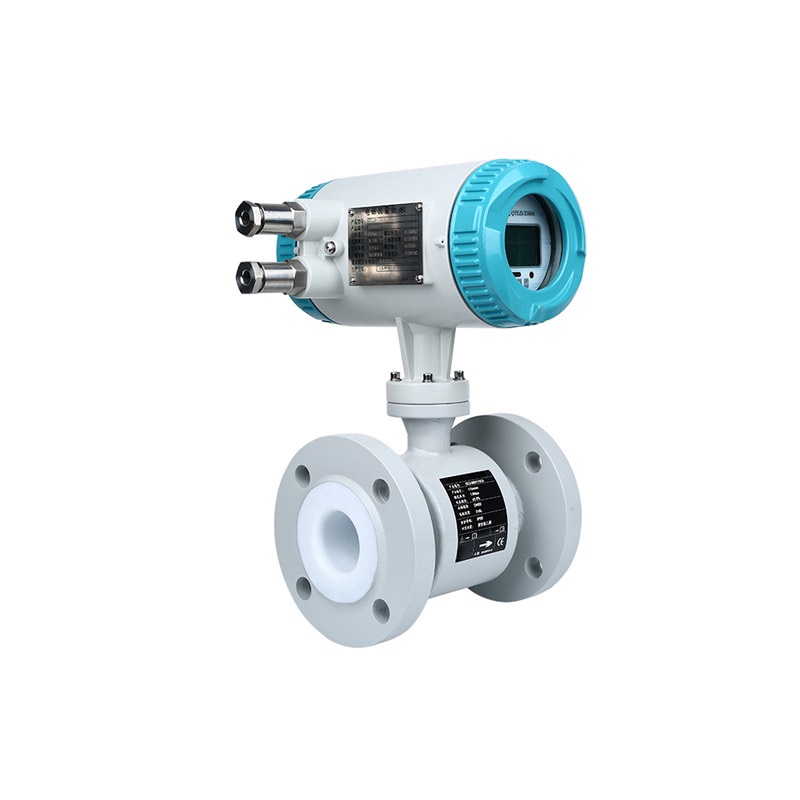
1. Polytetrafluoroethylene (PTFE, preferred for strong corrosion): resistant to strong acid, strong alkali, high temperature (-20 ℃ ~ 180 ℃), non-sticky, anti-aging, suitable for strong corrosion of industrial wastewater (such as chemical and pharmaceutical wastewater), but the wear resistance is general, and sewage with solid content ≥ 5% should be used with caution;
2. Polyurethane rubber (PU, wear-resistant preferred): super wear-resistant, anti-particle erosion, suitable for high impurity, high wear sewage (such as sludge, mine wastewater, sand sewage), temperature range -10 ℃ ~ 80 ℃, but not resistant to strong corrosion;
3. Neoprene (CR, economical): general corrosion resistance, high cost performance, suitable for domestic sewage, neutral sewage (no strong corrosion, low impurity content), temperature resistance -10 ℃ ~ 80 ℃, suitable for conventional municipal scenes with limited budget;
4. Ceramic (Al₂ O, special for high temperature wear resistance): wear resistance, corrosion resistance, high temperature resistance (-20 ℃ ~ 250 ℃), suitable for high solid content, strong wear, high temperature sewage, but brittleness, poor impact resistance and high cost.
Material matching formula (directly applied):
Domestic sewage → 316L stainless steel electrode neoprene lining;
Strong corrosion industrial wastewater → Hastelloy/tantalum electrode PTFE lining;
High miscellaneous wear-resistant sewage → polyurethane electrode polyurethane lining;
Chlorinated sewage → titanium electrode PTFE lining.
Core parameter 3: caliber and flow range (matching pipeline to avoid measurement deviation)
The caliber and flow range directly determine whether the equipment can be adapted to the existing pipeline, avoiding the problems of "large pipe diameter and small flow" and "small pipe diameter and large flow", resulting in inaccurate measurement and accelerated equipment wear.
• Caliber selection (core principle: fit existing pipeline, priority):
1. General scene: the caliber of the flowmeter is consistent with the caliber of the pipeline (for example, DN100 pipeline, DN100 flowmeter is selected) to avoid flow fluctuation caused by throttling or diameter expansion and ensure accurate measurement;
2. Special Scenarios:
-Low flow rate scenario (actual flow rate <0.5 m/s): No. 1 caliber can be reduced (such as DN100 pipeline, DN80 flowmeter is selected) to increase flow rate and avoid signal instability;
-High flow rate scenario (actual flow rate> 6 m/s): the first caliber can be expanded, the flow rate can be reduced, and the wear of pipelines and equipment can be reduced;
-Large diameter pipeline (DN500 or above): plug-in sewage electromagnetic flowmeter is preferred, which can be installed under pressure without damaging the pipeline, and is suitable for the renovation scene of old pipe network.
• Flow range (core principle: reserve margin, adapt to fluctuation):
1. The flow range shall cover the actual sewage flow and reserve a margin of 10%-30% to avoid over-range or insufficient range of the equipment when the sewage flow fluctuates;
2. Ideal flow rate range: the best flow rate of sewage electromagnetic flowmeter is 1.0-3.0 m/s, which has the highest measurement accuracy and the least wear. The allowable flow rate range is 0.3-10 m/s, the signal is weak below 0.3 m/s, and the wear is aggravated above 10 m/s;
3. For example, the actual maximum flow rate of the municipal sewage station is 500 m/h, and a flowmeter with a range of 0-600~650 m/h should be selected to reserve enough fluctuation space.
Core parameter 4: temperature and pressure (suitable for sewage conditions, anti-leakage and anti-damage)
The temperature and pressure of sewage directly affect the sealing performance and service life of the equipment, especially for industrial wastewater. Some scenes will have high temperature and high pressure conditions, which must be accurately matched to avoid equipment leakage and electronic component damage.
• Temperature selection:
1. Conventional sewage scene (domestic sewage, ordinary industrial wastewater): temperature ≤ 80 ℃, select the conventional model (lining temperature -20 ℃ ~ 80 ℃);
2. High temperature sewage scene (such as chemical and metallurgical wastewater): temperature 80 ℃-180 ℃, high temperature type, PTFE or ceramic lining (temperature resistance can reach above 180 ℃);
3. Key points for selection: the temperature resistance of the lining shall be ≥ the maximum temperature of sewage, and a margin of 10 ℃ shall be reserved to avoid aging and damage of the lining caused by high temperature.
• Pressure selection:
1. Conventional scene (municipal sewage, gravity flow pipeline): pressure ≤ 1.6MPa, select standard model;
2. High-pressure scene (such as pump station outlet and high-pressure backwashing pipeline): pressure 2.5-4.0MPa, select high-pressure model, supporting high-pressure sealing structure, and prevent sewage leakage;
3. Selection points: the nominal pressure of the equipment is ≥ the design pressure of the pipeline, and overpressure is strictly prohibited, otherwise it will lead to flange seal failure and sensor damage.
Core parameter 5: protection level (suitable for installation environment, anti-failure)
Sewage flowmeters are mostly installed in humid, dusty and even flooded environments such as outdoors, sewage stations and underground pipe corridors. The protection level directly determines whether the equipment can operate stably for a long time to avoid damage to electronic components caused by water inflow and dust inflow.
The meaning of protection level: with "IPXX", the first X represents the dustproof level, the second X represents the waterproof level, the larger the number, the stronger the protection ability.
• Selection criteria (combined with installation environment):
1. Indoor dry environment (such as control room, dry pump room): IP65 can be selected to prevent dust and splash water from entering;
2. Outdoor and humid environment (such as outdoor pipeline of sewage station and outdoor pumping station): IP67 can be selected to soak in water for a short time (depth ≤ 1m) to prevent rainwater and sewage from splashing into it;
3. Underwater, underground pipe gallery, easy immersion environment (such as channel installation, underground sewage pipeline): choose IP68, can be long-term immersion, completely prevent dust, water into, to ensure the normal operation of the equipment;
4. Explosion-proof scenarios (such as chemical sewage stations and flammable and explosive areas): Select additional explosion-proof models (explosion-proof grade is not lower than ExdⅡ BT4), and at the same time ensure that the grounding resistance is less than 10Ω to avoid potential safety hazards.
Core parameter 6: signal output and installation method (adaptive intelligent monitoring, reduced operation and maintenance)
Although these two parameters do not directly affect the measurement accuracy, but related to the later operation and maintenance convenience and intelligent monitoring needs, especially suitable for municipal sewage stations, large-scale industrial wastewater treatment projects.
(1) Signal output (adapt to the monitoring system to realize data linkage)
• General output mode:
1. Analog output (4-20mA): strong anti-interference ability, suitable for long-distance transmission, can be connected to SCADA system to realize real-time monitoring of flow data;
2. Digital output (RS485/Modbus): easy to integrate into the intelligent water, industrial control platform, support remote parameter adjustment, data upload;
3. Wireless transmission (NB-IoT/LoRa): suitable for remote sewage stations, decentralized treatment facilities, no wiring, reduce construction costs, support remote monitoring and fault warning.
Selection suggestion: "4-20mA RS485" dual output is preferred for municipal sewage stations and large-scale projects, taking into account real-time monitoring and intelligent linkage; Wireless transmission models can be selected for small sewage stations and scattered scenes to simplify construction.
(2) Installation method (adapt to pipeline conditions and reduce installation, operation and maintenance costs)
Common installation methods and adaptation scenarios:
1. Integrated: sensor and converter integrated, low cost, simple installation, suitable for indoor, dry, space-sufficient scenes, conventional small diameter (DN15-DN100) is preferred;
2. Split type: the sensor is installed on site, and the converter is installed in the control room (away from sewage, high temperature, and corrosive environment), suitable for high temperature, strong corrosion, and outdoor humid scenes to avoid damage to the converter;
3. Plug-in type: no need to stop, no need to damage the pipeline, can be installed under pressure, installation and debugging can be completed within 10 minutes, suitable for large-diameter pipelines (DN500 or more), old pipe network transformation scenarios, greatly reducing construction costs.
Installation supplement: no matter which installation method, it is necessary to ensure that the pipeline is fully operated (the medium is installed vertically from bottom to top), and the upstream shall reserve a straight pipe section ≥ 5 times the pipe diameter and the downstream shall reserve a straight pipe section ≥ 3 times the pipe diameter, avoiding elbows, valves and pump outlets, and avoiding flow interference affecting the measurement accuracy; Metal pipelines shall be reliably grounded, and the grounding wire diameter shall be ≥ 5.5mm to avoid electrostatic accumulation interference signals.
Selection summary: 3-step fast matching, farewell tangle
1. Working conditions: clear sewage type (domestic/industrial), medium characteristics (impurity content, corrosion), pipe diameter, temperature and pressure, installation environment;
2. Matching parameters: according to the order of "accuracy → material → caliber flow → temperature pressure → protection level → signal installation", match one by one, give priority to the principle of "adapting working conditions", and do not blindly chase high parameters;
3. Pit avoidance: the material is not blindly selected as expensive, and the corrosion of sewage is accurately matched; The caliber is not blindly selected to adapt to the pipeline flow rate. The protection level is not lowered and it is suitable for the installation environment.
In fact, the core of the selection of sewage electromagnetic flowmeter is not "the more high-end parameters, the better", but "accurate adaptation of sewage conditions". Grasping the above six core parameters and matching them one by one in combination with their own scenes, both novice and experienced engineers can quickly select the right equipment, which not only ensures accurate measurement and durability of the equipment, but also controls procurement and operation and maintenance costs, and completely bid farewell to the tangle of selection.
If you would like to learn more about flow meters orFlowmeter Selection, can be consultedHerbalifeFlowmeter manufacturersTechnical customer service:139 2699 8050(WeChat ID is the same) Get help.
Hot News
- 电磁流量计厂家如何选择?国内外十大品牌综合对比
- Buy flowmeter, first look at the site conditions! 2026 Depth Comparison of Domestic and Imported Brands of Electromagnetic Flowmeter Manufacturers
- 2026 domestic electromagnetic flow manufacturers recommended: top ten brands of intelligent flow meter recommended reasons
- How to choose imported flat electromagnetic flowmeter? How to choose micro-caliber, conventional flange and plug-in electromagnetic? Recommended by domestic high-quality manufacturers
- Four major brands of electromagnetic flowmeter hard core PK: Herbalife Water, Cloud Meter, E H, Cologne, who is more worthy of choice?
- November 2026 Top Ten Brands of Electromagnetic Flowmeter at Home and Abroad Ranking
- Recommended Top Ten Brands of Electromagnetic Flowmeter in 2026: Reference for Project Selection of Water Treatment, Sewage and Conductive Liquid
- TOP5 Manufacturer's Selection Guide for Food Sanitary Electromagnetic Flowmeter: Material and Connection Mode Check before Purchase
- Cost-effective chemical oxygen demand water quality online monitor manufacturers contact information
- How to choose the integrated electromagnetic water meter? Domestic high-quality manufacturers recommendation and selection guide



