




Technical Characteristics and Application Guide for Large Flow Scenarios of Screw-wing Water Meter
2026-01-13 16:46:42
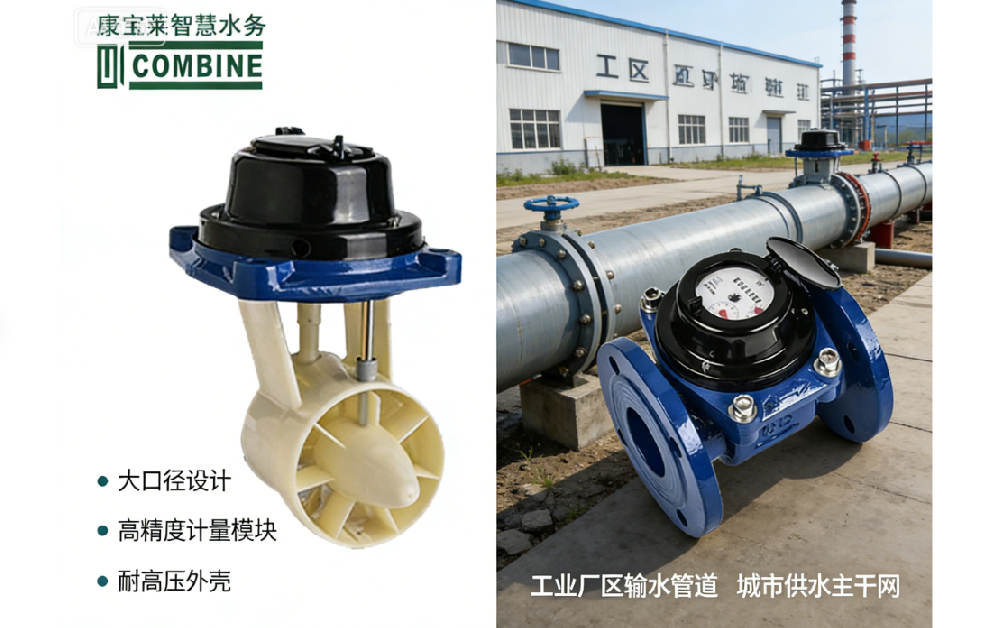
As a classic mechanical water meter, the propeller-type water meter is widely used in high-flow applications such as industrial production, commercial buildings, and municipal water supply, thanks to its low pressure loss, ability to withstand high flow velocities, and robust construction. This article will thoroughly analyze the technical aspects of propeller-type water meters—including their operating principles, product classifications, key advantages, selection criteria, installation and maintenance, and application scenarios—to provide users with expert guidance on equipment selection and operational management.
1. Core Working Principle of Propeller Water Meters
The core component of a helical‑impeller water meter is the spiral‑shaped rotor (helical impeller). The impeller is typically made of high‑strength aluminum alloy or engineering plastic, precision‑machined, and its blade angles are optimized according to fluid dynamics principles. When water flows through the meter’s measuring section, the flow acts axially on the impeller blades, generating thrust that drives the impeller to rotate about its axis. The number of rotations of the impeller is strictly proportional to the volume of water passing through (number of rotations=Water volume×Coefficient; the coefficient is determined by the propeller structure and the pipe diameter. The rotational motion of the impeller is transmitted to the counting mechanism via a mechanical transmission system (gear set). The counting mechanism then converts the number of rotations into water volume using pointer or digital display, thereby measuring water flow. The core of its measurement lies in the energy conversion between the water flow and the helical impeller. By optimizing the blade angle, number, and structural design of the impeller, it ensures a precise match between rotational speed and flow rate, thereby reducing metering error.
Compared with rotary‑type water meters, propeller‑type water meters use axial flow to drive the impeller, resulting in lower flow resistance and reduced pressure loss, making them better suited for measuring large diameters and high flow rates. Its applicable pipe diameter is typicallyDN50and above, the maximum flow rate can reach several thousand cubic meters per hour (e.g.,DN1000mmThe maximum flow rate of a propeller-type water meter can reach5000m³/h), capable of meeting the high water demand of industrial production, large commercial complexes, municipal trunk pipelines, and other applications.
2. Classification and Characteristics of Propeller Water Meters
1. Dry-type propeller water meter: In a dry-type propeller water meter, the counting mechanism is completely isolated from the water flow. The rotational motion of the propeller is transmitted to the counting assembly via magnetic coupling, with only the propeller itself rotating in the water. This design effectively prevents clogging, corrosion, and scaling of the counting mechanism caused by poor water quality—such as the presence of impurities or corrosive substances—thereby significantly extending the meter’s service life and enhancing the accuracy and stability of its measurements. Its protection rating is typicallyIP65It is suitable for industrial wastewater networks or municipal sewage networks with poor water quality and high impurity content, and is particularly well-suited for high-flow scenarios requiring long-term stable operation, such as wastewater discharge measurement in industrial parks and monitoring of municipal sewer trunk lines.
2. Wet-type propeller water meter: All mechanical components of a wet-type propeller water meter (including the propeller, transmission gears, and counting mechanism) are in direct contact with water. It has a relatively simple structure and lower manufacturing costs. Its counting mechanism is driven by water lubrication, providing good operational stability, and its metering accuracy can reach2Level. However, this type of water meter has relatively high requirements for water quality; it must be ensured that the water contains no large particulate matter or highly corrosive substances. It is suitable for use in clean drinking water distribution networks, such as for metering main supply lines in commercial buildings and residential complexes, or for metering municipal drinking water branch lines.
3. Smart propeller water meter: Based on a traditional mechanical structure, the smart propeller water meter integrates electronic sensors (such as Hall-effect sensors and photoelectric sensors) and an IoT communication module (NB-IoT、4G) and the data processing unit. Rotational data from the propeller is collected via electronic sensors, converted into electrical signals, and transmitted to a processing unit. After computational processing, water consumption data is obtained and remotely sent to a management platform via IoT communication. It features remote meter reading, real-time flow monitoring, anomaly alerts (e.g., flow exceeding limits, equipment failure), and prepaid control, enabling intelligent management of high‑volume water consumption. At the same time, a mechanical counting device is retained as a backup to ensure the reliability of metering data. It is widely used at high‑consumption metering nodes in smart water‑management systems, such as industrial water‑use metering and water‑supply metering for large commercial complexes.
3. Core Technical Advantages of Propeller Water Meters
1. Low pressure loss and high flow rate compatibility: The axial flow design of propeller-type water meters significantly reduces flow resistance, resulting in pressure loss far lower than that of rotary vane meters or certain electronic meters of the same nominal diameter; under the same nominal diameter, its pressure loss is only that of a rotary vane meter.1/3-1/2. In high‑flow water supply scenarios, it can effectively maintain stable network pressure and prevent insufficient pressure at the downstream end caused by excessive pressure loss across meters. It has a wide applicable flow range, with a turndown ratio of up to1:100It can reliably handle operating conditions with significant flow fluctuations, such as intermittent water use in industrial production and peak‑period water demand in commercial buildings (e.g., shopping mall foot traffic spikes during holidays or hotels’ peak water usage periods).
2. Robust construction and high durability: The meter body is manufactured from high-strength materials such as cast iron and ductile iron. After aging treatment and anti-corrosion coating, it can withstand harsh operating conditions, including vibration, impact, and corrosive gas exposure in industrial environments. The internal mechanical components have a simple structure, reliable transmission, and no precision electronic parts, resulting in a long service life that typically reaches10years or more; some high-quality products can last up to15Year. In the absence of severe impurity blockage, frequent maintenance is unnecessary, and maintenance costs are only a fraction of those for electronic water meters.1/5-1/3。
3. Bidirectional measurement capability: Some high-end propeller-type water meters feature bidirectional measurement. By optimizing the impeller design and transmission mechanism, they can accurately measure both forward and reverse flow rates, with measurement errors for both directions kept within acceptable tolerances. It is suitable for scenarios where the direction of water flow may change, such as industrial recirculating water systems, reciprocating irrigation systems in agriculture, and fire‑fighting water systems, thereby preventing measurement losses caused by reverse flow and ensuring the integrity of water consumption data.
4. Good metrological stability: Under long-term high-flow operating conditions, the metering accuracy of propeller-type water meters degrades slowly; after professional calibration, their accuracy can remain stable.2Class level, with metering stability superior to that of conventional rotary‑vane water meters. Its mechanical structure is minimally affected by ambient temperature, humidity, and electromagnetic interference, in-20℃-60℃It can operate reliably across a wide range of ambient temperatures, making it suitable for long-term deployment in complex industrial settings or harsh outdoor environments, and it meets the high‑flow water‑trade settlement requirements between industrial enterprises and water utilities.
4. Key Considerations for Selecting Propeller Water Meters
1. Caliber and Flow Rate Matching: Select an appropriate water meter size based on the actual pipe diameter and maximum water consumption flow rate. The key principle is to ensure that the typical flow rate falls within the water meter’s optimal measurement range (i.e., the range of20%-80%). Before selecting a meter, collect data on the pipeline’s design flow rate, normal operating flow rate, peak flow rate, and minimum flow rate to prevent damage caused by flow overload or excessive measurement error due to insufficient flow. For example, in a certain industrial park...DN200mmWater supply pipeline, maximum flow rate is500m³/h, the daily operating flow is200-300m³/h, the range should be selected as0-600m³/hofDN200mmPropeller-type water meters ensure that the typical flow rate remains within the optimal measurement range.
2. Water Quality and Meter Type Selection: Choose between dry‑type or wet‑type propeller water meters based on water quality. In applications with poor water quality and high levels of impurities (e.g., sediment, suspended solids), prioritize dry‑type meters to prevent contaminants from entering the counting mechanism and causing malfunctions. For clean potable water applications, wet‑type meters are suitable and can reduce procurement costs. For scenarios requiring intelligent management and remote monitoring, smart rotary‑vane water meters with integrated IoT capabilities should be selected, and the communication protocol (e.g.,Modbus、MQTT) Compatibility with existing smart water management platforms, ensuring seamless data integration.
3. Work environment compatibility: Consider factors such as temperature, pressure, vibration, and corrosiveness in the installation environment, and select a water meter that meets these environmental requirements. Under high-temperature operating conditions (such as industrial hot water networks, water temperature≤100℃) Under such conditions, water meters made of high-temperature-resistant materials (such as heat-resistant cast iron) must be selected; in high-pressure water supply networks (pressure≥2.5MPa4), it is necessary to confirm that the pressure level of the water meter meets the pressure requirements of the pipeline, and select a high-pressure water meter in the form of flange connection; in industrial sites with large vibration (such as steel plants and machinery plants), it is necessary to select a water meter with a shock absorber, or install flexible joints before and after the water meter to reduce the impact of vibration on the measurement accuracy.
4. Certification and accuracy requirements: The screw-wing water meter used for trade settlement needs to have national measurement certification qualifications, such.CPACertification; imported products must haveMIDAccredited by international metrology authorities. Select the accuracy class according to the application scenario; for industrial and trade settlement, it is recommended to choose2Accuracy classes of level and above; suitable for metering at large municipal water supply customers.1Accuracy class; can be selected for non‑trade settlement scenarios (e.g., internal monitoring)3Grade accuracy level, reducing costs. At the same time, it must be confirmed that the water meter complies with relevant industry standards, such asGB/T 778.1-2018Cold Water Meter Part1Part: Metrological Requirements and Technical Requirements.
5. Installation and Maintenance Specifications for Propeller Water Meters
1. Installation Location and Straight Pipe Requirements: The water meter should be installed in a location that facilitates reading, maintenance, and inspection, avoiding low-lying areas prone to water accumulation, strong magnetic fields, direct exposure to high temperatures, or locations with concentrated corrosive gases. During installation, ensure the meter body is level and that the impeller axis is aligned with the direction of water flow; reverse installation is strictly prohibited. Because propeller-type water meters have high requirements for flow conditions, a straight pipe section of no less than10DNof straight pipe sections, with a minimum of... reserved after the meter5DNof straight pipe sections; if the pipeline contains obstacles such as elbows, tees, or valves, the length of the straight pipe sections must be increased (before the meter, increase to15DN, added after the table to8DN) Or install a rectifier to ensure that the water flow forms a stable axisymmetric flow state and reduce the measurement error.
2. Pipeline pretreatment and filtration: before installation, the pipeline shall be thoroughly cleaned to remove rust, sand, welding slag, hemp wire and other sundries in the pipeline, which can be washed by high pressure or mechanical cleaning. Install before the water meterYType filter, filtration accuracy is not less1mmTo prevent impurities from entering the water meter and wearing the screw and transmission mechanism. The filter shall be provided with a sewage outlet to clean up and filter impurities regularly (it is recommended to clean up once a month, and clean up once a week in cases of poor water quality) to avoid accumulation of impurities causing poor water flow and affecting measurement accuracy.
3. Daily maintenance and calibration: establish a regular inspection system, check the operation status of the counting device of the water meter and the sealing performance of the meter body every month to ensure that there are no water leakage, stuck meter, stuck pointer and other faults. Dry screw wing water meter shall regularly check the tightness of the counting device to avoid water damage. Wet screw wing water meter shall regularly observe the water quality in the meter. In case of turbidity, scaling, etc., the inside of the water meter shall be cleaned in time. each2-3The water meter shall be professionally calibrated once every year. The calibration items include indication error, repeatability, sealing performance, etc. The water meter that fails to pass the calibration shall be repaired or replaced in time. The intelligent screw-wing water meter needs to regularly check the operation status of the communication module and the battery power to ensure stable data transmission and timely replacement when the battery power is insufficient.
Typical application scenarios of 6. screw type water meter
1. Industrial production scenario: In the circulating water system, production water pipe network and wastewater discharge pipe network of chemical, electric power, iron and steel, textile and other industrial enterprises, the screw-type water meter is used for large-flow water measurement to realize the cost accounting, energy consumption control and environmental protection monitoring of production water. For example, the circulating water system of a thermal power plant adoptsDN500mmThe intelligent screw wing water meter monitors the circulating water flow in real time (the normal operating flow is2000-2500m³/h) to ensure the stable operation of the unit cooling system and avoid overheating of the unit due to insufficient flow; at the same time, through remote data transmission, automatic statistics and reporting of water consumption can be realized to improve energy management efficiency.
2. Commercial building scenario: In the measurement of water supply trunk pipes in large shopping malls, hotels, office buildings, hospitals and other commercial buildings, the screw-wing water meter, with the advantages of low pressure loss and large flow, ensures that the water supply pressure in the building is stable and meets the peak water demand. For example, a large shopping centerDN300mmThe water supply trunk pipe adopts intelligent screw wing water meter, real-time monitoring of water consumption in each area, to achieve the cost of water partition accounting, remote meter reading function instead of manual meter reading, to avoid the meter reading personnel into the mall inside the cumbersome, improve the efficiency of property management.
3. Municipal water supply scenario: In the main pipe of the urban water supply network, the partition metering node, the secondary water supply pump house outlet and other locations, the screw-type water meter is used to monitor the flow distribution of the network and provide data support for water supply scheduling. Through the linkage with the intelligent water platform, the trend of flow change in each region is analyzed, and the leakage analysis and flow balance regulation of the pipe network are realized. For example, a city in the water supply network zoning measurement.DN600mmScrew-wing water meter, real-time monitoring of water consumption in each partition, combined with pressure data to identify leakage areas, the pipe network leakage rate control.10%Within.
4. Agricultural irrigation scenario: In the main canal irrigation water supply system of large farms and irrigation areas, the screw water meter is used to accurately measure the irrigation water consumption, so as to realize the rational allocation of water resources and cost control. Its resistance to harsh environment (open air, high temperature, vibration) characteristics, suitable for the long-term operation of open-air irrigation pipe network. For example, the main irrigation pipeline of a large irrigation district adoptsDN400mmPropeller-type water meters measure the irrigation water usage of each field and charge irrigation fees based on consumption, encouraging farmers to conserve water and improving water resource efficiency.
Hot News
- Buy flowmeter, first look at the site conditions! 2026 Depth Comparison of Domestic and Imported Brands of Electromagnetic Flowmeter Manufacturers
- 2026 domestic electromagnetic flow manufacturers recommended: top ten brands of intelligent flow meter recommended reasons
- How to choose imported flat electromagnetic flowmeter? How to choose micro-caliber, conventional flange and plug-in electromagnetic? Recommended by domestic high-quality manufacturers
- Four major brands of electromagnetic flowmeter hard core PK: Herbalife Water, Cloud Meter, E H, Cologne, who is more worthy of choice?
- November 2026 Top Ten Brands of Electromagnetic Flowmeter at Home and Abroad Ranking
- Recommended Top Ten Brands of Electromagnetic Flowmeter in 2026: Reference for Project Selection of Water Treatment, Sewage and Conductive Liquid
- TOP5 Manufacturer's Selection Guide for Food Sanitary Electromagnetic Flowmeter: Material and Connection Mode Check before Purchase
- Cost-effective chemical oxygen demand water quality online monitor manufacturers contact information
- How to choose the integrated electromagnetic water meter? Domestic high-quality manufacturers recommendation and selection guide
- Selection of Electromagnetic Flowmeter for Small Diameter Ultra-high Temperature Medium Metering Engineering



