




Why is electromagnetic flowmeter not afraid of corrosion? Reveal its "anti-corrosion coat" material code
2026-01-08 11:04:25
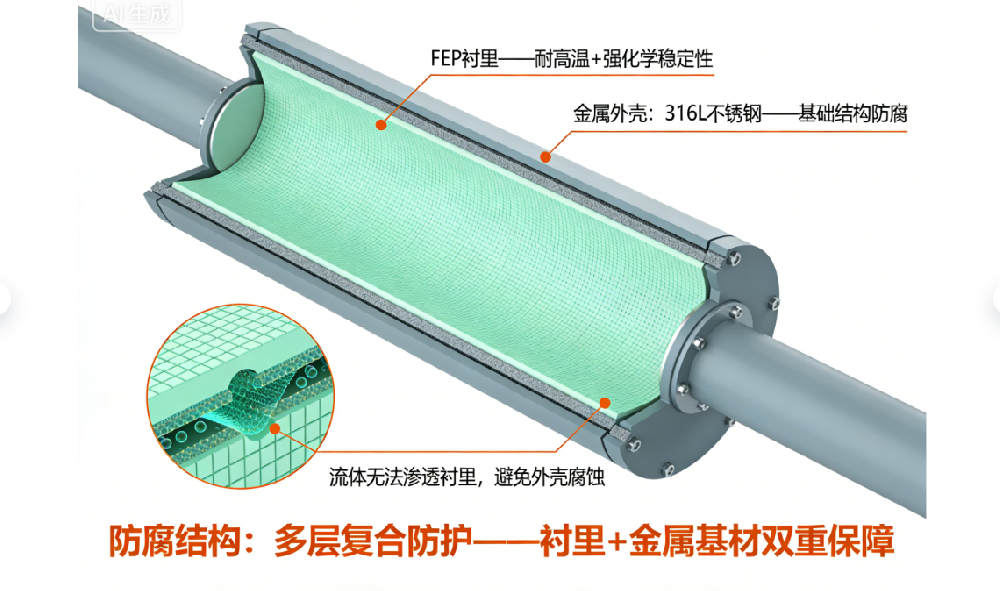
In industries such as petrochemicals, wastewater treatment, and the production of acids and alkalis, fluid media often exhibit strong corrosivity—examples include concentrated acids, strong bases, and chlorine-containing solutions. These corrosive substances can severely erode flow-measurement equipment, leading to equipment damage, reduced measurement accuracy, or even complete failure of operation. The electromagnetic flowmeter can work stably in these harsh corrosive environments, as if wearing a layer“Anti-corrosion coat”. So, this layer“Anti-corrosion coat”What is it? What is its material code? This article will detail the anti-corrosion material of popular science electromagnetic flowmeter, revealing the core reason why it is not afraid of corrosion.
electromagnetic flowmeter“Anti-corrosion coat”It is not a single material, but is composed of anti-corrosion materials of multiple core components such as measuring tubes, linings, electrodes, etc. These components are in direct contact with corrosive media, and the anti-corrosion performance of the material directly determines the overall corrosion resistance of the electromagnetic flowmeter. Engineers through the precise selection and optimization of the material of different components, so that the electromagnetic flowmeter can adapt to different types of corrosive media, to achieve stable flow measurement.
The first is the material selection of the measuring tube. The measuring tube is the flow channel of the fluid, which needs to take into account the structural strength and anti-corrosion performance, and at the same time meet the non-magnetic requirements (to avoid interference with the magnetic field distribution). For different corrosion conditions, the material of the measuring tube is mainly as follows:316LStainless steel is the most commonly used basic anti-corrosion material, has good corrosion resistance and mechanical strength, can withstand weak acid, weak alkali, medium corrosion containing trace chloride ions, suitable for most conventional corrosion conditions;C- 276It is a high-performance corrosion-resistant alloy, which can withstand the corrosion of strong acids, strong alkalis, oxidizing media (such as nitric acid, chlorine) and other strong corrosive media, and is suitable for harsh corrosion conditions in the chemical industry. Titanium alloy has excellent corrosion resistance and high temperature resistance, especially in chlorine-containing media (such as sea water, sodium hypochlorite solution) and strong oxidizing media, and is suitable for marine engineering, sewage treatment and other scenarios; the glass fiber reinforced plastic material is light in weight and strong in corrosion resistance, and can withstand the corrosion of most acid and alkali media. It is suitable for large-diameter, low-pressure corrosive media transportation and metering scenarios.
The second is the material selection of the lining. The lining is an insulating protective layer on the inner wall of the measuring tube, which is in direct contact with corrosive media and is an electromagnetic flowmeter.“Anti-corrosion coat”A core component. The lining should not only have excellent anti-corrosion performance, but also have good insulation, wear resistance and sealing to prevent the medium from penetrating and corroding the measuring tube. Common lining materials include the following: polytetrafluoroethylene (PTFE) Is one of the lining materials with the strongest anti-corrosion performance, known“The Plastic King”It can withstand almost all corrosive media such as strong acids, strong alkalis, organic solvents, etc., and the use temperature can reach150℃, is the preferred lining material for strong corrosion conditions, widely used in chemical, pharmaceutical and other fields (FEP) is slightly inferiorPTFEHowever, the processing performance is better, it can be made into complex shapes, suitable for conventional corrosive media and normal temperature working conditions, and the cost is relatively low. Natural rubber lining has good elasticity and corrosion resistance, is suitable for non-corrosive or weakly corrosive media (such as clean water and sewage), but is not resistant to oil and strong oxidants; NBR lining has excellent oil resistance, can withstand corrosion of oily media such as crude oil and lubricating oil, and has certain weak corrosion resistance, it is suitable for the measurement of oily media in the field of petrochemical industry. The main advantage of ceramic lining (alumina ceramic) is excellent wear resistance and certain corrosion resistance. It is suitable for corrosive media with high solid content and strong abrasion (such as sand-containing sewage and corrosive slurry).
The electrode is the core component of signal acquisition, which is in direct contact with corrosive media. The anti-corrosion performance and conductivity of the material directly affect the measurement accuracy and equipment life. Common electrode materials are the following:316LStainless steel electrode is suitable for neutral, weak corrosive medium, strong versatility, cost economy;BElectrode has excellent resistance to hydrochloric acid, sulfuric acid and other strong acid corrosion performance, suitable for chemical industry strong acid medium measurement;CThe electrode can withstand the corrosion of strong corrosive media such as oxidizing acid (such as nitric acid) and mixed acid, and is a common electrode material for strong corrosive conditions. Titanium electrode has good stability in chlorine-containing medium and strong oxidizing medium, with outstanding corrosion resistance and high temperature resistance, and is suitable for seawater, sewage treatment and high temperature corrosive medium measurement. Platinum-iridium alloy electrode is the electrode material with the strongest corrosion resistance and can withstand extreme conditions of high temperature, high pressure and strong corrosion, it is suitable for high-end chemical, pharmaceutical and other scenarios that require high measurement accuracy and anti-corrosion performance, but the cost is extremely high, and it is only selected under special needs.
The anti-corrosion ability of the electromagnetic flowmeter depends not only on the material of the individual components, but also on the matching and sealing performance between the components. For example, the bonding strength between the lining and the measuring tube must be high enough to avoid the penetration of the medium from the gap between the lining and the tube body, resulting in corrosion of the measuring tube; the sealing between the electrode and the lining must be tight to prevent the corrosive medium from entering the electrode and damaging the signal transmission structure of the electrode. Therefore, in the manufacturing process of the electromagnetic flowmeter, in addition to selecting high-quality anti-corrosion materials, precise processing technology and strict quality inspection will be used to ensure the matching accuracy and sealing performance between the components.
In practical applications, electromagnetic flowmeter“Anti-corrosion coat”Accurate matching according to specific media characteristics is required. For example, when measuring concentrated hydrochloric acid medium, Hastelloy alloy should be used.BElectrodes,PTFELining and HastelloyC- 276Measuring tube; when measuring chlorine-containing sewage, titanium electrodes should be used,PTFELining &316LStainless steel measuring tube; When measuring crude oil, it should be selected316Lstainless steel electrode, nitrile rubber lining and316LStainless steel measuring tube. Only by realizing the precise matching of material and medium can the anti-corrosion performance of electromagnetic flowmeter be brought into full play to ensure the long-term stable operation of the equipment.
In summary, the electromagnetic flowmeter is not afraid of corrosion because it has a measuring tube, lining, electrodes and other components.“Anti-corrosion coat”,These components were selected316LStainless steel, Hastelloy, Titanium alloy,PTFESuch as high-quality anti-corrosion materials, at the same time through the precision manufacturing process to ensure the fit between the components and sealing performance. This layer“Anti-corrosion coat”The material code of the engineer is the precise selection and optimization design of the material according to different corrosion conditions. With the continuous development of material science, more and more high-performance anti-corrosion materials will be applied to electromagnetic flowmeter, which will further improve its anti-corrosion ability and expand its application range in severe corrosion conditions.
Hot News
- Buy flowmeter, first look at the site conditions! 2026 Depth Comparison of Domestic and Imported Brands of Electromagnetic Flowmeter Manufacturers
- 2026 domestic electromagnetic flow manufacturers recommended: top ten brands of intelligent flow meter recommended reasons
- How to choose imported flat electromagnetic flowmeter? How to choose micro-caliber, conventional flange and plug-in electromagnetic? Recommended by domestic high-quality manufacturers
- Four major brands of electromagnetic flowmeter hard core PK: Herbalife Water, Cloud Meter, E H, Cologne, who is more worthy of choice?
- November 2026 Top Ten Brands of Electromagnetic Flowmeter at Home and Abroad Ranking
- Recommended Top Ten Brands of Electromagnetic Flowmeter in 2026: Reference for Project Selection of Water Treatment, Sewage and Conductive Liquid
- TOP5 Manufacturer's Selection Guide for Food Sanitary Electromagnetic Flowmeter: Material and Connection Mode Check before Purchase
- Cost-effective chemical oxygen demand water quality online monitor manufacturers contact information
- How to choose the integrated electromagnetic water meter? Domestic high-quality manufacturers recommendation and selection guide
- Selection of Electromagnetic Flowmeter for Small Diameter Ultra-high Temperature Medium Metering Engineering



