




Non-contact Measurement Principle of Electromagnetic Flowmeter
2026-01-08 10:45:19
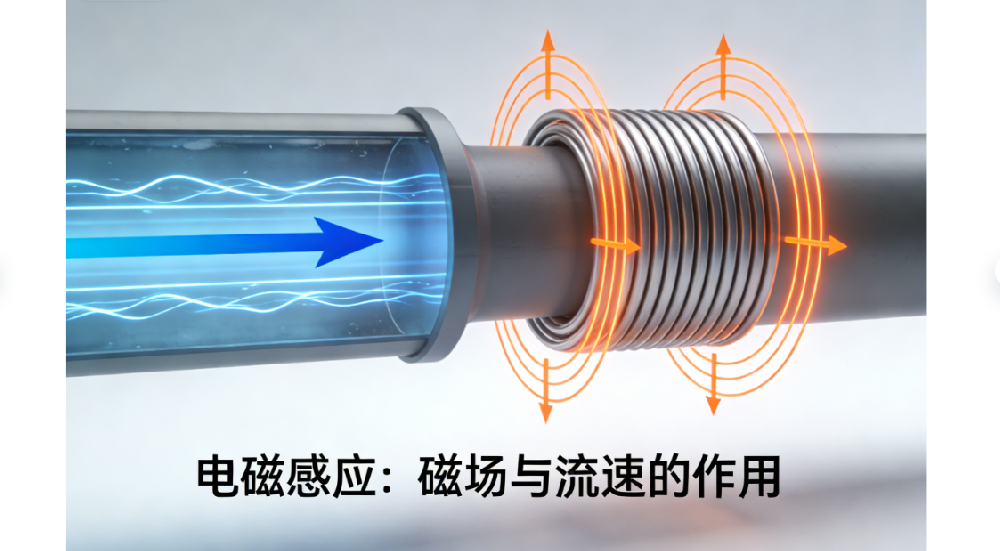
In the field of flow metering,“contact measurement”It used to be the mainstream way, that is, through the direct contact between the mechanical parts and the fluid, the flow is calculated by the kinetic energy of the fluid to push the parts to rotate. However, this approach suffers from drawbacks such as wear, clogging, and susceptibility to contamination, making it difficult to ensure measurement accuracy under complex operating conditions. The non-contact measurement technology of electromagnetic flowmeter has completely changed this situation and realized“Can also measure flow without contact”A breakthrough. What exactly is the principle of this non-contact measurement? How can it accurately capture the flow signal without direct contact with the fluid? This article will detail the non-contact measurement principle of popular science electromagnetic flowmeter, and interpret its technical advantages and application scenarios.
First of all, it needs to be clear that the non-contact measurement of electromagnetic flowmeter does not mean that the equipment is completely out of contact with the pipeline and the fluid, but that the core signal acquisition component (electrode) is not in direct contact with the fluid. Its working principle is still based on Faraday's law of electromagnetic induction. The core logic is to generate an induced electromotive force through the interaction of a magnetic field and a conductive fluid, and then capture this electromotive force signal in a non-contact manner to calculate the flow. Compared with the traditional contact electrode, the non-contact electrode is isolated from the fluid by the insulating lining, which fundamentally avoids the direct contact between the electrode and the fluid, thus solving the problem of easy corrosion, easy scaling and easy wear in contact measurement.
The core structure of a non-contact electromagnetic flowmeter comprises the measuring tube, excitation coil, non-contact electrodes, and converter. The measuring tube is a fluid flow channel, and its inner wall is lined with a lining with excellent insulation performance (such as polytetrafluoroethylene, ceramic, etc.). This lining can not only prevent the measuring tube from being corroded, but also is the key to realize the isolation between the electrode and the fluid. The excitation coil is wound outside the measuring tube to generate a uniform and stable magnetic field, and the magnetic field direction is perpendicular to the fluid flow direction; non-contact electrodes (commonly capacitive electrodes) are installed on the outside of the lining and are closely attached to the inner wall of the measuring tube without direct contact with the fluid; the converter is responsible for processing the signals captured by the electrodes and converting them into flow data.
The specific measurement process can be divided into three steps: the first step is to generate a uniform and stable magnetic field after the excitation coil is energized. The magnetic field penetrates the measuring tube and the lining and acts on the conductive fluid flowing through the measuring tube; The second step is to cut the magnetic induction line to generate induced electromotive force when the conductive fluid flows in the magnetic field. Because the lining is insulated, the induced electromotive force cannot be conducted through the lining. At this time, a capacitance will be formed between the fluid and the non-contact electrode, the induced electromotive force is transmitted to the electrode by capacitive coupling; in the third step, the electrode captures the coupled induced electromotive force signal and transmits it to the converter. The converter amplifies, filters, and calculates the signal, and finally converts it into fluid. Volume flow.
The key technology here is capacitive coupling to transmit signals. The lining between the non-contact electrode and the fluid is equivalent to the dielectric of the capacitor, and the fluid and the electrode are equivalent to the two plates of the capacitor, forming a parallel plate capacitor. When an induced electromotive force is generated in the fluid, a potential difference is formed at both ends of the capacitor, and the electrode captures the induced electromotive force signal by sensing the potential difference. In order to ensure the stability and strength of signal transmission, the area of the non-contact electrode is usually large, and it is closely attached to the lining, and the thickness of the lining needs to be strictly controlled, not only to ensure the insulation performance, but also to ensure the effect of capacitive coupling.
Compared with contact measurement, non-contact measurement has significant technical advantages: First, it has strong anti-pollution ability, and the electrode does not directly contact the fluid, which avoids the adsorption of suspended solids, organic matter and other pollutants in the fluid on the electrode surface. Scaling and corrosion greatly reduce the probability of equipment failure and extend the service life; the second is excellent wear resistance, for fluids with high solid content and strong abrasion (such as slurry and sandy water), the non-contact electrode will not be washed and worn by solid particles and can maintain stable measurement performance for a long time. Third, the maintenance cost is low, and there is no need to disassemble and clean the electrode regularly, which reduces the workload of manual maintenance and equipment downtime, and improves production efficiency.
However, non-contact measurement also has certain limitations: first, there is attenuation in signal transmission. As the induced electromotive force needs to be transmitted through capacitive coupling, the signal strength will be weakened, so a high-sensitivity signal processing circuit is required, otherwise the measurement accuracy will be affected; Second, the measurement accuracy is slightly lower than that of contact measurement, which may not meet the requirements in high-precision trade settlement scenarios. Third, the performance requirements for lining are relatively high, the insulation of the lining, the thickness uniformity, and the fit with the measuring tube will affect the capacitive coupling effect, and then affect the measurement accuracy.
Based on these characteristics, non-contact electromagnetic flowmeter is mainly suitable for the following working conditions: first, fluid measurement with high solid content and easy scaling, such as sewage treatment, mine slurry transportation, sediment water measurement in metallurgical industry, etc.; Second, strong corrosive fluid measurement, such as strong acid and strong alkali solution measurement in chemical industry, to avoid electrode corrosion; Third, fluid measurement with high sanitary requirements, such as the food and pharmaceutical industry liquid, beverage measurement, the electrode is not in contact with the fluid to avoid contamination of the fluid, in line with health standards. In these scenarios, the advantages of non-contact electromagnetic flowmeters can be brought into full play, solving the problem that contact measurement cannot cope.
With the continuous development of technology, the performance of non-contact electromagnetic flowmeter is also improving. At present, by optimizing the electrode structure, improving the signal processing algorithm, and improving the lining manufacturing process, the measurement accuracy of the non-contact electromagnetic flowmeter has been greatly improved, and the accuracy of some products has been close to the contact measurement level, which can meet the needs of more scenarios. At the same time, the integration of intelligent technology enables the non-contact electromagnetic flowmeter to have the functions of remote monitoring and self-diagnosis, which further improves the operation and maintenance efficiency of the equipment.
The non-contact measurement principle of electromagnetic flowmeter is a major breakthrough in the traditional contact measurement technology. It realizes the non-contact signal acquisition through capacitive coupling, and solves many problems of flow measurement under complex working conditions. Although there are some limitations, the advantages of non-contact electromagnetic flowmeter can not be replaced under certain conditions. With the continuous advancement of technology, it is believed that non-contact measurement technology will continue to improve, bringing more innovations and breakthroughs in the field of flow measurement, and better meeting the complex needs of industrial production and people's livelihood.
Hot News
- Buy flowmeter, first look at the site conditions! 2026 Depth Comparison of Domestic and Imported Brands of Electromagnetic Flowmeter Manufacturers
- 2026 domestic electromagnetic flow manufacturers recommended: top ten brands of intelligent flow meter recommended reasons
- How to choose imported flat electromagnetic flowmeter? How to choose micro-caliber, conventional flange and plug-in electromagnetic? Recommended by domestic high-quality manufacturers
- Four major brands of electromagnetic flowmeter hard core PK: Herbalife Water, Cloud Meter, E H, Cologne, who is more worthy of choice?
- November 2026 Top Ten Brands of Electromagnetic Flowmeter at Home and Abroad Ranking
- Recommended Top Ten Brands of Electromagnetic Flowmeter in 2026: Reference for Project Selection of Water Treatment, Sewage and Conductive Liquid
- TOP5 Manufacturer's Selection Guide for Food Sanitary Electromagnetic Flowmeter: Material and Connection Mode Check before Purchase
- Cost-effective chemical oxygen demand water quality online monitor manufacturers contact information
- How to choose the integrated electromagnetic water meter? Domestic high-quality manufacturers recommendation and selection guide
- Selection of Electromagnetic Flowmeter for Small Diameter Ultra-high Temperature Medium Metering Engineering



