




Analysis of Factors Affecting the Accuracy of Electromagnetic Flowmeter: How to Avoid Interference to Achieve Accurate Measurement?
2025-12-23 09:33:03
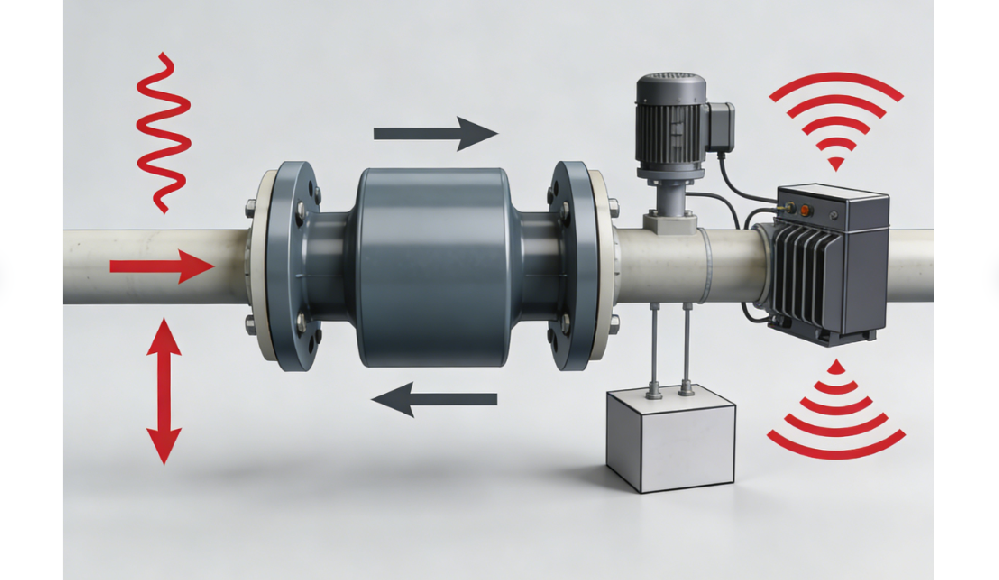
In industrial process control, energy metering, environmental monitoring, and other fields, electromagnetic flowmeters serve as critical instruments for measuring the flow of conductive fluids; their measurement accuracy directly impacts improvements in production efficiency, control of energy costs, and compliance with environmental standards. Thanks to its advantages—non-contact measurement, zero pressure loss, and compatibility with a wide range of corrosive fluids—electromagnetic flowmeters are now widely used in industries such as water treatment, petrochemicals, food, and pharmaceuticals. However, in actual operation, the measurement accuracy is prone to deviation due to many factors such as sensor design, fluid characteristics, external environment, installation and debugging. This paper systematically analyzes the core factors affecting the accuracy of electromagnetic flowmeter, and puts forward the interference avoidance strategy to provide technical reference for the realization of accurate measurement.
1. core influencing factors: multi-dimensional interference from the device itself to the operating environment
The measurement accuracy of electromagnetic flowmeter is the result of the synergy of sensor signal acquisition, signal processing and fluid flow characteristics, and any deviation in any link will lead to measurement error. Combined with the actual application scenario, the factors affecting the accuracy can be divided into four categories: the sensor's own design and performance defects, the measured fluid characteristics fluctuations, external environmental interference, installation and debugging is not standardized.
1. Sensor's own factors: the basis of measurement accuracy to ensure short board
As the signal acquisition core of electromagnetic flowmeter, the structure design and component performance of the sensor directly determine the reliability of the measurement benchmark. The first is the design defect of the measuring tube. If the inner diameter of the measuring tube is not accurate enough, the lining material is not properly selected or worn and aged, the magnetic field uniformity will be destroyed or the fluid flow channel will be distorted. For example, after the lining is worn, the actual inner diameter of the measuring tube will become larger. According to the flow calculation formula Q = v. S(S is the cross-sectional area of the pipeline), the measured flow value will be small. However, if the hard lining is not tightly attached to the measuring tube, it will vibrate under the impact of the fluid and introduce false signals.
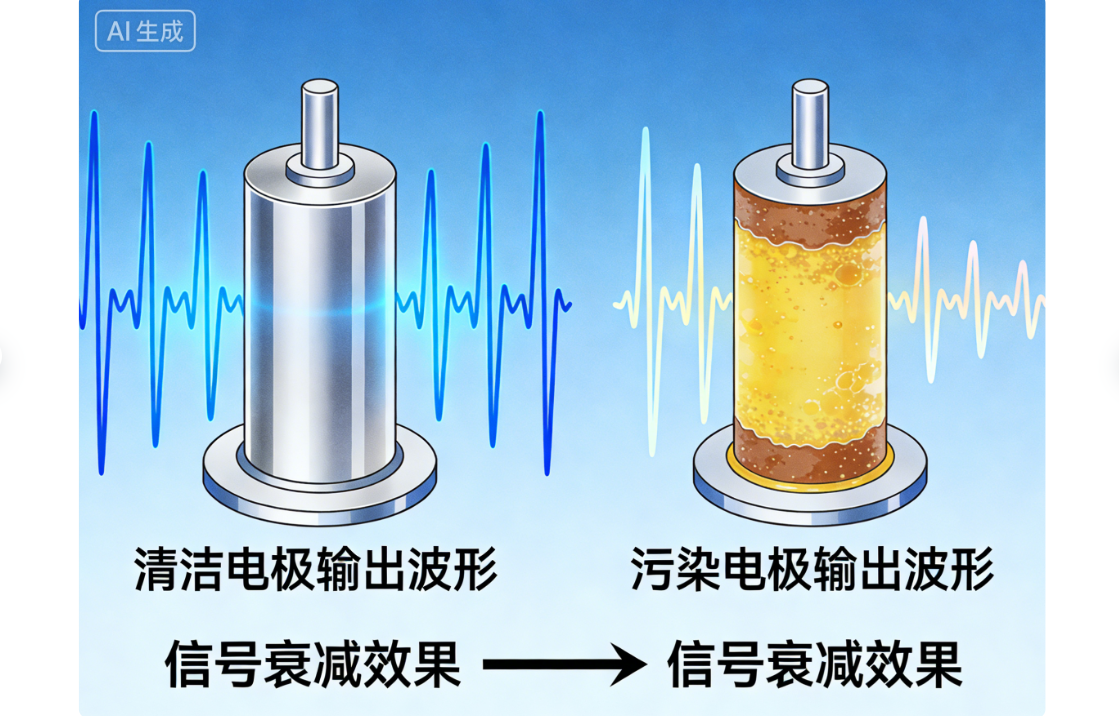
Secondly, the performance of the excitation system is insufficient, and the uneven winding of the excitation coil will lead to the asymmetry of the magnetic field distribution, which will cause the deviation of the induced electromotive force collected by the electrode; the poor stability of the excitation power supply will cause the fluctuation of the magnetic field strength and destroy the linear relationship between the induced electromotive force and the flow rate. The early DC excitation method is easy to cause electrode polarization, resulting in signal attenuation, and if the sine wave alternating excitation is not shielded, the signal stability will be further affected by power frequency interference. In addition, improper selection of electrode materials or surface pollution and oxidation will increase the contact resistance and reduce the signal conduction efficiency, especially in low flow conditions, the attenuation of weak signals will directly lead to the expansion of measurement errors.
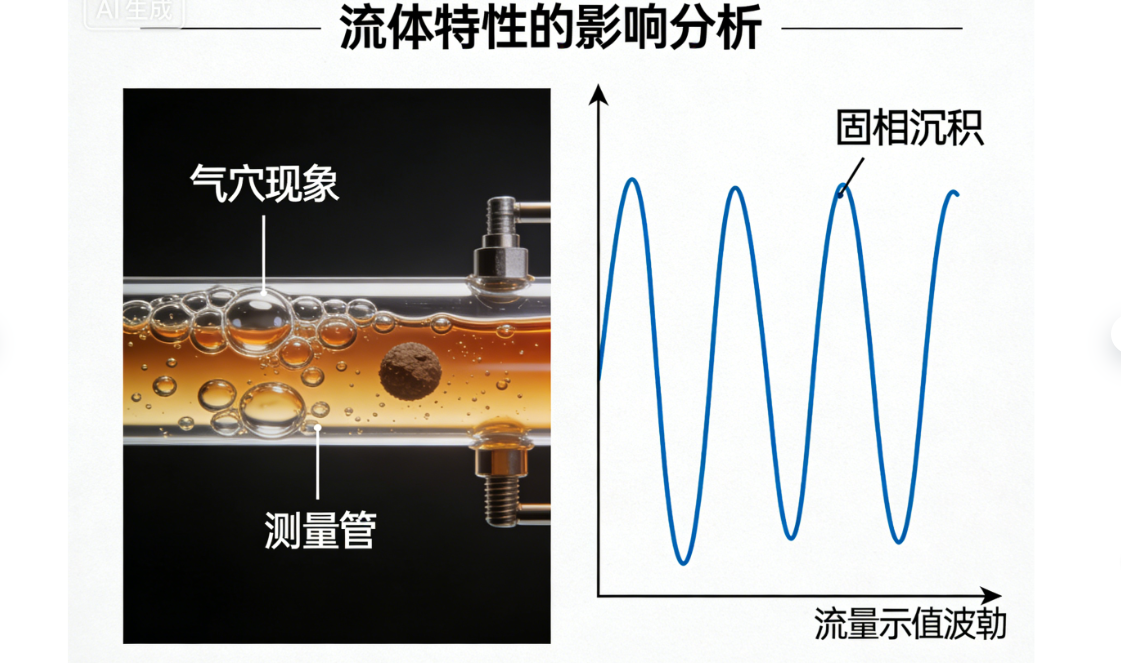
2. The measured fluid characteristics: media interference factors can not be ignored
The measurement principle of electromagnetic flowmeters relies on the conductivity of the fluid; therefore, fluctuations in fluid properties directly affect measurement accuracy. First, the conductivity of the fluid does not meet the requirements. When the conductivity is too low (such as less than 5 μS/cm), the induced electromotive force signal is weak, the signal-to-noise ratio is extremely low, and it is easy to be submerged by interference signals. When the conductivity is too high, the fluid is easy to form a short circuit effect with the electrode, which will also lead to signal distortion. For example, when measuring high-purity deionized water, the measured value often drifts due to insufficient conductivity; and when measuring strong electrolyte solutions, if the conductivity is too high, it may cause leakage between electrodes and affect signal acquisition.
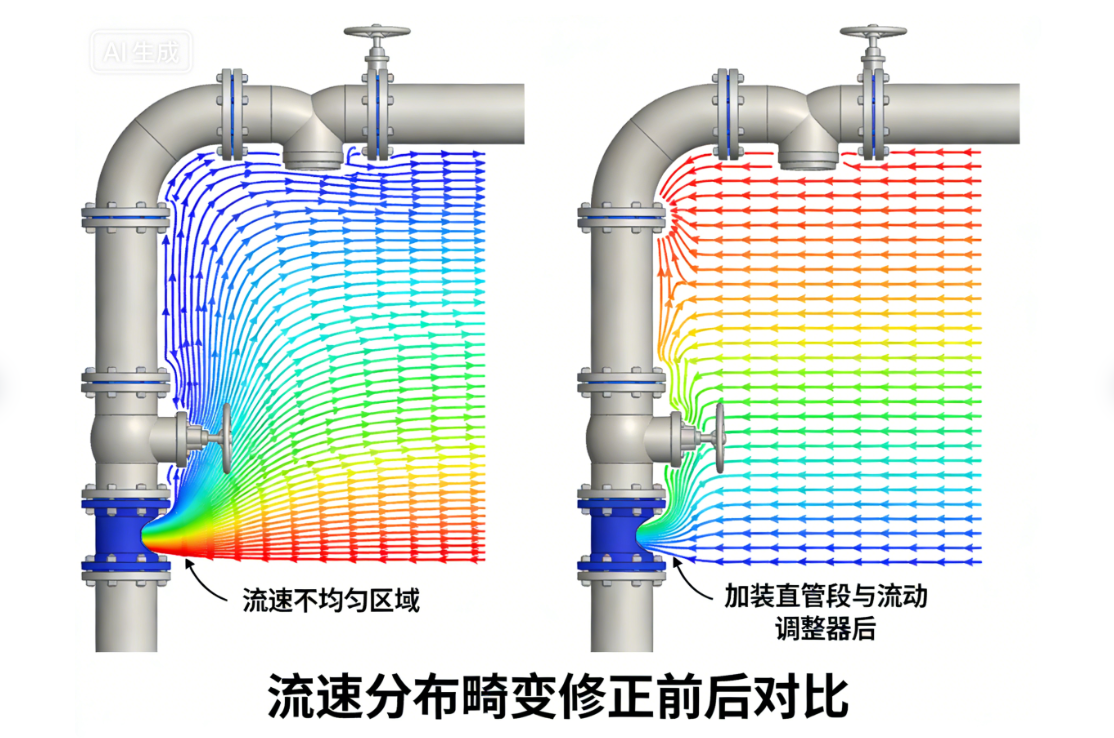
The second is the uneven distribution of fluid flow rate. If the fluid flows in the measuring tube in non-axisymmetric flow such as eddy current and swirl flow, it will lead to the difference of flow rate in different regions, so that the induced electromotive force collected by the electrode can not accurately reflect the average flow rate. This situation occurs in the pipeline elbow, downstream of the valve, the fluid did not form a fully developed laminar flow state. In addition, the gas content and solid content in the fluid will also affect the measurement accuracy, bubbles will destroy the continuity of the fluid, so that the induction signal pulse-type fluctuations, solid particles will wear the lining, impact the electrode, while changing the equivalent conductivity of the fluid, resulting in the measured value deviating from the true value.
3. External environment interference: external interference source under complex working conditions
The complex environment of industrial field is an important interference source of electromagnetic flowmeter accuracy, mainly including electromagnetic interference, mechanical vibration and temperature and humidity. Electromagnetic interference is the most important external interference. Industrial field frequency converters, motors, high-voltage lines and other equipment will produce strong electromagnetic radiation. These radiation signals will invade the sensor and signal processing circuit through spatial coupling or line conduction, and interfere with the induced electromotive force signal. Among them, 50Hz power frequency interference is the most common, which will be superimposed with the excitation signal, resulting in the signal processing system can not accurately separate the effective signal.
Mechanical vibration interference mostly comes from pipeline vibration and equipment resonance. When the pipeline generates high-frequency vibration due to pump body vibration and fluid impact, it will drive the sensor component to vibrate, causing the relative position of the electrode and the fluid to change slightly, resulting in false induction signals. Changes in temperature and humidity will affect the performance of sensor components. High temperature environment will cause the excitation coil resistance to increase and the magnetic field strength to decrease. If the high humidity environment is not sealed, the electrodes and circuits will be affected with moisture, causing leakage or short circuit. Especially in outdoor installation scenarios, day and night fluctuations in temperature and humidity will aggravate accuracy deviation.
4. Installation and commissioning: system error caused by human operation
Non-standard practices during installation and commissioning can compromise the measurement accuracy of electromagnetic flowmeters. First, the installation position is improper, the sensor is installed near the pipe elbow, tee, valve and other throttling components, will lead to uneven distribution of fluid velocity; installed near the source of strong electromagnetic interference (such as frequency converter), not do a good job shielding isolation, will directly introduce electromagnetic interference. In addition, if the sensor is not installed horizontally or vertically, it will cause the fluid to deposit in the measuring tube, which will affect the normal operation of the lining and the electrode.
Second, the debugging parameters are set incorrectly. If the inner diameter of the measuring tube, fluid conductivity, excitation frequency and other parameters are not accurately set according to the actual working conditions, the flow calculation deviation will be directly caused. For example, setting the inner diameter of the measuring tube too small will make the calculated flow value too large; the excitation frequency setting does not match the fluid flow rate, which will reduce the signal response speed and cannot accurately track the dynamic flow change. At the same time, non-standard zero calibration is also a common problem. If zero calibration is performed when the fluid is not completely stationary, initial errors will be introduced and subsequent measurement accuracy will be affected.
2. Interference Avoidance Strategy: A Technical Path to Ensure Accurate Metering in the Whole Process
In view of the above influencing factors, measures should be taken from the whole process of sensor selection, installation and commissioning, signal processing optimization, operation and maintenance to avoid all kinds of interference and ensure the measurement accuracy of electromagnetic flowmeter.
1. Scientific selection and sensor optimization: build a solid foundation for accuracy
Proper sensor selection is a prerequisite for avoiding accuracy degradation. The appropriate sensor parameters shall be selected according to the characteristics of the fluid to be measured: for corrosive fluids, corrosion-resistant electrodes such as Hastelloy and titanium alloys and corrosion-resistant linings such as polytetrafluoroethylene and ceramics shall be selected; for high-viscosity and particulate-containing fluids, large-diameter, wear-resistant lining sensors shall be selected, and filters shall be installed to reduce particle impact. At the same time, according to the fluid conductivity to choose the appropriate excitation mode, low conductivity fluid preferred square wave alternating excitation or dual-frequency excitation sensor, improve the signal to noise ratio; high conductivity fluid is to optimize the electrode spacing, to avoid short circuit effect.
In addition, the anti-interference ability can be improved through the optimization of the sensor structure: the symmetrical excitation coil design is adopted to ensure the uniform distribution of the magnetic field; the diversion device is added at both ends of the measuring tube to improve the fluid flow rate distribution; the sensor housing is metal shielded and encapsulated to reduce the intrusion of electromagnetic radiation. For harsh conditions, sensors with temperature compensation function can also be used to correct the temperature drift of magnetic field strength and electrode resistance in real time through the built-in temperature sensor.
2. Standard installation and debugging: avoid human and installation interference
The installation process shall strictly follow the principle of "avoiding interference and equalflow velocity. The sensor shall be installed away from the source of electromagnetic interference such as frequency converter and high voltage line. If it cannot be avoided, it shall be connected by shielded cable. The cable shall be laid away from the power cable and parallel laying shall be avoided. The installation position should be selected straight pipe section, the length of the upstream straight pipe section is not less than 5 times the inner diameter of the pipe, and the downstream straight pipe section is not less than 3 times the inner diameter of the pipe to ensure that the fluid forms a fully developed laminar flow; if it must be installed near the throttle component, a rectifier should be installed upstream of the sensor.
The parameters shall be set accurately and calibrated in the debugging process: input parameters accurately according to the actual measuring pipe inner diameter and fluid type to ensure the correctness of the flow calculation formula; The excitation frequency shall be adjusted according to the fluid flow rate, and high frequency excitation shall be preferred for dynamic flow measurement. Zero calibration shall be carried out under the condition that the fluid is completely stationary and the pipeline is full of fluid to eliminate the initial error. At the same time, the standard flowmeter shall be used for comparison and calibration to correct the instrument constant to ensure that the measurement accuracy meets the requirements.
3. Signal processing and anti-interference optimization: improve signal reliability
By optimizing the signal processing system, the interference signal can be effectively separated and the extraction accuracy of the effective signal can be improved. At the hardware level, a differential amplifier circuit with high common mode rejection ratio is used to suppress common mode signals such as power frequency interference; a notch filter circuit is added to filter 50Hz power frequency interference; 16-bit and above high-precision A/D converters are selected to improve the conversion accuracy of weak signals. At the software level, adaptive filtering algorithms (such as Kalman filtering and wavelet transform filtering) are introduced to identify and eliminate random interference signals in real time, and the signal stability is improved through multi-cycle signal average processing.
In addition, the integrated design of grounding and shielding can be adopted to enhance anti-interference ability: the sensor housing, measuring tube and electrode shall be reliably grounded, and the grounding resistance shall not be greater than 10Ω to form equal potential shielding; The signal cable adopts twisted pair shielded wire, and the shielding layer is grounded at one end to avoid interference signal conduction through the cable. For outdoor or humid environments, the signal processing unit needs to be sealed and moisture-proof to ensure stable circuit performance.
4. 常态化运行维护:保障长期精度稳定
长期稳定运行离不开常态化的维护与校准。定期检查传感器衬里磨损情况,对于磨损超过1mm的衬里及时更换;定期清洁电极表面,去除油污、结垢与氧化层,确保电极与流体的良好接触。定期检查励磁线圈与信号电缆的连接状态,避免因线路老化、松动导致信号传输故障。
同时,建立定期校准机制,每年至少进行一次现场校准或实验室校准,通过标准流量计对比修正仪表误差;对于工况复杂、流量波动大的场景,缩短校准周期至半年一次。此外,实时监测流体特性变化,当流体导电率、含气含固率出现较大波动时,及时调整传感器参数或采取预处理措施(如加装除气装置、过滤器),确保计量精度持续稳定。
三、结语
电磁流量计的计量精度受传感器性能、流体特性、外界环境、安装调试等多维度因素影响,各类干扰相互交织,给精准计量带来挑战。实现精准计量的核心在于构建“选型科学、安装规范、处理优化、维护到位”的全流程保障体系:通过合理选型与传感器优化筑牢精度基础,通过规范安装与调试规避人为与安装干扰,通过信号处理优化提升抗干扰能力,通过常态化维护确保长期稳定。随着工业自动化技术的发展,引入人工智能算法实现干扰信号的智能识别与自适应补偿,将成为电磁流量计精度提升的重要方向,为复杂工况下的精准计量提供更可靠的技术支撑。
Hot News
- Buy flowmeter, first look at the site conditions! 2026 Depth Comparison of Domestic and Imported Brands of Electromagnetic Flowmeter Manufacturers
- 2026 domestic electromagnetic flow manufacturers recommended: top ten brands of intelligent flow meter recommended reasons
- How to choose imported flat electromagnetic flowmeter? How to choose micro-caliber, conventional flange and plug-in electromagnetic? Recommended by domestic high-quality manufacturers
- Four major brands of electromagnetic flowmeter hard core PK: Herbalife Water, Cloud Meter, E H, Cologne, who is more worthy of choice?
- November 2026 Top Ten Brands of Electromagnetic Flowmeter at Home and Abroad Ranking
- Recommended Top Ten Brands of Electromagnetic Flowmeter in 2026: Reference for Project Selection of Water Treatment, Sewage and Conductive Liquid
- TOP5 Manufacturer's Selection Guide for Food Sanitary Electromagnetic Flowmeter: Material and Connection Mode Check before Purchase
- Cost-effective chemical oxygen demand water quality online monitor manufacturers contact information
- How to choose the integrated electromagnetic water meter? Domestic high-quality manufacturers recommendation and selection guide
- Selection of Electromagnetic Flowmeter for Small Diameter Ultra-high Temperature Medium Metering Engineering



