




Flowmeter Selection in Large Flow Scenario: Double Guarantee of Stability and Accurate
2025-12-22 11:33:41
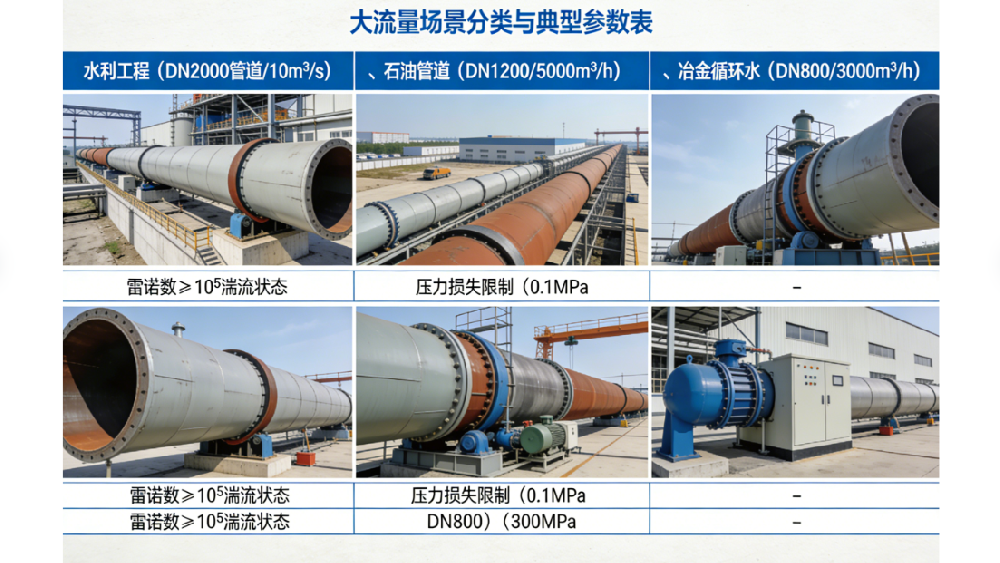
In high‑flow applications across municipal water supply and wastewater treatment, thermal power generation, petrochemicals, and metallurgy, the stability and accuracy of flow measurement directly impact production cost control, energy efficiency, and compliance with environmental regulations. High‑flow applications typically feature a large base flow rate, high flow velocity, complex operating‑condition fluctuations, and large pipe diameters, imposing stringent requirements on flow meters for span adaptability, anti‑interference capability, and long‑term operational stability. At present, the mainstream electromagnetic flowmeter, ultrasonic flowmeter, vortex flowmeter and other equipment in the market have significant differences in performance under large flow conditions, and improper selection is prone to problems such as excessive measurement deviation, serious equipment wear and tear, and frequent failures. Based on the core characteristics and measurement requirements of large flow scenarios, this paper deeply disassemels the core principles of selection, compares the suitability of mainstream flowmeters, provides targeted selection strategies and practical suggestions, and provides guarantee for enterprises to realize accurate measurement of large flow.
The core characteristics and metering pain points of large traffic scenarios. The large flow scenario is not a simple "large flow value", its complex operating environment and special operating requirements, constitute a unique measurement pain point, but also the selection of the core difficulties to focus on.
Judging from the scene characteristics, first, the flow fluctuation range is wide. For example, the inflow flow of municipal sewage treatment plant during rainstorm period may be 3-5 times of normal, and the circulating water flow of thermal power generation industry fluctuates significantly due to the unit load. Second, the pipeline diameter is large, mostly large diameter pipelines above DN500 or even DN2000, which requires high installation conditions and measurement coverage of flowmeter. Third, the medium characteristics are complex, and the medium of municipal water supply and the scene contains suspended substances and impurities, the medium of petrochemical scene is mostly flammable, explosive and corrosive fluid, and the medium of metallurgical scene may contain high-temperature waste residue; fourth, the operating environment is harsh, and there are many harsh conditions such as strong vibration, strong electromagnetic interference, high temperature and high pressure.
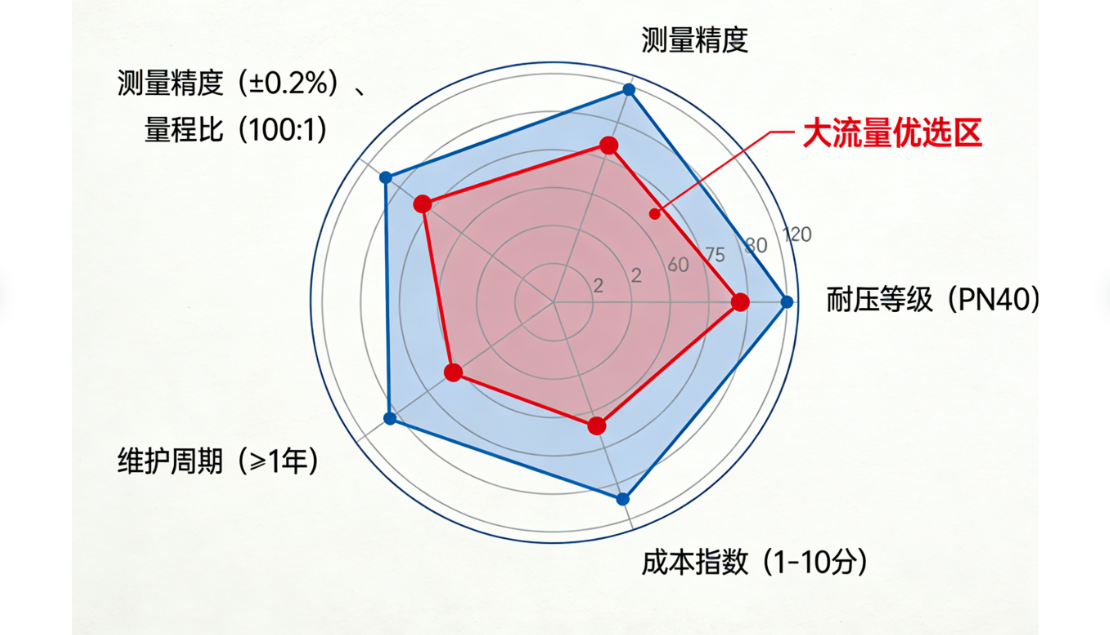
The corresponding measurement pain points are mainly manifested in three aspects: first, accuracy is difficult to guarantee. Under large flow base, small measurement deviation may lead to huge economic losses or compliance risks. For example, in the scenario of annual oil transportation of 10 million tons in petrochemical industry, 1% measurement deviation may cause millions of yuan loss; Second, stability is easily affected. Vibration and interference under complex working conditions are easy to cause flowmeter signal distortion and component wear, affect long-term operation stability; Third, installation and maintenance is difficult, large-diameter pipeline transformation, flowmeter disassembly and maintenance need to spend a lot of manpower and material resources, and may affect the normal production operation.
Core selection principle: Align with the dual objectives of stability and precision. When selecting equipment for high‑throughput scenarios, it is essential to move beyond the mindset of merely meeting a single performance metric. Instead, prioritize stability, ensure accuracy, and match adaptability to achieve a deep alignment between the equipment and the specific use case.
Stability priority principle, the core is to ensure that the flowmeter in the long-term large flow, complex conditions of continuous and stable operation. It is necessary to focus on the structural design, material wear resistance and anti-interference ability of the equipment to avoid failure and shutdown caused by component wear and signal interference. For example, under the condition of large flow and high flow rate, the contact parts of the flowmeter and the medium need to have excellent wear resistance to avoid structural deformation caused by long-term erosion; under the environment of strong electromagnetic interference in the industrial field, it is necessary to select equipment with strong anti-interference ability to ensure stable signal transmission.
The principle of accuracy assurance requires that the flow meter maintain high measurement accuracy across its entire range, particularly at both high-flow peaks and low-flow troughs. In high‑flow applications, flow rates can fluctuate significantly, so it is essential to select a flow meter with a wide turndown ratio to prevent accuracy errors caused by flows outside the meter’s range or operating at the range limits. At the same time, measurement accuracy must meet the core requirements of the specific application scenario; for example, trade settlement applications require high-accuracy devices with an accuracy of ±0.2% FS or better, while general process measurement applications can tolerate a more relaxed tolerance of up to ±1% FS.
The principle of suitability matching requires comprehensive consideration of media characteristics, pipeline conditions, installation environment and maintenance costs. Different media have clear requirements on the material and measurement principle of the flowmeter. For example, corrosive media need to choose corrosion-resistant materials, and media containing suspended solids need to choose non-dead cavity and anti-blocking structure. Large-diameter pipelines need to choose flowmeters with convenient installation and large pipe diameter to avoid increasing construction costs due to excessive installation difficulty.
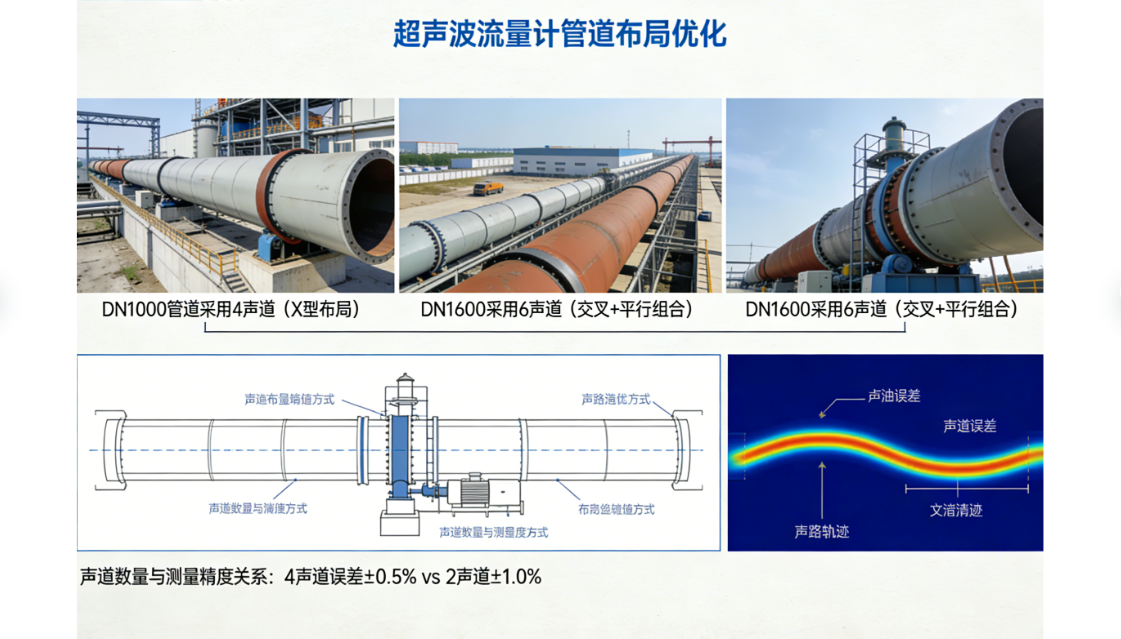
A comparative analysis of the suitability of mainstream flow meters in high-flow applications. Taking into account the characteristics of high‑flow applications and selection criteria, this paper conducts a comprehensive comparison of the suitability of four major flowmeter types—electromagnetic, ultrasonic, vortex, and differential pressure—clarifying the advantages of each device and its applicable operating limits.
Electromagnetic flowmeters: the preferred choice for high-flow applications involving complex media. The electromagnetic flowmeter features an all-through, mechanically simple design with no throttling elements, resulting in minimal pressure loss. This makes it well suited for the long-term operation of high‑flow, high‑velocity media, effectively reducing system energy consumption. With a turndown ratio of up to 1:100, it seamlessly accommodates wide fluctuations in high‑flow applications, maintaining high accuracy of ±0.2% to ±0.5% FS across both peak and valley flow rates. Flexible material options—including corrosion‑ and wear‑resistant grades such as 316L stainless steel and Hastelloy—ensure compatibility with high‑flow scenarios involving suspended solids or corrosive fluids. In terms of installation, electromagnetic flowmeters are suitable for large-diameter pipelines ranging from DN50 to DN2000 and above, supporting various connection methods such as flanged connections and insertion-type installation to accommodate different pipeline conditions. After a municipal wastewater treatment plant installed insertion-type electromagnetic flowmeters on its DN1200 influent pipeline, flow measurement accuracy remained stable within ±0.3% of full scale, successfully handling peak flow surges during heavy rainfall events, and the system has operated for three years without failure. Its limitation is that the medium must be conductive, so it cannot be used for measuring non-conductive media (such as high-purity deionized water or certain organic solvents).
Ultrasonic flow meters: a convenient choice for upgrading large-diameter pipelines. Ultrasonic flow meters use non‑contact measurement and require no pipe disruption, making them especially suitable for upgrading aging large‑diameter pipelines. They feature short installation times and low construction costs, and can accommodate extra‑large diameters from DN100 to DN3000. With no components in direct contact with the process fluid, they eliminate erosion and wear caused by high‑flow, high‑velocity media, resulting in extremely low maintenance costs—requiring only periodic probe cleaning. Doppler ultrasonic flow meters are suitable for high‑flow sewage and industrial wastewater containing suspended solids, while time‑difference ultrasonic flow meters are better suited for cleaner high‑flow fluids such as tap water and cooling circulating water. Its measurement accuracy is ±1% FS, which can meet the requirements of typical process measurement; however, in environments with strong electromagnetic interference, excessive scaling on pipe inner walls, or high gas content in the medium, accuracy may be compromised. In a DN1500 circulating water pipeline renovation project at a thermal power plant, time-difference ultrasonic flow meters were selected; installation could be completed without shutting down the boiler, and the meters operate stably with convenient maintenance.
Vortex flowmeter: the ideal choice for clean, high‑flow gases and low‑viscosity liquids. Vortex flowmeters have a simple structure and moderate cost, making them suitable for measuring clean, low-viscosity gases or liquids at high flow rates, such as air, steam, and low-viscosity chemical feedstocks. They offer an accuracy of ±1% FS and a turndown ratio of 1:20, meeting the requirements of high-flow applications with relatively stable flow conditions. However, under conditions of high flow rate and high velocity, the vortex shedding body is prone to erosion and wear by the process fluid, compromising long-term stability. Moreover, it is highly sensitive to vibration; vibrations in large-diameter pipelines can cause signal distortion, necessitating the installation of vibration-damping devices. Additionally, it is unsuitable for media containing suspended solids or with high viscosity, as clogging is likely to occur. Therefore, vortex flowmeters are suitable only for measuring large flows under clean, stable operating conditions, which limits their range of applications.
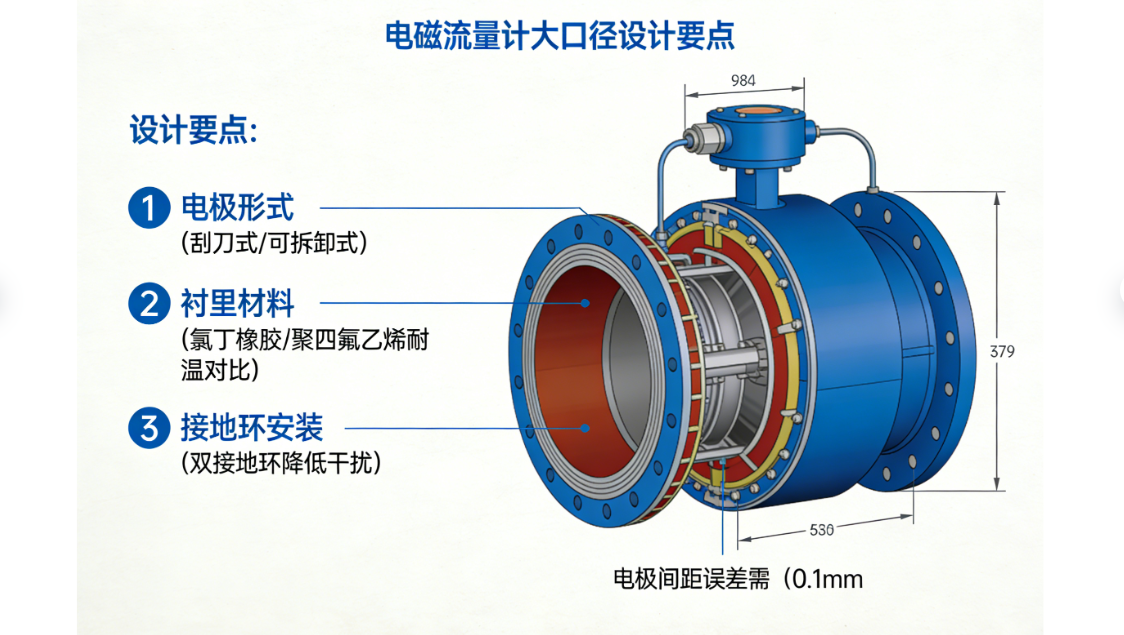
Differential pressure flowmeters: a complementary option for low-cost, simple applications involving high flow rates. Differential pressure flowmeters are technologically mature and low in procurement cost, making them suitable for certain high-flow applications. However, due to the presence of a throttling device, pressure loss is significant, substantially increasing system energy consumption under high-flow conditions; the turndown ratio is only 1:10, making it unsuitable for applications with large flow fluctuations; the throttling orifice is prone to scaling and blockage, leading to frequent failures in media containing suspended solids and resulting in high maintenance costs. Currently, the share of differential-pressure flowmeters in high-flow applications is gradually declining; they are now suitable only for simple scenarios involving low cost, modest accuracy requirements, clean media, and stable flow rates.
Practical selection strategies and considerations for high-traffic scenarios. Based on the above compatibility comparison, we provide precise selection strategies for different niche scenarios and supplement them with key considerations regarding installation, maintenance, and other critical factors to ensure successful implementation.
Segmented application selection strategy: First, for municipal water supply and drainage, industrial wastewater, and other high‑flow scenarios containing suspended solids or corrosive substances, prioritize electromagnetic flowmeters; for large‑diameter pipelines, consider insertion‑type electromagnetic flowmeters to reduce installation costs. Second, for retrofitting aging large‑diameter pipelines or temporary high‑flow monitoring, ultrasonic flowmeters are the preferred choice: use Doppler‑type for media with suspended solids and time‑difference‑type for clean media. Third, for measuring clean, high‑flow gases (such as steam or compressed air) or low‑viscosity liquids in thermal power generation and the chemical industry, vortex shedding flowmeters can be used, equipped with vibration‑damping devices. Fourth, for clean, stable high‑flow applications with low cost and modest accuracy requirements, differential pressure flowmeters are suitable, but the energy consumption associated with pressure loss should be evaluated.
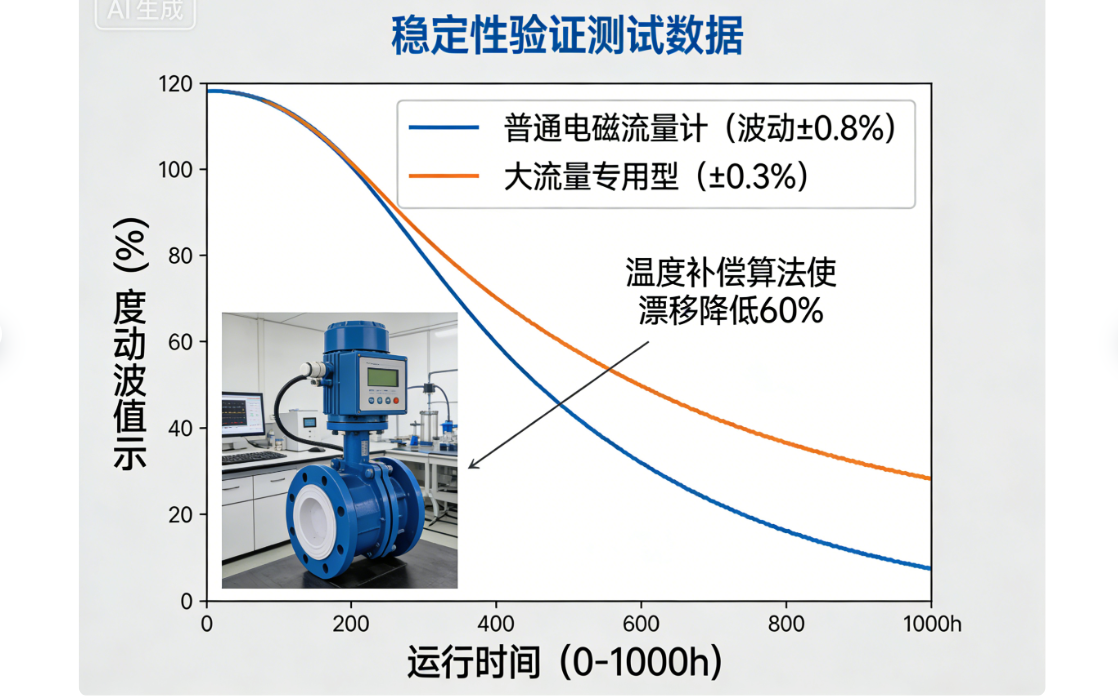
Key considerations: First, regarding installation, large-diameter flow meters require sufficient straight pipe lengths upstream and downstream (10 times the pipe diameter upstream and 5 times downstream for electromagnetic flow meters; 15 times upstream and 5 times downstream for ultrasonic flow meters) to ensure uniform velocity distribution. The installation location should be away from vibration and interference sources such as pumps and valves, and proper grounding must be ensured. Second, material selection: choose appropriate materials for wetted parts based on the corrosivity and wear resistance requirements of the process fluid; in high‑flow, high‑velocity applications, prioritize wear‑resistant materials. Third, maintenance: establish a regular inspection schedule, focusing on the flow meter’s operating condition and signal stability. For complex fluids at high flow rates, shorten maintenance intervals, promptly remove scale buildup, and inspect components for wear. Fourth, calibration: calibrate flow meters used in high‑flow applications with standard equipment suitable for the wide flow range to ensure accuracy; in commercial metering applications, mandatory periodic verification is required.
Conclusion: When selecting flow meters for high‑flow applications, the key is to strike an optimal balance between stability and accuracy, with the critical factor being a thorough understanding of the application’s specific characteristics and a precise alignment of equipment capabilities. Thanks to its wide turndown ratio, high accuracy, and strong adaptability, the electromagnetic flowmeter has become the optimal solution for most high‑flow, complex applications; ultrasonic flowmeters, with their easy installation and low maintenance costs, are well suited for retrofitting large‑diameter pipelines; vortex shedding and differential pressure flowmeters, on the other hand, are only appropriate for specific clean, simple, high‑flow scenarios. When selecting equipment, companies should abandon a one-size-fits-all approach and comprehensively assess fluid properties, flow rate variability, piping conditions, accuracy requirements, and budget constraints. They should then make precise selections by aligning these factors with the specific performance limits of each type of equipment. At the same time, by emphasizing adherence to installation standards and routine maintenance, we ensure that flow meters deliver accurate data consistently over the long term, providing reliable support for production operations, cost control, and compliance verification in high‑flow scenarios.
Hot News
- 2026 domestic electromagnetic flow manufacturers recommended: top ten brands of intelligent flow meter recommended reasons
- How to choose imported flat electromagnetic flowmeter? How to choose micro-caliber, conventional flange and plug-in electromagnetic? Recommended by domestic high-quality manufacturers
- Four major brands of electromagnetic flowmeter hard core PK: Herbalife Water, Cloud Meter, E H, Cologne, who is more worthy of choice?
- November 2026 Top Ten Brands of Electromagnetic Flowmeter at Home and Abroad Ranking
- Recommended Top Ten Brands of Electromagnetic Flowmeter in 2026: Reference for Project Selection of Water Treatment, Sewage and Conductive Liquid
- TOP5 Manufacturer's Selection Guide for Food Sanitary Electromagnetic Flowmeter: Material and Connection Mode Check before Purchase
- Cost-effective chemical oxygen demand water quality online monitor manufacturers contact information
- How to choose the integrated electromagnetic water meter? Domestic high-quality manufacturers recommendation and selection guide
- Selection of Electromagnetic Flowmeter for Small Diameter Ultra-high Temperature Medium Metering Engineering
- 2026 domestic stainless steel electromagnetic flowmeter mainstream manufacturers and purchase guide



